QUESTION IMAGE
Question
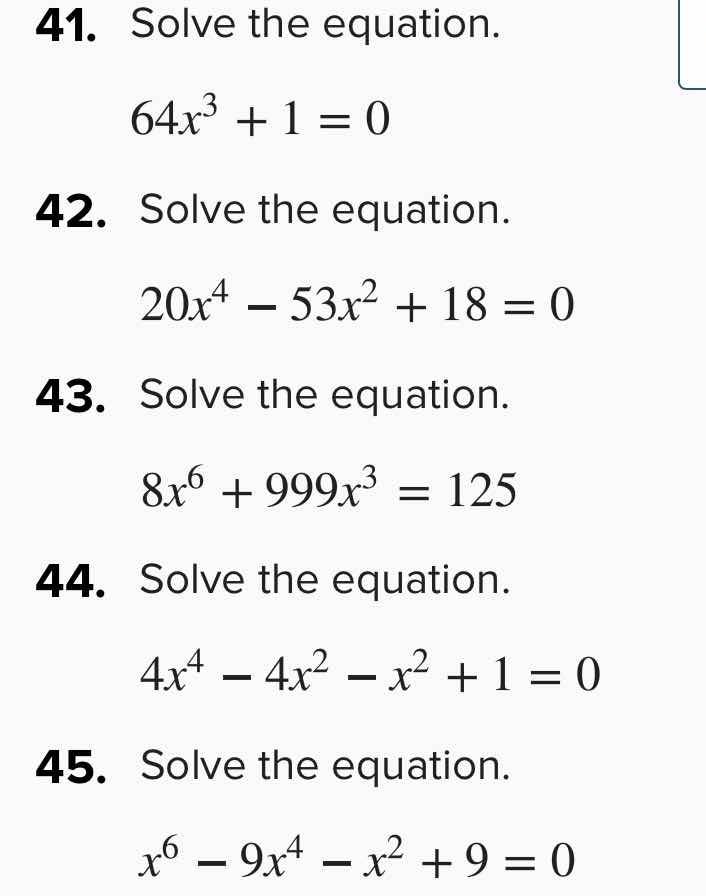
- solve the equation.
64x³ + 1 = 0
- solve the equation.
20x⁴ − 53x² + 18 = 0
- solve the equation.
8x⁶ + 999x³ = 125
- solve the equation.
4x⁴ − 4x² − x² + 1 = 0
- solve the equation.
x⁶ − 9x⁴ − x² + 9 = 0
Problem 41: Solve \( 64x^3 + 1 = 0 \)
Step 1: Rewrite the equation
Rewrite the equation as a sum of cubes. Recall that \( a^3 + b^3=(a + b)(a^2 - ab + b^2) \). Here, \( 64x^3=(4x)^3 \) and \( 1 = 1^3 \), so the equation becomes \( (4x)^3+1^3 = 0 \).
Step 2: Factor using sum of cubes
Using the sum of cubes formula \( a^3 + b^3=(a + b)(a^2 - ab + b^2) \) with \( a = 4x \) and \( b = 1 \), we get:
\( (4x + 1)((4x)^2-4x\times1 + 1^2)=0 \)
Simplify the quadratic factor: \( (4x + 1)(16x^2-4x + 1)=0 \)
Step 3: Solve for \( x \)
Set each factor equal to zero:
- For \( 4x+1 = 0 \), we have \( 4x=-1 \), so \( x =-\frac{1}{4} \).
- For \( 16x^2-4x + 1 = 0 \), calculate the discriminant \( \Delta=b^2 - 4ac=(-4)^2-4\times16\times1=16 - 64=-48<0 \). Since the discriminant is negative, there are no real solutions from this factor, and the complex solutions are given by \( x=\frac{4\pm\sqrt{-48}}{2\times16}=\frac{4\pm4i\sqrt{3}}{32}=\frac{1\pm i\sqrt{3}}{8} \). But if we are looking for real solutions, the only real solution is \( x =-\frac{1}{4} \).
Step 1: Let \( y = x^2 \)
Substitute \( y=x^2 \) (so \( y\geq0 \) for real \( x \)) into the equation. The equation becomes a quadratic in \( y \): \( 20y^2-53y + 18 = 0 \).
Step 2: Solve the quadratic equation for \( y \)
Use the quadratic formula \( y=\frac{-b\pm\sqrt{b^2 - 4ac}}{2a} \), where \( a = 20 \), \( b=-53 \), \( c = 18 \).
First, calculate the discriminant: \( \Delta=(-53)^2-4\times20\times18=2809 - 1440 = 1369 = 37^2 \)
Then, \( y=\frac{53\pm37}{40} \)
- For the plus sign: \( y=\frac{53 + 37}{40}=\frac{90}{40}=\frac{9}{4} \)
- For the minus sign: \( y=\frac{53-37}{40}=\frac{16}{40}=\frac{2}{5} \)
Step 3: Solve for \( x \)
Since \( y = x^2 \), we solve for \( x \) in each case:
- When \( y=\frac{9}{4} \), \( x^2=\frac{9}{4} \), so \( x=\pm\frac{3}{2} \)
- When \( y=\frac{2}{5} \), \( x^2=\frac{2}{5} \), so \( x=\pm\sqrt{\frac{2}{5}}=\pm\frac{\sqrt{10}}{5} \)
Step 1: Rewrite the equation
Rewrite the equation as \( 8x^6+999x^3 - 125 = 0 \). Let \( y = x^3 \), then the equation becomes a quadratic in \( y \): \( 8y^2+999y - 125 = 0 \)
Step 2: Solve the quadratic equation for \( y \)
Use the quadratic formula \( y=\frac{-b\pm\sqrt{b^2 - 4ac}}{2a} \), where \( a = 8 \), \( b = 999 \), \( c=-125 \)
Calculate the discriminant: \( \Delta=999^2-4\times8\times(-125)=998001 + 4000 = 1002001 \)
Notice that \( 1002001 = 1001^2 \) (since \( 1001^2=(1000 + 1)^2=1000000+2000 + 1 = 1002001 \))
Then, \( y=\frac{-999\pm1001}{16} \)
- For the plus sign: \( y=\frac{-999 + 1001}{16}=\frac{2}{16}=\frac{1}{8} \)
- For the minus sign: \( y=\frac{-999-1001}{16}=\frac{-2000}{16}=-125 \)
Step 3: Solve for \( x \)
Since \( y = x^3 \), we solve for \( x \) in each case:
- When \( y=\frac{1}{8} \), \( x^3=\frac{1}{8} \), so \( x=\frac{1}{2} \) (real solution, and two complex cube roots)
- When \( y=-125 \), \( x^3=-125 \), so \( x=-5 \) (real solution, and two complex cube roots)
If we consider only real solutions, the real solutions are \( x=\frac{1}{2},-5 \). If complex solutions are considered, we can find the complex roots using the cube - root formula, but for simplicity, the real solutions are \( \boldsymbol{x=\frac{1}{2},-5} \)

Snap & solve any problem in the app
Get step-by-step solutions on Sovi AI
Photo-based solutions with guided steps
Explore more problems and detailed explanations
The real solution is \( \boldsymbol{x =-\frac{1}{4}} \), and the complex solutions are \( \boldsymbol{x=\frac{1\pm i\sqrt{3}}{8}} \) (if complex solutions are considered). If only real solutions, then \( \boldsymbol{x =-\frac{1}{4}} \).