QUESTION IMAGE
Question
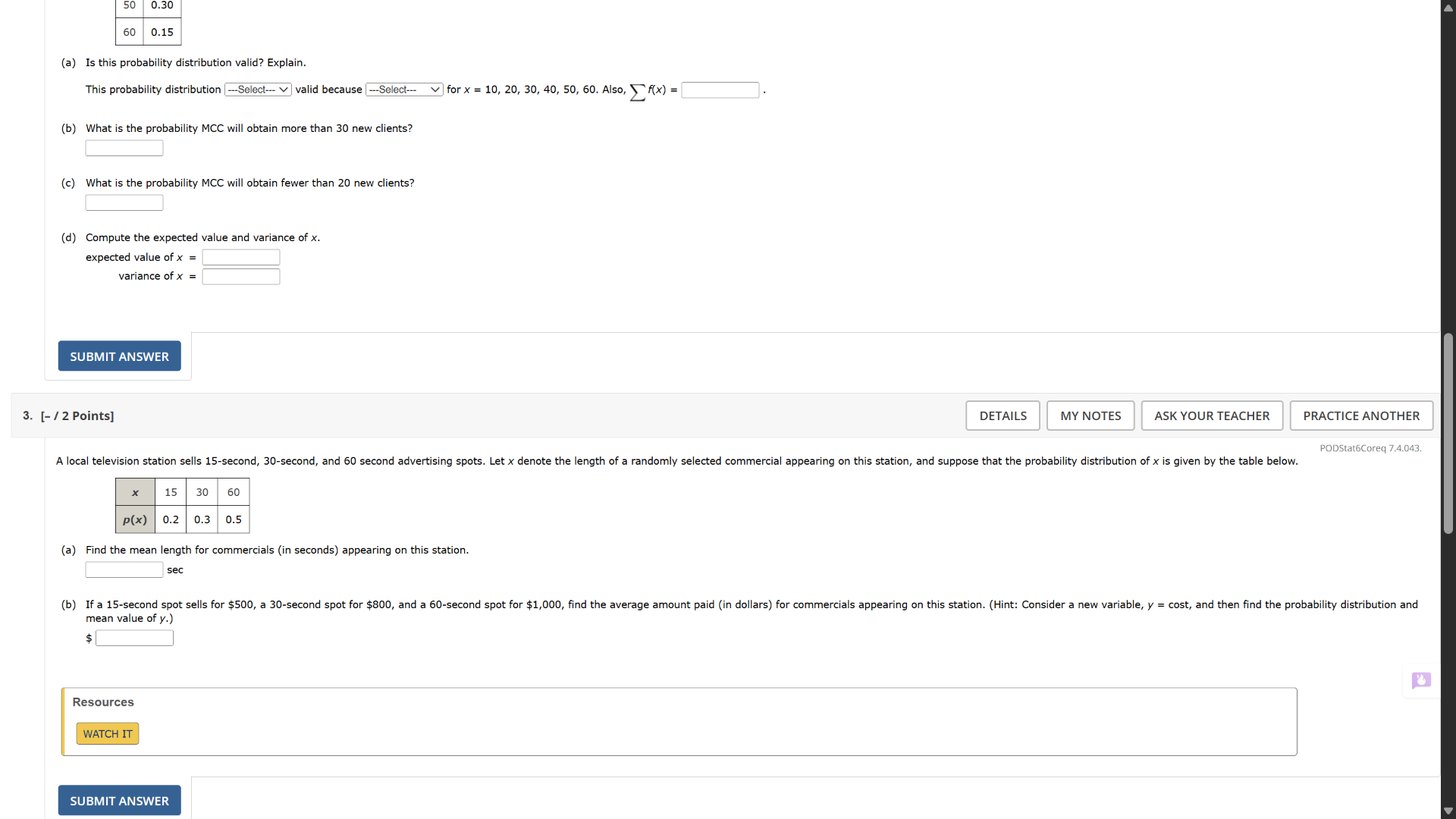
50 0.30
60 0.15
(a) is this probability distribution valid? explain.
this probability distribution ---select--- valid because ---select--- for x = 10, 20, 30, 40, 50, 60. also, \\(\sum f(x) = \\) .
(b) what is the probability mcc will obtain more than 30 new clients?
(c) what is the probability mcc will obtain fewer than 20 new clients?
(d) compute the expected value and variance of x.
expected value of x =
variance of x =
submit answer
- - / 2 points
a local television station sells 15 - second, 30 - second, and 60 second advertising spots. let x denote the length of a randomly selected commercial appearing on this station, and suppose that the probability distribution of x is given by the table below.
\\(\
\\)
(a) find the mean length for commercials (in seconds) appearing on this station.
sec
(b) if a 15 - second spot sells for $500, a 30 - second spot for $800, and a 60 - second spot for $1,000, find the average amount paid (in dollars) for commercials appearing on this station. (hint: consider a new variable, y = cost, and then find the probability distribution and mean value of y.)
$
resources
watch it
submit answer
Part 3 (a)
Step1: Recall the formula for the mean of a discrete random variable
The mean (expected value) \( \mu \) of a discrete random variable \( x \) is given by \( \mu=\sum x\cdot p(x) \), where \( x \) are the values of the random variable and \( p(x) \) are their corresponding probabilities.
Step2: Identify the values of \( x \) and \( p(x) \)
From the table, \( x = 15, 30, 60 \) and \( p(x)=0.2, 0.3, 0.5 \) respectively.
Step3: Calculate the product \( x\cdot p(x) \) for each \( x \)
- For \( x = 15 \) and \( p(x)=0.2 \): \( 15\times0.2 = 3 \)
- For \( x = 30 \) and \( p(x)=0.3 \): \( 30\times0.3 = 9 \)
- For \( x = 60 \) and \( p(x)=0.5 \): \( 60\times0.5 = 30 \)
Step4: Sum the products to find the mean
\( \mu=3 + 9+30=42 \)
Step1: Define the new variable \( y \) (cost)
Let \( y \) be the cost of the commercial. Then:
- When \( x = 15 \) (15 - second spot), \( y = 500 \) with \( p(y)=0.2 \)
- When \( x = 30 \) (30 - second spot), \( y = 800 \) with \( p(y)=0.3 \)
- When \( x = 60 \) (60 - second spot), \( y = 1000 \) with \( p(y)=0.5 \)
Step2: Recall the formula for the mean of a discrete random variable
The mean (expected value) \( \mu_y \) of \( y \) is \( \mu_y=\sum y\cdot p(y) \)
Step3: Calculate the product \( y\cdot p(y) \) for each \( y \)
- For \( y = 500 \) and \( p(y)=0.2 \): \( 500\times0.2 = 100 \)
- For \( y = 800 \) and \( p(y)=0.3 \): \( 800\times0.3 = 240 \)
- For \( y = 1000 \) and \( p(y)=0.5 \): \( 1000\times0.5 = 500 \)
Step4: Sum the products to find the mean
\( \mu_y=100 + 240+500 = 840 \)

Snap & solve any problem in the app
Get step-by-step solutions on Sovi AI
Photo-based solutions with guided steps
Explore more problems and detailed explanations
42