QUESTION IMAGE
Question
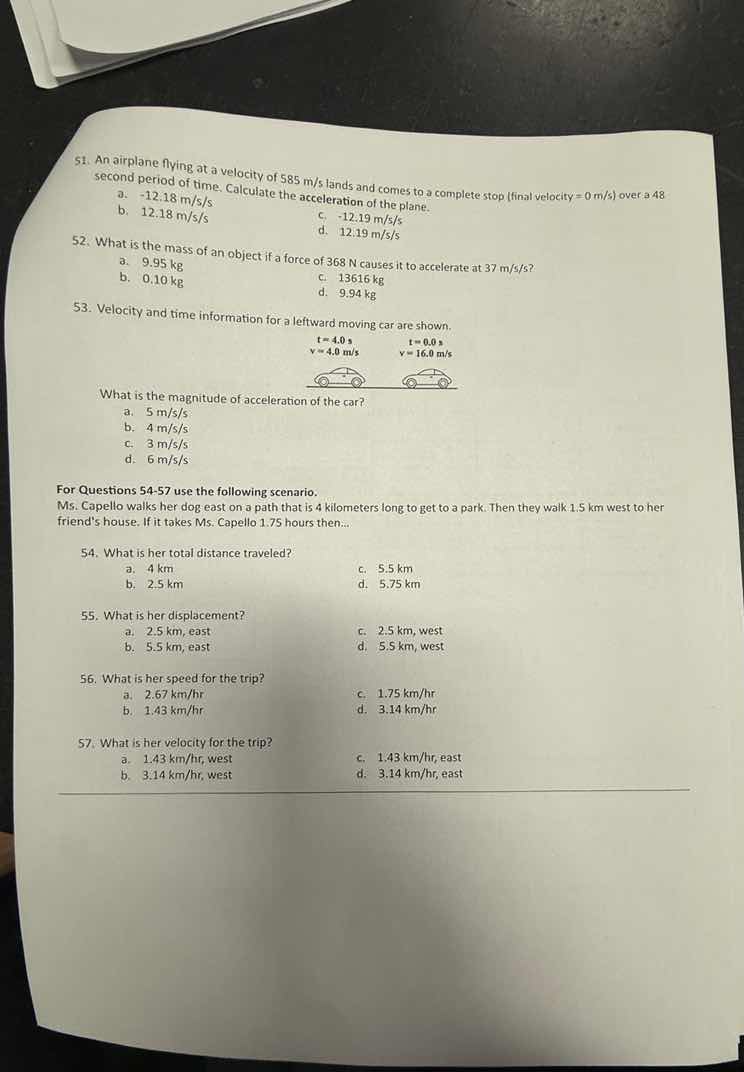
- an airplane flying at a velocity of 585 m/s lands and comes to a complete stop (final velocity = 0 m/s) over a 48 second period of time. calculate the acceleration of the plane.
a. -12.18 m/s/s
b. 12.18 m/s/s
c. -12.19 m/s/s
d. 12.19 m/s/s
- what is the mass of an object if a force of 368 n causes it to accelerate at 37 m/s/s?
a. 9.95 kg
b. 0.10 kg
c. 13616 kg
d. 9.94 kg
- velocity and time information for a leftward moving car are shown.
\\\
\\
what is the magnitude of acceleration of the car?
a. 5 m/s/s
b. 4 m/s/s
c. 3 m/s/s
d. 6 m/s/s
for questions 54 - 57 use the following scenario:
ms. capello walks her dog east on a path that is 4 kilometers long to get to a park. then they walk 1.5 km west to her friend’s house. if it takes ms. capello 1.75 hours then...
- what is her total distance traveled?
a. 4 km
b. 2.5 km
c. 5.5 km
d. 5.75 km
- what is her displacement?
a. 2.5 km, east
b. 5.5 km, east
c. 2.5 km, west
d. 5.5 km, west
- what is her speed for the trip?
a. 2.67 km/hr
b. 1.43 km/hr
c. 1.75 km/hr
d. 3.14 km/hr
- what is her velocity for the trip?
a. 1.43 km/hr, west
b. 3.14 km/hr, west
c. 1.43 km/hr, east
d. 3.14 km/hr, east
Question 51
Step1: Recall acceleration formula
Acceleration \( a = \frac{v_f - v_i}{t} \), where \( v_f \) is final velocity, \( v_i \) is initial velocity, \( t \) is time.
Step2: Substitute values
\( v_f = 0 \, \text{m/s} \), \( v_i = 585 \, \text{m/s} \), \( t = 48 \, \text{s} \). So \( a = \frac{0 - 585}{48} \approx -12.19 \, \text{m/s}^2 \). The magnitude is considered, but the negative sign indicates deceleration (direction, but the option with negative is c).
Step1: Recall Newton's second law
\( F = ma \), so \( m = \frac{F}{a} \).
Step2: Substitute values
\( F = 368 \, \text{N} \), \( a = 37 \, \text{m/s}^2 \). \( m = \frac{368}{37} \approx 9.94 \, \text{kg} \).
Step1: Acceleration formula
\( a = \frac{v_f - v_i}{t} \). Here, \( v_f = 16.0 \, \text{m/s} \), \( v_i = 4.0 \, \text{m/s} \), \( t = 6.0 - 4.0 = 2.0 \, \text{s} \)? Wait, no, wait the times: t=4.0s, v=4.0 m/s; t=6.0s, v=16.0 m/s. So time change \( \Delta t = 6 - 4 = 2 \, \text{s} \), velocity change \( \Delta v = 16 - 4 = 12 \, \text{m/s} \)? Wait no, wait the car is moving leftward? Wait, maybe I misread. Wait the velocities: at t=4.0s, v=4.0 m/s; t=6.0s, v=16.0 m/s? Wait no, maybe the times are t=0.0s and t=4.0s? Wait the diagram: t=4.0s, v=4.0 m/s; t=0.0s, v=16.0 m/s? Wait no, the problem says "leftward moving car". Wait maybe the times are t=0.0s (v=16.0 m/s) and t=4.0s (v=4.0 m/s)? Wait the user's diagram: t=4.0s, v=4.0 m/s; t=0.0s, v=16.0 m/s? Wait the question is "magnitude of acceleration". Let's recalculate. If \( v_i = 16.0 \, \text{m/s} \), \( v_f = 4.0 \, \text{m/s} \), \( t = 4.0 \, \text{s} \) (from t=0 to t=4). Then \( a = \frac{4 - 16}{4} = -3 \, \text{m/s}^2 \), magnitude 3? Wait no, maybe the times are t=4.0s and t=6.0s? Wait the original problem: "t = 4.0 s v = 4.0 m/s" and "t = 6.0 s v = 16.0 m/s". So \( \Delta t = 6 - 4 = 2 \, \text{s} \), \( \Delta v = 16 - 4 = 12 \, \text{m/s} \), \( a = 12 / 2 = 6 \)? No, that can't be. Wait maybe I misread the velocities. Wait the car is moving leftward, maybe the velocities are in leftward direction (negative if right is positive). Wait the options are 5,4,3,6. Wait let's check again. Wait maybe the initial time is t=0, v=4.0 m/s; t=4.0s, v=16.0 m/s? No, the diagram shows t=4.0s and t=6.0s? Wait the user's image: "t = 4.0 s v = 4.0 m/s" and "t = 6.0 s v = 16.0 m/s". So time difference is 2s, velocity difference is 12 m/s. Then acceleration is 12/2=6? But option d is 6 m/s². Wait but the car is moving leftward, but acceleration magnitude. Wait maybe the problem has a typo, but according to the numbers, \( a = \frac{16 - 4}{6 - 4} = \frac{12}{2} = 6 \, \text{m/s}^2 \). So answer d? Wait no, wait maybe I got the initial and final wrong. If t=4.0s is initial, t=6.0s is final. So yes, 16-4=12, 6-4=2, 12/2=6. So answer d.

Snap & solve any problem in the app
Get step-by-step solutions on Sovi AI
Photo-based solutions with guided steps
Explore more problems and detailed explanations
c. -12.19 m/s²