QUESTION IMAGE
Question
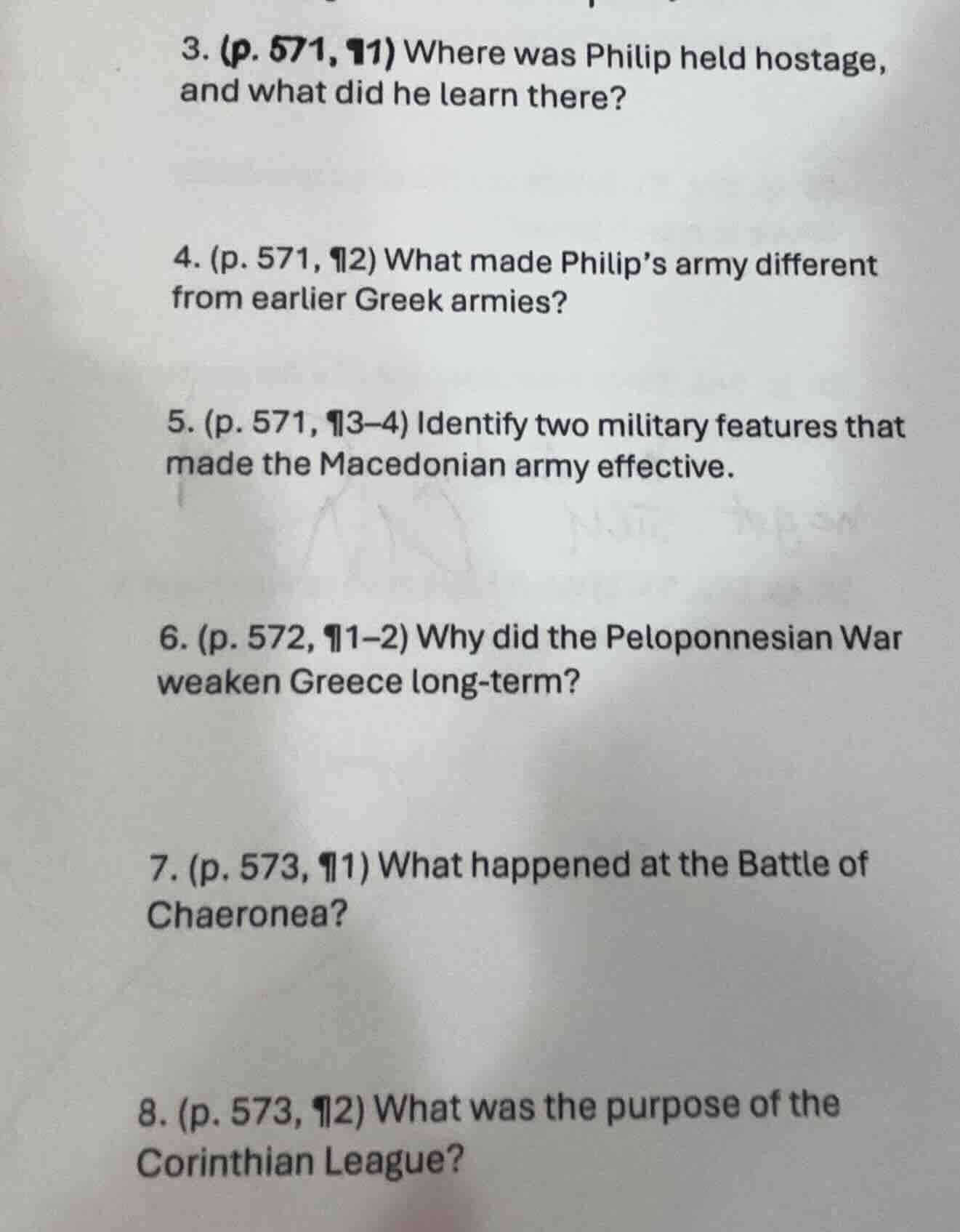
- (p. 571, ¶1) where was philip held hostage, and what did he learn there?
- (p. 571, ¶2) what made philips army different from earlier greek armies?
- (p. 571, ¶3-4) identify two military features that made the macedonian army effective.
- (p. 572, ¶1-2) why did the peloponnesian war weaken greece long-term?
- (p. 573, ¶1) what happened at the battle of chaeronea?
- (p. 573, ¶2) what was the purpose of the corinthian league?
Brief Explanations
- Philip II of Macedon was held hostage in Thebes, where he learned advanced Greek military tactics, especially the Theban phalanx formation, and studied Greek politics and statecraft.
- Philip's army combined Macedonian warrior traditions with refined Greek military tactics, used a standardized, professional standing army (instead of citizen militias), and integrated new specialized units.
- Two key features: 1) The Macedonian phalanx, armed with long sarissa pikes that outranged enemy weapons, creating an impenetrable defensive and offensive formation; 2) Combined arms tactics, pairing the phalanx with heavy cavalry (Companion Cavalry) to flank and break enemy lines.
- The Peloponnesian War weakened Greece long-term by devastating city-states through loss of population, economic ruin, and widespread destruction; it also destroyed the cooperative unity between Greek city-states, leaving them divided and vulnerable to outside conquest, while eroding the traditional civic values that underpinned their societies.
- At the Battle of Chaeronea (338 BCE), Philip II of Macedon, leading a combined Macedonian and allied army, defeated the joint forces of Athens and Thebes. This victory gave Philip control over most of Greece, ending Greek city-state independence and paving the way for his son Alexander the Great's conquests.
- The Corinthian League, founded by Philip II after Chaeronea, was designed to unify Greek city-states under Macedonian leadership. Its core purpose was to coordinate a pan-Hellenic military campaign against the Persian Empire, while also preventing future conflict between Greek city-states and securing Macedonian dominance over Greece.

Snap & solve any problem in the app
Get step-by-step solutions on Sovi AI
Photo-based solutions with guided steps
Explore more problems and detailed explanations
- Hostage location: Thebes; He learned advanced Greek military tactics (including the Theban phalanx) and Greek political systems.
- It was a professional, standing army that merged Macedonian and refined Greek tactics, with specialized units.
- 1. The long-sarissa Macedonian phalanx; 2. Combined arms warfare (phalanx + heavy cavalry).
- It caused widespread population/economic damage, destroyed Greek city-state unity, and left them vulnerable to outside invasion.
- Philip II of Macedon defeated Athens and Thebes, gaining control over most of Greece and ending Greek city-state self-rule.
- To unify Greek city-states under Macedonian leadership for a planned invasion of Persia, and to prevent internal Greek conflict.