QUESTION IMAGE
Question
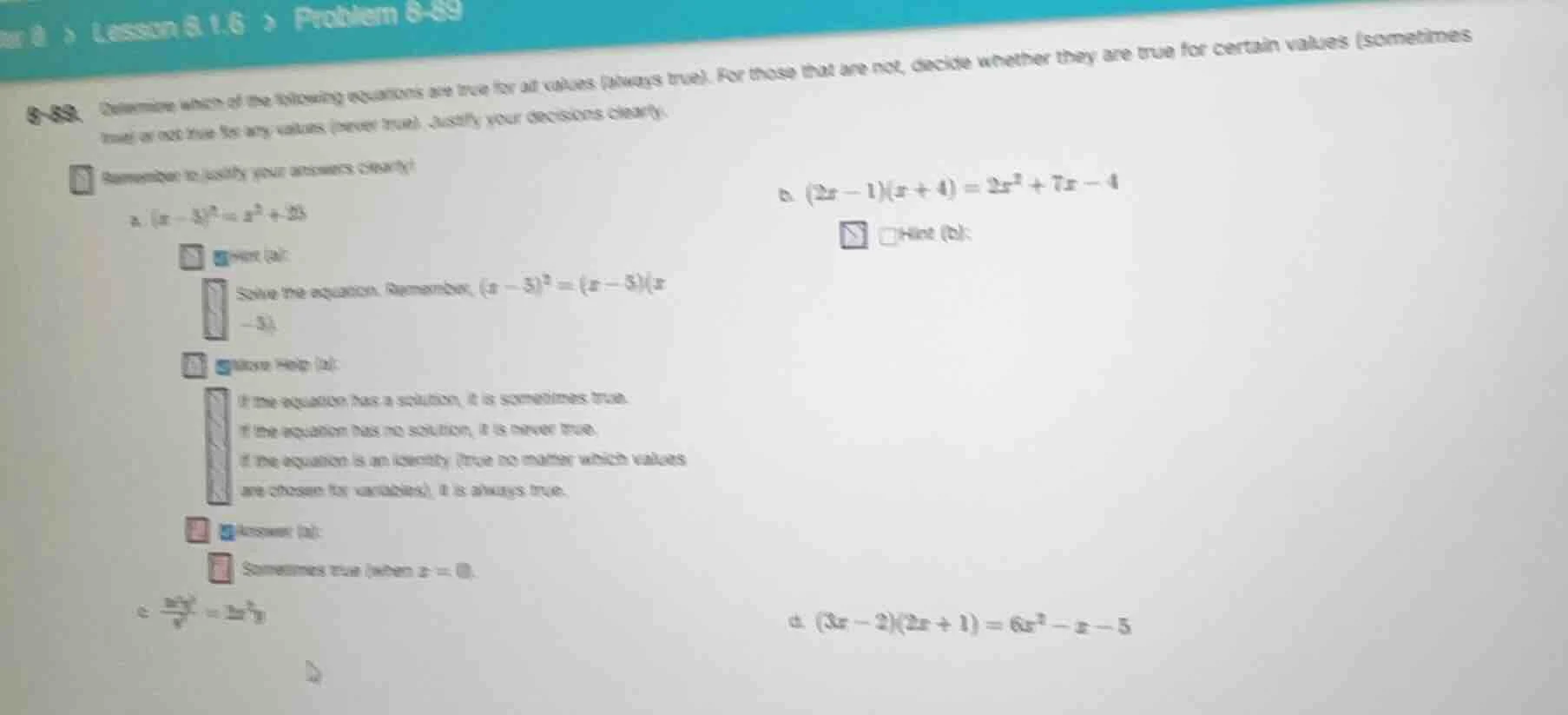
8-89. determine which of the following equations are true for all values (always true). for those that are not, decide whether they are true for certain values (sometimes true) or not true for any values (never true). justify your decisions clearly.
remember to justify your answers clearly!
a. ((x - 5)^2 = x^2 + 25)
b. ((2x - 1)(x + 4) = 2x^2 + 7x - 4)
hint (a):
solve the equation. remember, ((x - 5)^2 = (x - 5)(x - 5)).
more help (a):
if the equation has a solution, it is sometimes true.
if the equation has no solution, it is never true.
if the equation is an identity (true no matter which values are chosen for variables), it is always true.
answer (a):
sometimes true (when (x = 0)).
c. (\frac{8x^3y^2}{y} = 2x^3y)
d. ((3x - 2)(2x + 1) = 6x^2 - x - 5)
Part a: \((x - 5)^2 = x^2 + 25\)
Step 1: Expand the left - hand side
We know that \((a - b)^2=a^2-2ab + b^2\). For \((x - 5)^2\), where \(a = x\) and \(b = 5\), we have \((x - 5)^2=(x-5)(x - 5)=x^2-10x + 25\).
Step 2: Compare with the right - hand side
The right - hand side of the equation is \(x^2+25\). Now we set the expanded left - hand side equal to the right - hand side: \(x^2-10x + 25=x^2+25\).
Subtract \(x^2\) and 25 from both sides of the equation: \(x^2-10x + 25-(x^2 + 25)=x^2+25-(x^2 + 25)\).
Simplifying, we get \(-10x=0\), so \(x = 0\).
Since the equation is true only when \(x = 0\) and not for all values of \(x\), it is sometimes true (true when \(x = 0\)).
Part b: \((2x - 1)(x + 4)=2x^2+7x - 4\)
Step 1: Expand the left - hand side
Using the distributive property (FOIL method): \((2x-1)(x + 4)=2x\times x+2x\times4-1\times x-1\times4=2x^2+8x-x - 4=2x^2+7x - 4\).
Step 2: Compare with the right - hand side
The right - hand side of the equation is also \(2x^2+7x - 4\). Since the left - hand side is equal to the right - hand side for all values of \(x\), the equation is always true.
Part c: \(\frac{x^{5}y^{2}}{y}=2x^{5}y\)
Step 1: Simplify the left - hand side
Using the rule of exponents \(\frac{a^m}{a^n}=a^{m - n}\) (for \(a
eq0\)), for \(\frac{x^{5}y^{2}}{y}\), we have \(x^{5}y^{2-1}=x^{5}y\).
Step 2: Compare with the right - hand side
The right - hand side of the equation is \(2x^{5}y\). Now we set \(x^{5}y=2x^{5}y\).
Subtract \(x^{5}y\) from both sides: \(x^{5}y-2x^{5}y=2x^{5}y - 2x^{5}y\), which gives \(-x^{5}y = 0\). This equation is true when \(x = 0\) or \(y = 0\), but not for all non - zero values of \(x\) and \(y\). However, if we consider the equation \(\frac{x^{5}y^{2}}{y}=2x^{5}y\) as a statement about the equality of the two expressions, the left - hand side simplifies to \(x^{5}y\) and the right - hand side is \(2x^{5}y\). The only way \(x^{5}y=2x^{5}y\) is if \(x^{5}y=0\) (i.e., \(x = 0\) or \(y = 0\)). But if we made a mistake in the original problem and it was supposed to be \(\frac{2x^{5}y^{2}}{y}\), then it would be always true. Assuming the problem is as written, we solve \(x^{5}y=2x^{5}y\).
\(x^{5}y-2x^{5}y = 0\Rightarrow -x^{5}y=0\). The solution is \(x = 0\) or \(y = 0\). So the equation is sometimes true (true when \(x = 0\) or \(y = 0\)).
Part d: \((3x - 2)(2x + 1)=6x^2-x - 5\)

Snap & solve any problem in the app
Get step-by-step solutions on Sovi AI
Photo-based solutions with guided steps
Explore more problems and detailed explanations
Step 1: Expand the left - hand side
Using the distributive property: \((3x-2)(2x + 1)=3x\times2x+3x\times1-2\times2x-2\times1=6x^2+3x-4x - 2=6x^2-x - 2\).
Step 2: Compare with the right - hand side
The right - hand side of the equation is \(6x^2-x - 5\). Now we set \(6x^2-x - 2=6x^2-x - 5\).
Subtract \(6x^2-x\) from both sides: \(6x^2-x - 2-(6x^2-x)=6x^2-x - 5-(6x^2-x)\).
Simplifying, we get \(-2=-5\), which is a false statement. So the equation has no solution and is never true.
Final Answers:
a. Sometimes true (true when \(x = 0\))
b. Always true
c. Sometimes true (true when \(x = 0\) or \(y = 0\))
d. Never true