QUESTION IMAGE
Question
a1.s.id.c.5-identify context of the data
a1.f.if.b.4-identify key features of graphs
a1.f.if.c.7-graph and show key features of graphs by hand and
a1.ced.a.2-write equations in standard form given context. find x- and y-intercepts. graph intercepts. identify equations in standard form given a graph.
a1.ced.a.3-write equations in standard form from context. identify solutions as viable and non-viable.
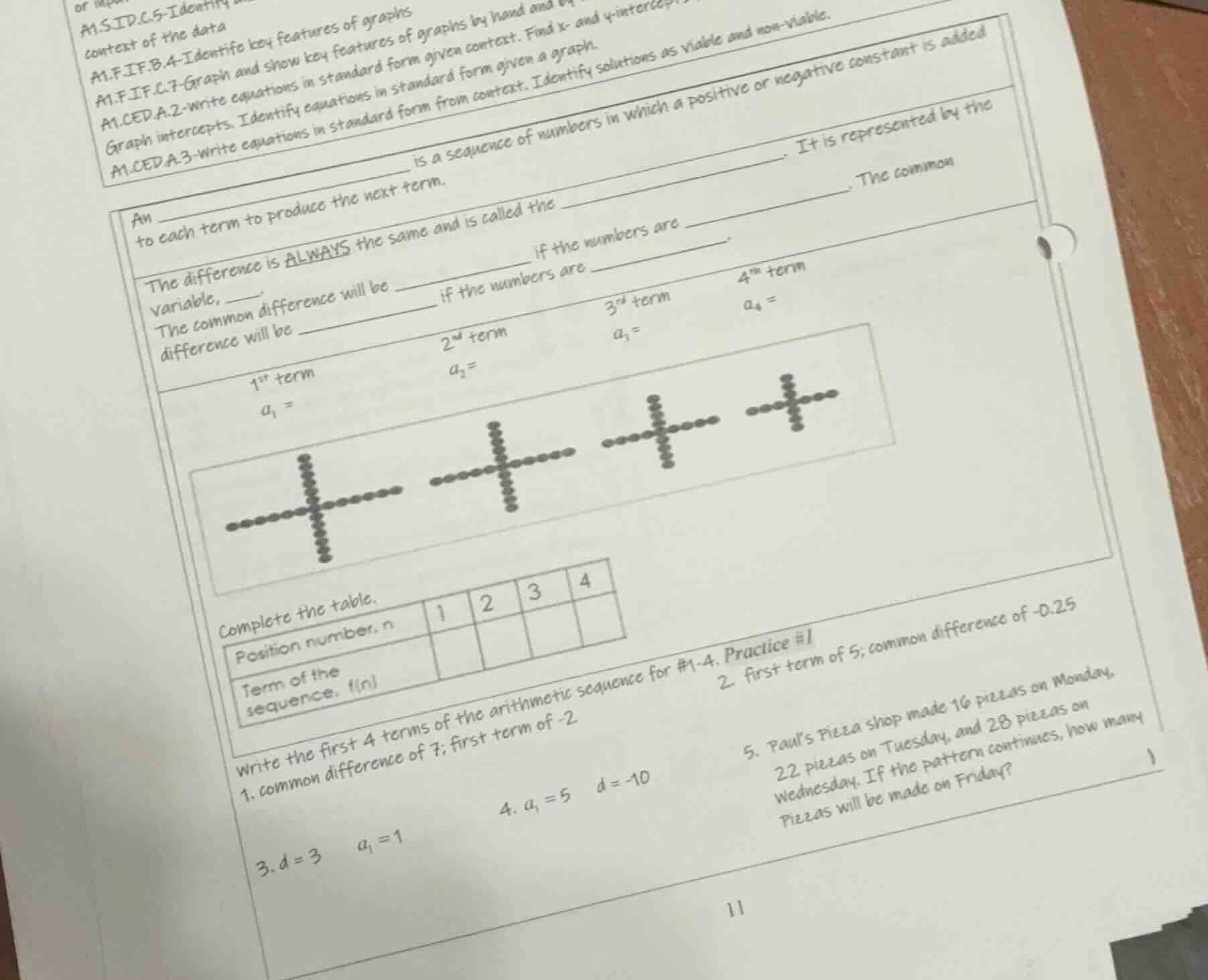
an ______ is a sequence of numbers in which a positive or negative constant is added to each term to produce the next term.
the difference is always the same and is called the ____. it is represented by the variable, ____.
the common difference will be ____ if the numbers are __. the common difference will be __ if the numbers are ____.
$1^{st}$ term $a_1 =$
$2^{nd}$ term $a_2 =$
$3^{rd}$ term $a_3 =$
$4^{th}$ term $a_4 =$
complete the table.
| position number, $n$ | 1 | 2 | 3 | 4 |
|---|
write the first 4 terms of the arithmetic sequence for #1-4. practice #1
- common difference of 7; first term of -2
- first term of 5; common difference of -0.25
- $d = 3$ $a_1 = 1$
- $a_1 = 5$ $d = -10$
- pauls pizza shop made 16 pizzas on monday, 22 pizzas on tuesday, and 28 pizzas on wednesday. if the pattern continues, how many pizzas will be made on friday?
Step1: Fill sequence definition blanks
An arithmetic sequence is a sequence of numbers in which a positive or negative constant is added to each term to produce the next term.
The difference is ALWAYS the same and is called the common difference. It is represented by the variable, $d$.
The common difference will be positive if the numbers are increasing. The common difference will be negative if the numbers are decreasing.
Step2: Count dots for the pattern
Count total dots in each figure:
- $a_1 = 5 + 9 = 14$
- $a_2 = 5 + 7 = 12$
- $a_3 = 5 + 5 = 10$
- $a_4 = 5 + 3 = 8$
Fill the table:
| Position number, $n$ | 1 | 2 | 3 | 4 |
|---|
Step3: Generate arithmetic sequences (1)
Use formula $a_n = a_1 + (n-1)d$
- $a_1=-2, d=7$:
$a_1=-2$
$a_2=-2+7=5$
$a_3=5+7=12$
$a_4=12+7=19$
Step4: Generate arithmetic sequences (2)
- $a_1=5, d=-0.25$:
$a_1=5$
$a_2=5+(-0.25)=4.75$
$a_3=4.75+(-0.25)=4.5$
$a_4=4.5+(-0.25)=4.25$
Step5: Generate arithmetic sequences (3)
- $a_1=1, d=3$:
$a_1=1$
$a_2=1+3=4$
$a_3=4+3=7$
$a_4=7+3=10$
Step6: Generate arithmetic sequences (4)
- $a_1=5, d=-10$:
$a_1=5$
$a_2=5+(-10)=-5$
$a_3=-5+(-10)=-15$
$a_4=-15+(-10)=-25$
Step7: Solve pizza sequence problem
This is arithmetic: $a_1=16, d=22-16=6$.
Friday is 5th term:
$a_5 = 16 + (5-1)(6)=16+24=40$

Snap & solve any problem in the app
Get step-by-step solutions on Sovi AI
Photo-based solutions with guided steps
Explore more problems and detailed explanations
- Definition blanks (top section):
arithmetic sequence; common difference; $d$; positive, increasing; negative, decreasing
- Dot pattern table:
| Position number, $n$ | 1 | 2 | 3 | 4 |
|---|
- Practice #1 sequences:
- $-2, 5, 12, 19$
- $5, 4.75, 4.5, 4.25$
- $1, 4, 7, 10$
- $5, -5, -15, -25$
- Pizza problem: 40