QUESTION IMAGE
Question
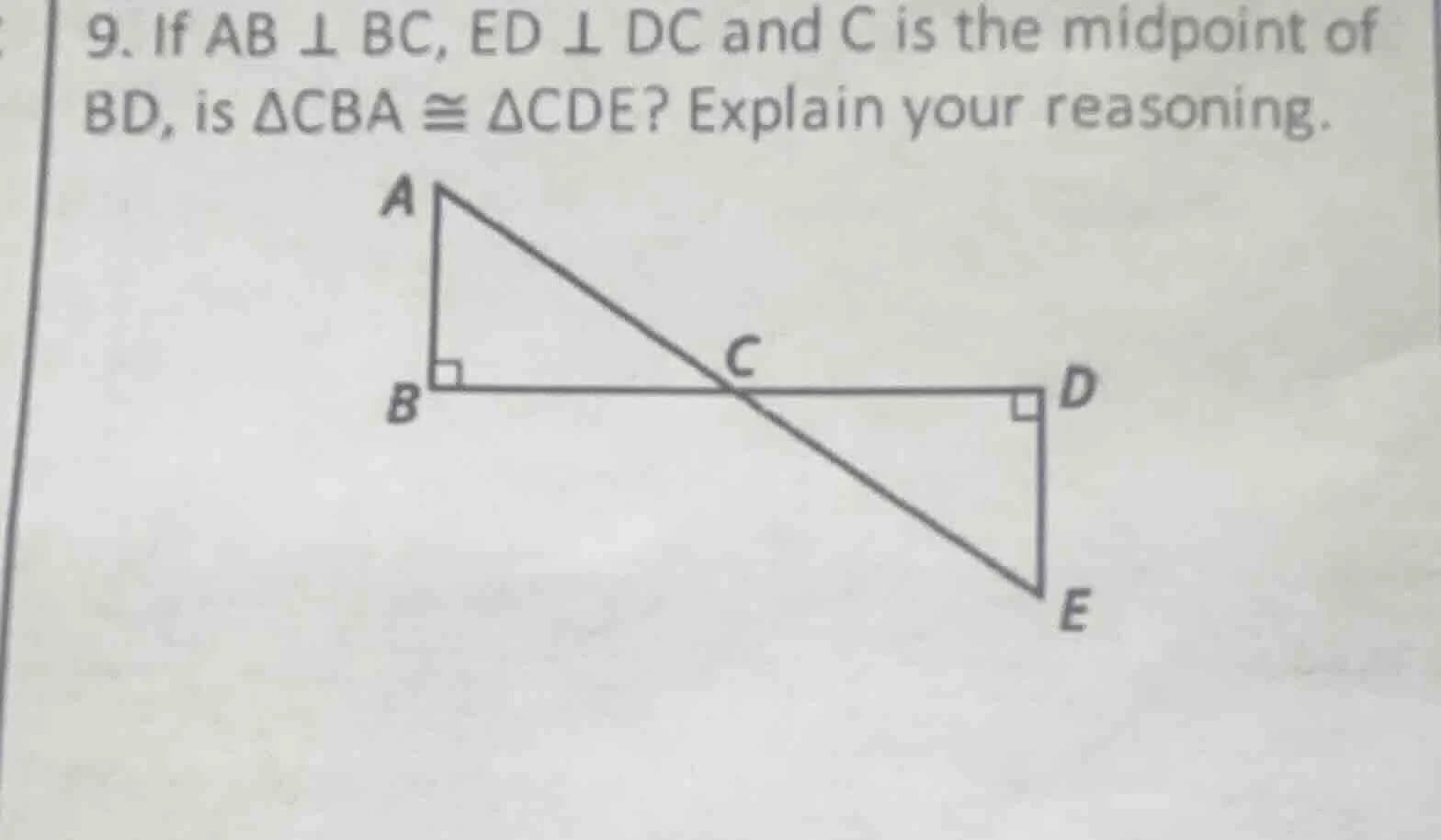
- if ab ⊥ bc, ed ⊥ dc and c is the midpoint of bd, is δcba ≅ δcde? explain your reasoning.
Step1: Identify right angles
Since \( AB \perp BC \) and \( ED \perp DC \), we have \( \angle ABC = 90^\circ \) and \( \angle EDC = 90^\circ \), so \( \angle ABC \cong \angle EDC \).
Step2: Identify midpoint segment
Given \( C \) is the midpoint of \( BD \), then \( BC = DC \).
Step3: Identify vertical angles
\( \angle ACB \) and \( \angle ECD \) are vertical angles, so \( \angle ACB \cong \angle ECD \).
Step4: Apply ASA congruence
By the Angle - Side - Angle (ASA) congruence criterion, in \( \triangle CBA \) and \( \triangle CDE \):
- \( \angle ABC \cong \angle EDC \) (right angles)
- \( BC = DC \) (midpoint definition)
- \( \angle ACB \cong \angle ECD \) (vertical angles)
So, \( \triangle CBA \cong \triangle CDE \) by ASA.

Snap & solve any problem in the app
Get step-by-step solutions on Sovi AI
Photo-based solutions with guided steps
Explore more problems and detailed explanations
Yes, \( \triangle CBA \cong \triangle CDE \) by the ASA (Angle - Side - Angle) congruence criterion. The right angles \( \angle ABC \) and \( \angle EDC \) are congruent, \( BC = DC \) (since \( C \) is the midpoint of \( BD \)), and the vertical angles \( \angle ACB \) and \( \angle ECD \) are congruent, satisfying the ASA conditions for triangle congruence.