QUESTION IMAGE
Question
b, abcdefg → abcdefgh
- two proteins differ by only one amino acid, yet one functions normally while the other does not. what is the best explanation?
a. amino acid changes always destroy protein structure.
b. protein function depends on its 3d shape, which can be altered by even one substitution.
c. codons determine how quickly proteins degrade.
d. ribosomes reject proteins with substitutions.
- researchers engineer a gene but accidentally remove one nucleotide near the beginning of the coding region. why is this mutation likely more harmful than removing three nucleotides?
a. one nucleotide deletion can shift the reading frame, altering every downstream codon.
b. ribosomes cannot read genes missing three nucleotides.
c. three nucleotides always create a stop codon.
d. single deletions prevent mrna from leaving the nucleus
- dna serves to store and transmit all heritable genetic information within an organism. which of the following statements is most consistent regarding the storage of this genetic information?
a. dna stores genetic information in the sugar-phosphate backbone.
b. dna stores genetic information in the double helix structure.
c. dna stores genetic information in the hydrogen bonds between base pairs.
d. dna stores genetic information in the series of nitrogenous bases.
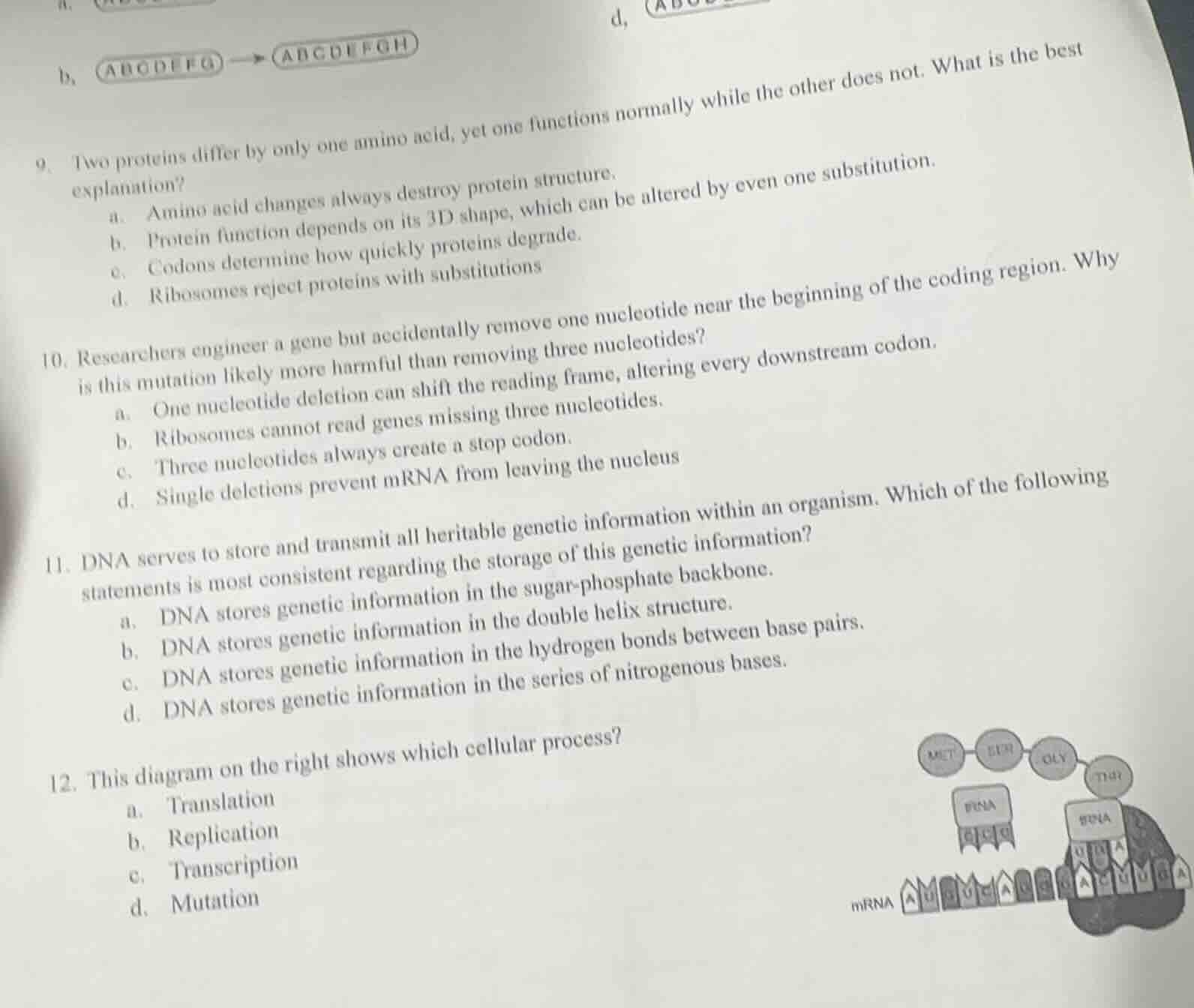
- this diagram on the right shows which cellular process?
a. translation
b. replication
c. transcription
d. mutation
- Protein function is tied to its 3D structure; a single amino acid swap can either disrupt or leave this shape intact, explaining why one protein works and the other does not.
- Removing one nucleotide causes a frameshift mutation, which changes all subsequent codons and the resulting amino acid sequence, while removing three nucleotides removes only one amino acid, leaving the rest of the reading frame intact.
- The specific sequence of nitrogenous bases (A, T, C, G) in DNA encodes the genetic information that dictates protein synthesis and heritable traits.
- The diagram shows mRNA being read by ribosomes to assemble a chain of amino acids, which is the process of translation (converting mRNA to a protein).

Snap & solve any problem in the app
Get step-by-step solutions on Sovi AI
Photo-based solutions with guided steps
Explore more problems and detailed explanations
- b. Protein function depends on its 3D shape, which can be altered by even one substitution.
- a. One nucleotide deletion can shift the reading frame, altering every downstream codon.
- d. DNA stores genetic information in the series of nitrogenous bases.
- a. Translation