QUESTION IMAGE
Question
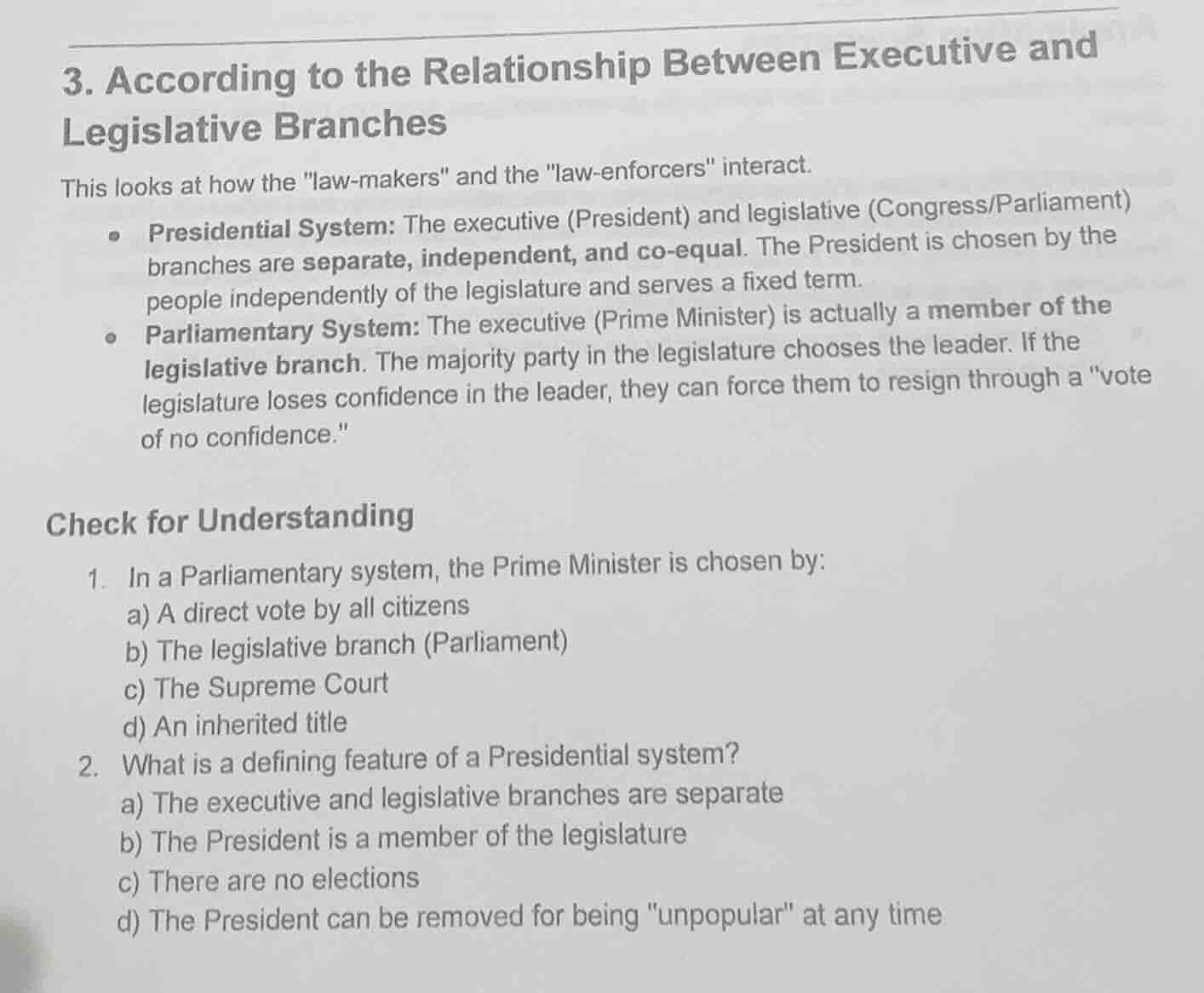
- according to the relationship between executive and legislative branches
this looks at how the \law - makers\ and the \law - enforcers\ interact.
- presidential system: the executive (president) and legislative (congress/parliament) branches are separate, independent, and co - equal. the president is chosen by the people independently of the legislature and serves a fixed term.
- parliamentary system: the executive (prime minister) is actually a member of the legislative branch. the majority party in the legislature chooses the leader. if the legislature loses confidence in the leader, they can force them to resign through a \vote of no confidence.\
check for understanding
- in a parliamentary system, the prime minister is chosen by:
a) a direct vote by all citizens
b) the legislative branch (parliament)
c) the supreme court
d) an inherited title
- what is a defining feature of a presidential system?
a) the executive and legislative branches are separate
b) the president is a member of the legislature
c) there are no elections
d) the president can be removed for being \unpopular\ at any time
Question 1
From the text, in a Parliamentary system, the Prime Minister is a member of the legislative branch and is chosen by the majority party in the legislature (Parliament). Option a is incorrect as it's not a direct vote by all citizens. Option c is incorrect as the Supreme Court doesn't choose the Prime Minister. Option d is incorrect as there's no inherited title for this role.
The text states that in a Presidential system, the executive and legislative branches are separate, independent, and co - equal. Option b is incorrect as the President is not a member of the legislature. Option c is incorrect as there are elections. Option d is incorrect as the President serves a fixed term and isn't removed for being "unpopular" at any time.

Snap & solve any problem in the app
Get step-by-step solutions on Sovi AI
Photo-based solutions with guided steps
Explore more problems and detailed explanations
b) The legislative branch (Parliament)