QUESTION IMAGE
Question
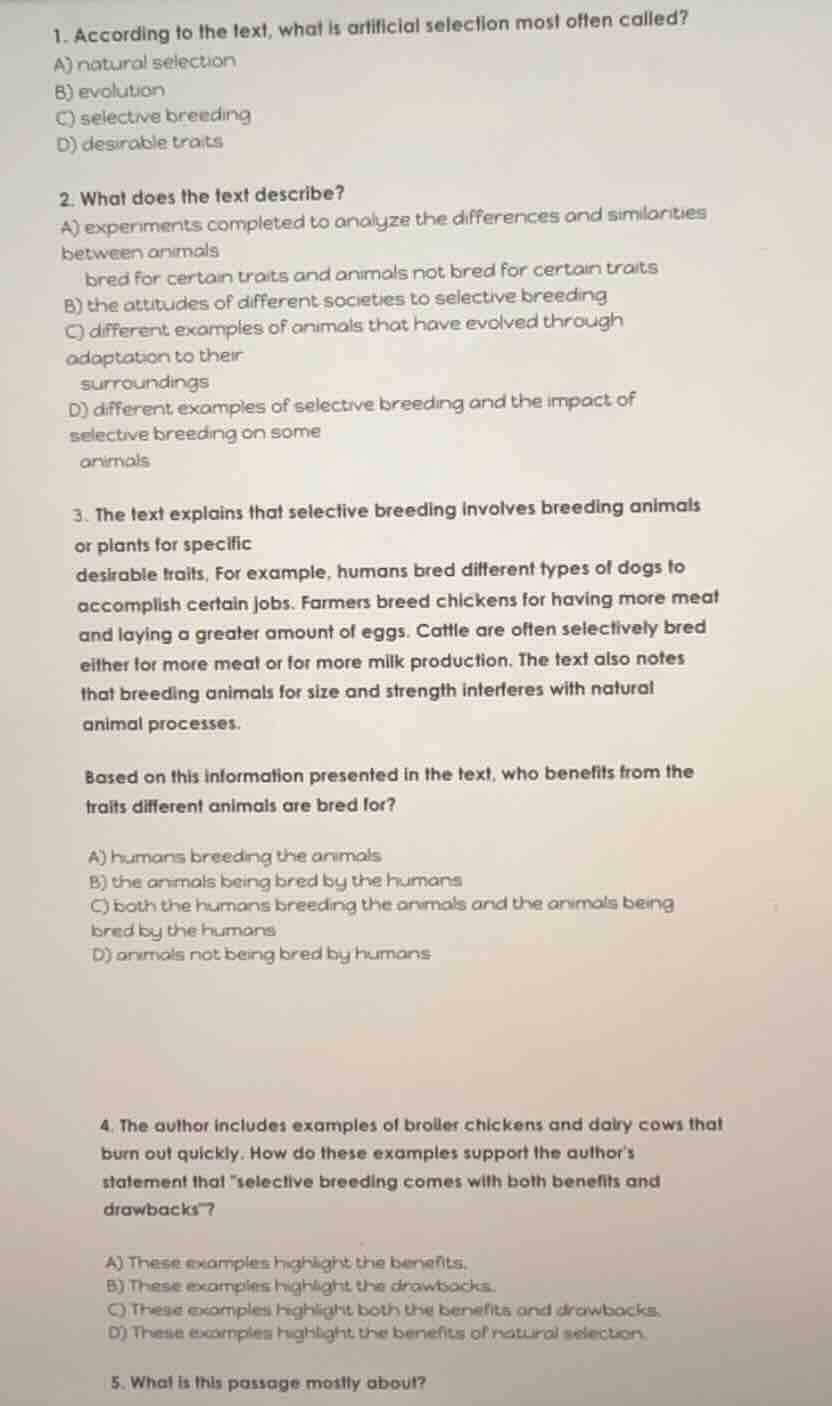
- according to the text, what is artificial selection most often called?
a) natural selection
b) evolution
c) selective breeding
d) desirable traits
- what does the text describe?
a) experiments completed to analyze the differences and similarities
between animals
bred for certain traits and animals not bred for certain traits
b) the attitudes of different societies to selective breeding
c) different examples of animals that have evolved through
adaptation to their
surroundings
d) different examples of selective breeding and the impact of
selective breeding on some
animals
- the text explains that selective breeding involves breeding animals
or plants for specific
desirable traits. for example, humans bred different types of dogs to
accomplish certain jobs. farmers breed chickens for having more meat
and laying a greater amount of eggs. cattle are often selectively bred
either for more meat or for more milk production. the text also notes
that breeding animals for size and strength interferes with natural
animal processes.
based on this information presented in the text, who benefits from the
traits different animals are bred for?
a) humans breeding the animals
b) the animals being bred by the humans
c) both the humans breeding the animals and the animals being
bred by the humans
d) animals not being bred by humans
- the author includes examples of broiler chickens and dairy cows that
burn out quickly. how do these examples support the author’s
statement that \selective breeding comes with both benefits and
drawbacks\?
a) these examples highlight the benefits.
b) these examples highlight the drawbacks.
c) these examples highlight both the benefits and drawbacks.
d) these examples highlight the benefits of natural selection.
- what is this passage mostly about?
- Artificial selection is the human-driven process of breeding for desired traits, which is most commonly called selective breeding.
- The text provides examples of selective breeding (dogs, chickens, cattle) and notes its impact (interfering with natural animal processes), matching option D.
- The examples given (dogs for jobs, chickens for meat/eggs, cattle for meat/milk) all serve human needs, so humans are the beneficiaries.
- Broiler chickens and dairy cows "burn out quickly" is a negative outcome, which illustrates the drawbacks of selective breeding.
- The passage defines selective breeding, gives real-world examples of its use for human benefit, and notes its negative impacts on animals, so its main focus is selective breeding, its applications, pros, and cons.

Snap & solve any problem in the app
Get step-by-step solutions on Sovi AI
Photo-based solutions with guided steps
Explore more problems and detailed explanations
- C) selective breeding
- D) different examples of selective breeding and the impact of selective breeding on some animals
- A) humans breeding the animals
- B) These examples highlight the drawbacks.
- Artificial/selective breeding, its examples, benefits, and drawbacks