QUESTION IMAGE
Question
activity
1.2 complementary
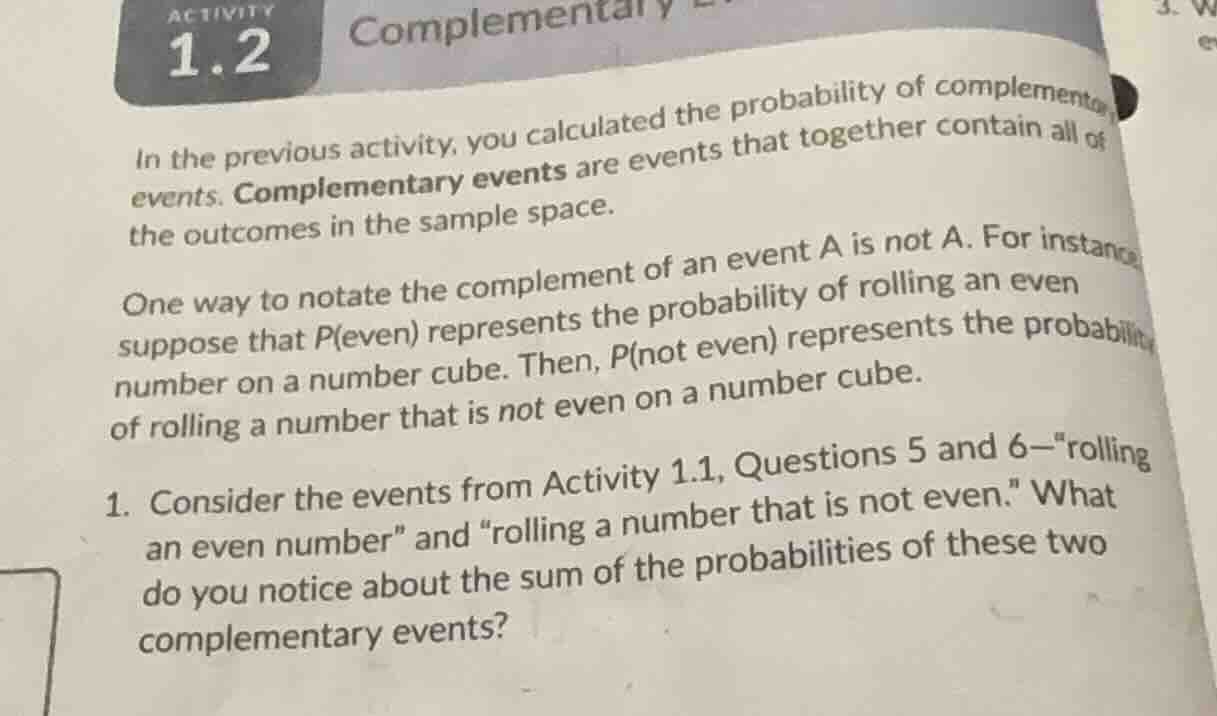
in the previous activity, you calculated the probability of complementary
events. complementary events are events that together contain all of
the outcomes in the sample space.
one way to notate the complement of an event a is not a. for instance,
suppose that p(even) represents the probability of rolling an even
number on a number cube. then, p(not even) represents the probability
of rolling a number that is not even on a number cube.
- consider the events from activity 1.1, questions 5 and 6—
olling
an even number\ and
olling a number that is not even.\ what
do you notice about the sum of the probabilities of these two
complementary events?
Complementary events cover all possible outcomes in a sample space, so their combined probability equals the probability of all possible outcomes, which is 1. For rolling a number cube, the even numbers are 2,4,6 (3 outcomes) and non-even are 1,3,5 (3 outcomes). The probability of rolling even is $\frac{3}{6} = \frac{1}{2}$, and non-even is also $\frac{3}{6} = \frac{1}{2}$. Their sum is $\frac{1}{2} + \frac{1}{2} = 1$.

Snap & solve any problem in the app
Get step-by-step solutions on Sovi AI
Photo-based solutions with guided steps
Explore more problems and detailed explanations
The sum of the probabilities of these two complementary events is equal to 1.