QUESTION IMAGE
Question
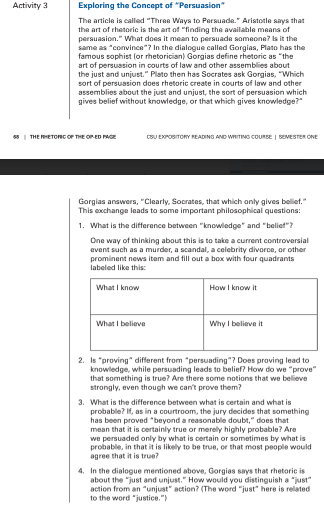
activity 3 exploring the concept of \persuasion\ the article is entitled \three ways to persuade.\ aristotle says that the art of rhetoric is the \art of finding the available means of persuasion.\ for him, rhetoric is not the same as \convincing.\ in the dialogued called gorgias, plato has the famous teacher of rhetoric gorgias say that rhetoric is \the art of persuasion in courts of law and other assemblies about the just and unjust.\ plato then has socrates ask gorgias, \which sort of persuasion is it, the sort that makes people in the assemblies believe the just and unjust, the sort of persuasion which gives belief without knowledge, or that which gives knowledge?\ gorgias answers, \clearly, socrates, that which only gives belief.\ to help you understand the difference between \persuade\ and \believe\: 1. what is the difference between \persuade\ and \believe\? even way of thinking about this is to take a current controversial issue such as a murders, a scandal, a celebrity divorce, or other prominent news item and fill out a box with four quadrants labeled like this: what i know how i know it what i believe why i believe it 2. is \proving\ different from \persuading\? does proving lead to knowledge, while persuading leads to belief? how do we \prove\ something strongly, even though we cant prove it? 3. what is the difference between what is certain and what is probable? if, as in a courtroom, the jury decides that something is \beyond a reasonable doubt,\ is that certain or only highly probable? is meant that it is certainly true or merely highly probable? are arguments based on what is probable weaker than those based on what is certain, or is that likely to be true or that most people would agree that it is true? 4. in the dialogue mentioned above, gorgias says that rhetoric is persuasion about the \just and unjust.\ what is the connection between \action from an \unjust\ action? the word \just\ here is related to the word \justice.\
- For the quadrant chart:
- Top-Left (What I know & What I believe): These are ideas you hold that you can verify with evidence, e.g., "Water boils at 100°C at sea level."
- Top-Right (What I know & Why I believe it): These are evidence-backed beliefs where you can explain the reasoning, e.g., "I know water boils at 100°C at sea level because atmospheric pressure at that elevation is 1 atm, which allows water to reach that temperature before vaporizing."
- Bottom-Left (What I believe & What I know): These are unexamined beliefs you accept without evidence, e.g., "I believe my favorite sports team is the best."
- Bottom-Right (What I believe & Why I believe it): These are beliefs you can explain the personal reasoning for, even without concrete evidence, e.g., "I believe my favorite sports team is the best because their playing style aligns with what I find exciting in the sport."
- "Proving" is rooted in establishing absolute truth using verifiable, objective evidence (like mathematical proofs or scientific experiments) to create knowledge. "Persuading" focuses on convincing someone to accept a claim, which may rely on emotion, rhetoric, or incomplete evidence, only aiming to create belief. We "prove" claims when we can use repeatable, testable evidence to confirm their truth (e.g., proving the Pythagorean theorem with geometric logic). We "persuade" when absolute proof is impossible, such as arguing for a political policy, where we use values, anecdotes, or probabilistic data to sway others.
- Certain refers to a claim that is definitively true, with no room for doubt, supported by irrefutable evidence (e.g., "2+2=4"). Probable refers to a claim that is likely true based on available evidence, but not confirmed (e.g., "It will rain tomorrow" based on a weather forecast). More or less highly probable describes degrees of likelihood: a highly probable claim has strong supporting evidence (e.g., "Smoking increases cancer risk"), while a low-probability claim has weak evidence (e.g., "A coin flip will land heads 10 times in a row"). Rhetoric deals primarily with probable claims, as absolute certainties rarely require persuasion.
- Gorgias links rhetoric to "justice" because rhetoric is the tool used to argue for what a speaker deems just or unjust in public spaces like assemblies or courts. The word "just" comes from the Latin iustus, meaning upright, fair, or in accordance with moral law, which ties to the core of rhetorical arguments about right and wrong in community life.

Snap & solve any problem in the app
Get step-by-step solutions on Sovi AI
Photo-based solutions with guided steps
Explore more problems and detailed explanations
- Example quadrant fill:
| What I know | What I believe |
|---|---|
| I know this because atmospheric pressure at sea level allows this boiling point | I believe this because their playing style feels exciting to me |
- Proving creates knowledge via objective evidence; persuading creates belief via rhetoric. Prove with testable evidence; persuade when proof is impossible.
- Certain = absolute truth; probable = likely true; varying probability = degrees of likelihood. Rhetoric focuses on probable claims.
- Rhetoric argues for just/unjust in public. "Just" comes from Latin iustus (fair/upright).