QUESTION IMAGE
Question
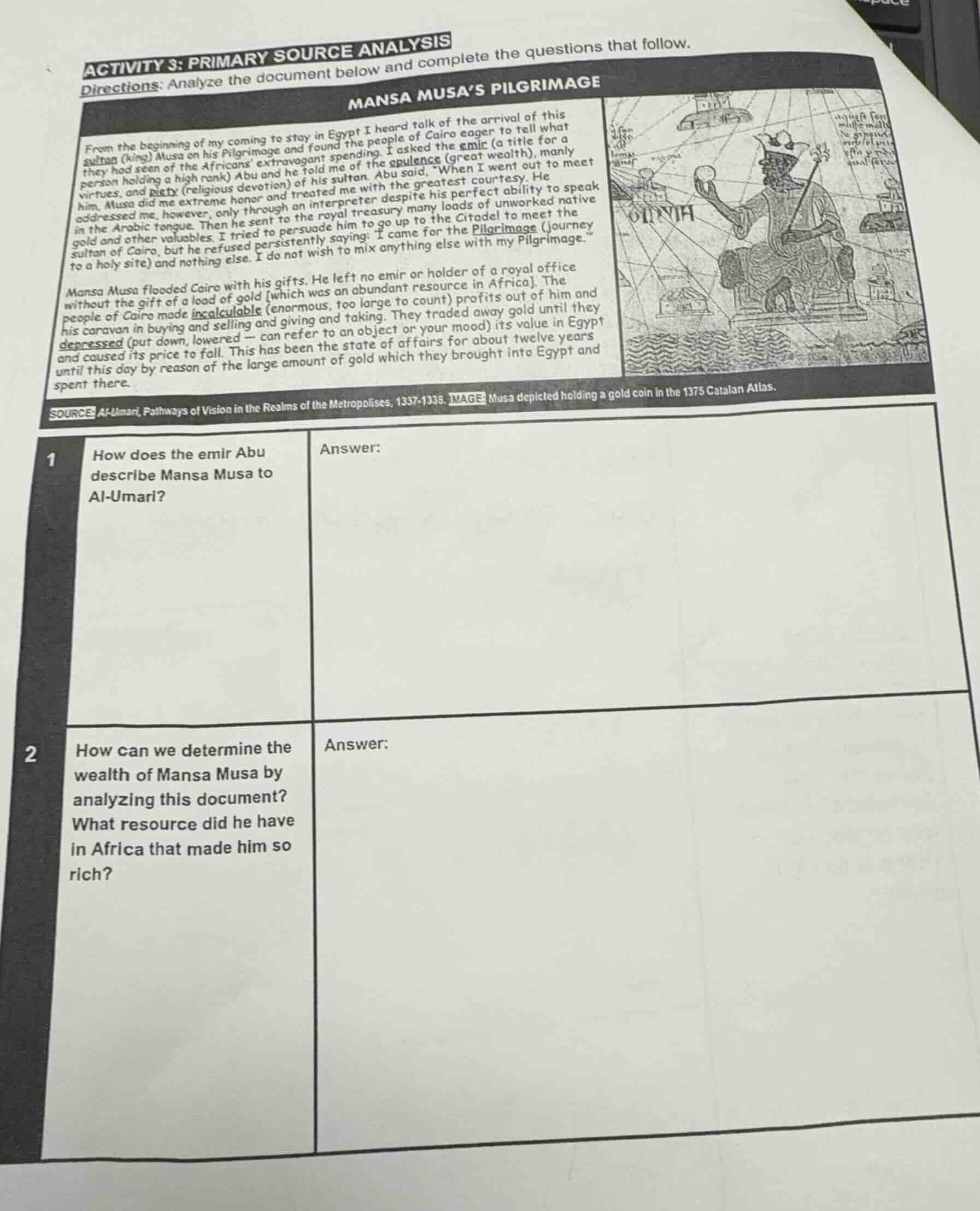
activity 3: primary source analysis
directions: analyze the document below and complete the questions that follow.
mansa musa’s pilgrimage
from the beginning of my coming to stay in egypt i heard talk of the arrival of this
sultan (king) musa on his pilgrimage and found the people of cairo eager to tell what
they had seen of the africans’ extravagant spending. i asked the emir (a title for a
person holding a high rank) abu and he told me of the opulence (great wealth), manly
virtues, and piety (religious devotion) of his sultan. abu said, “when i went out to meet
him, musa did me extreme honor and treated me with the greatest courtesy. he
addressed me, however, only through an interpreter despite his perfect ability to speak
in the arabic tongue. then he sent to the royal treasury many loads of unworked native
gold and other valuables. i tried to persuade him to go up to the citadel to meet the
sultan of cairo, but he refused persistently saying: ‘i came for the pilgrimage (journey
to a holy site) and nothing else. i do not wish to mix anything else with my pilgrimage.’
mansa musa flooded cairo with his gifts. he left no emir or holder of a royal office
without the gift of a load of gold which was an abundant resource in africa. the
people of cairo made incalculable (enormous and, too large to count) profits out of him and
his caravan in buying and selling and giving and taking. they traded away gold until they
depressed (put down, lowered — can refer to an object or your mood) its value in egypt
and caused its price to fall. this has been the state of affairs for about twelve years
until this day by reason of the large amount of gold which they brought into egypt and
spent there.
source: al-umari, pathways of vision in the realms of the metropolises, 1337 - 1338. image: musa depicted holding a gold coin in the 1375 catalan atlas.
1
how does the emir abu
describe mansa musa to
al - umari?
answer:
2
how can we determine the
wealth of mansa musa by
analyzing this document?
what resource did he have
in africa that made him so
rich?
answer:
Question 1
To answer this, we refer to the text where Abu describes Mansa Musa. The relevant sentence is: "Abu said, 'When I went out to meet him, Musa did me extreme honor and treated me with the greatest courtesy. He addressed me, however, only through an interpreter despite his perfect ability to speak in the Arabic tongue. Then he sent to the royal treasury many loads of unworked native gold and other valuables.'" Also, the text mentions the "opulence (great wealth), manly virtues, and piety (religious devotion)" of his sultan (Mansa Musa). So we extract these descriptions.
For determining his wealth, we look at the text: "Mansa Musa flooded Cairo with his gifts. He left no emir or holder of a royal office without the gift of a load of gold [which was an abundant resource in Africa]. The people of Cairo made incalculable (enormous and too large to count) profits out of him and his caravan in buying and selling and giving. They traded away gold until they depressed (put down, lowered — can refer to an object or your mood) its value in Egypt and caused its price to fall. This has been the state of affairs for about twelve years until this day by reason of the large amount of gold which they brought into Egypt and spent there." From this, we can see the impact of his gold on Cairo's economy (price of gold fell, people made incalculable profits) which shows his great wealth. The resource he had in Africa that made him rich is gold, as stated "a load of gold [which was an abundant resource in Africa]".

Snap & solve any problem in the app
Get step-by-step solutions on Sovi AI
Photo-based solutions with guided steps
Explore more problems and detailed explanations
Abu describes Mansa Musa as having great wealth (opulence), manly virtues, piety (religious devotion), treating Abu with extreme honor and greatest courtesy, addressing Abu through an interpreter despite being able to speak Arabic, and sending many loads of unworked native gold and other valuables from the royal treasury.