QUESTION IMAGE
Question
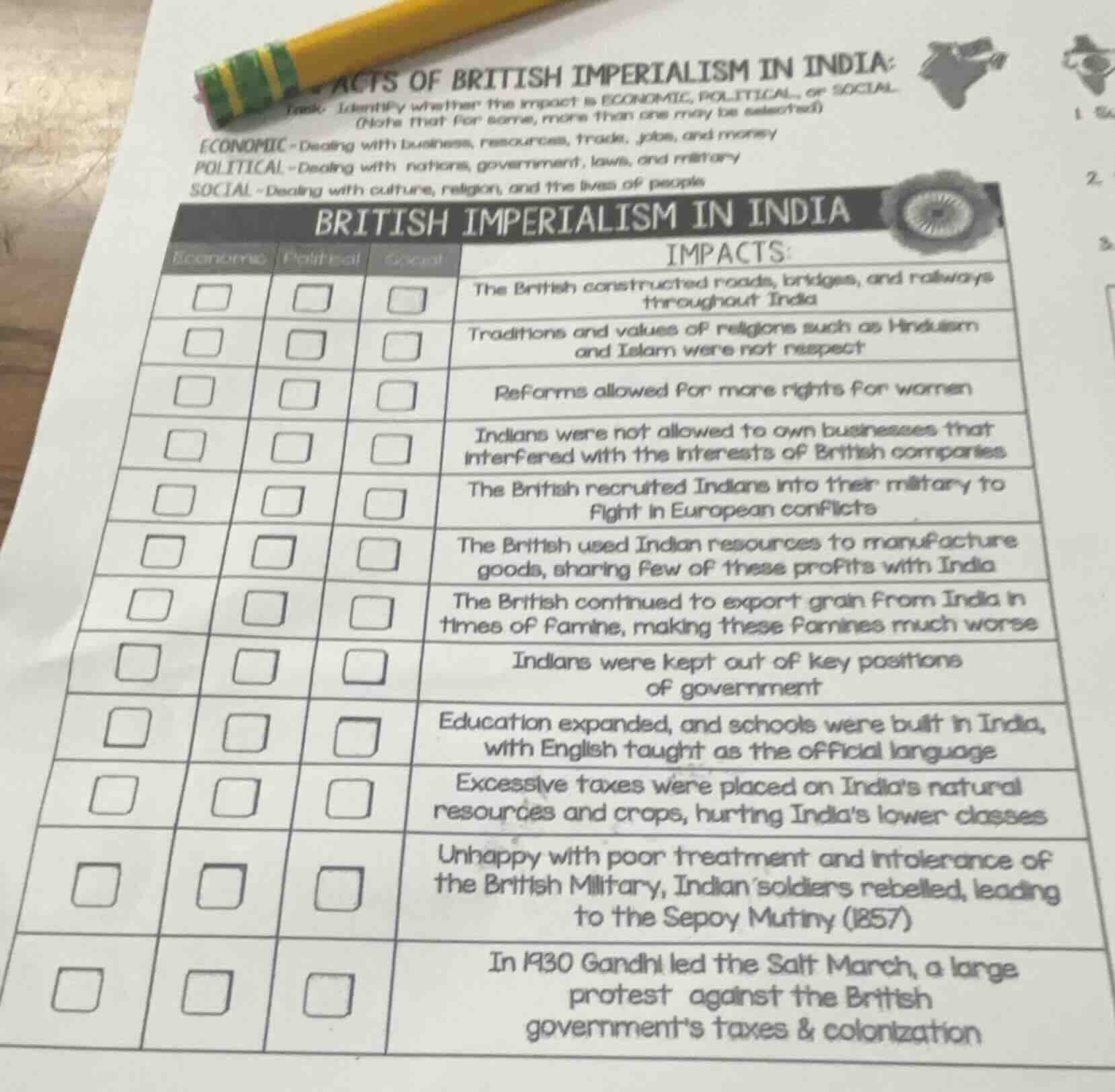
acts of british imperialism in india:task: identify whether the impact is economic, political, or social.(note that for some, more than one may be selected)economic - dealing with business, resources, trade, jobs, and moneypolitical - dealing with nations, government, laws, and militarysocial - dealing with culture, religion, and the lives of peoplebritish imperialism in indiaimpacts:1. the british constructed roads, bridges, and railways throughout india2. traditions and values of religions such as hinduism and islam were not respect3. reforms allowed for more rights for women4. indians were not allowed to own businesses that interfered with the interests of british companies5. the british recruited indians into their military to fight in european conflicts6. the british used indian resources to manufacture goods, sharing few of these profits with india7. the british continued to export grain from india in times of famine, making these famines much worse8. indians were kept out of key positions of government9. education expanded, and schools were built in india, with english taught as the official language10. excessive taxes were placed on indias natural resources and crops, hurting indias lower classes11. unhappy with poor treatment and intolerance of the british military, indian soldiers rebelled, leading to the sepoy mutiny (1857)12. in 1930 gandhi led the salt march, a large protest against the british governments taxes & colonization
Each impact is categorized based on the definitions:
- Economic: Relates to business, resources, trade, jobs, money
- Political: Relates to government, laws, military, nations
- Social: Relates to culture, religion, people's lives
- Infrastructure construction supports trade/economy, and is a political governance action.
- Disrespect for religious traditions falls under social/cultural impacts.
- Women's rights relate to social life and people's status.
- Restricting Indian businesses impacts economic activity.
- Recruiting for military is a political/military action.
- Exploiting resources for profit is an economic action.
- Exporting grain during famine harms economic livelihoods and social welfare.
- Excluding Indians from government is a political governance action.
- Education and language policy affects social culture and political control.
- Taxing resources/crops is an economic policy.
- Military rebellion stems from political (military) and social (treatment) grievances.
- The Salt March protests political rule and economic taxes.

Snap & solve any problem in the app
Get step-by-step solutions on Sovi AI
Photo-based solutions with guided steps
Explore more problems and detailed explanations
- The British constructed roads, bridges, and railways throughout India: Economic, Political
- Traditions and values of religions such as Hinduism and Islam were not respected: Social
- Reforms allowed for more rights for women: Social
- Indians were not allowed to own businesses that interfered with the interests of British companies: Economic
- The British recruited Indians into their military to fight in European conflicts: Political
- The British used Indian resources to manufacture goods, sharing few of these profits with India: Economic
- The British continued to export grain from India in times of Famine, making these Famines much worse: Economic, Social
- Indians were kept out of key positions of government: Political
- Education expanded, and schools were built in India, with English taught as the official language: Social, Political
- Excessive taxes were placed on India's natural resources and crops, hurting India's lower classes: Economic, Social
- Unhappy with poor treatment and intolerance of the British Military, Indian soldiers rebelled, leading to the Sepoy Mutiny (1857): Political, Social
- In 1930 Gandhi led the Salt March, a large protest against the British government's taxes & colonization: Political, Economic