QUESTION IMAGE
Question
6 - 8 additional practice
- (some text about angles and parallel lines, with a diagram)
measure of angle v is?
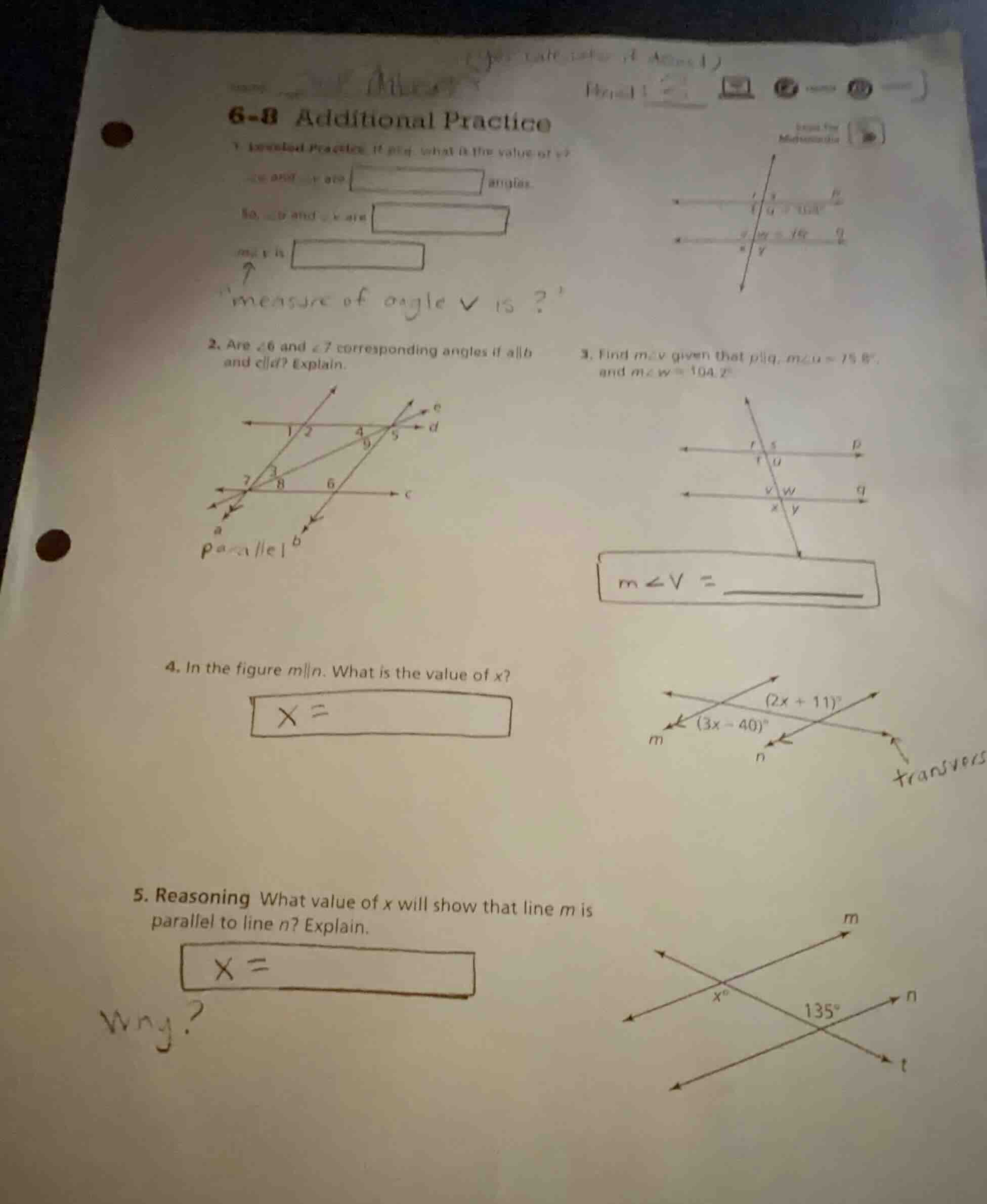
- are ∠6 and ∠7 corresponding angles if a∥b and c∥d? explain.
(diagram with lines a, b, c, d and angles 1 - 9)
- find m∠v given that p∥q, m∠u = 75.8°, and m∠w = 104.2°.
(diagram with lines p, q and angles u, v, w)
m∠v =
- in the figure m∥n. what is the value of x?
(diagram with lines m, n and angles (2x + 11)° and (3x - 40)°)
x =
- reasoning what value of x will show that line m is parallel to line n? explain.
(diagram with lines m, n, t and angles x° and 135°)
x =
why?
Problem 3:
Step1: Identify angle relationships
Since \( p \parallel q \), \( \angle u \) and \( \angle w \) are related to \( \angle v \). We know that \( \angle u \) and \( \angle v \) are same - side interior angles? Wait, no, let's look at the transversal. Wait, actually, \( \angle u \) and \( \angle v \) and \( \angle w \): first, \( \angle u \) and \( \angle s \) are vertical angles? Wait, no, the figure shows that \( p \) and \( q \) are parallel, cut by a transversal. Let's recall that when two parallel lines are cut by a transversal, consecutive interior angles are supplementary. Wait, \( \angle u \) and \( \angle v \): Wait, maybe \( \angle u \), \( \angle v \), and \( \angle w \): Let's see, \( \angle w \) and \( \angle v \) are same - side interior angles? Wait, no, the sum of angles on a straight line is \( 180^{\circ} \), and also with parallel lines. Wait, given \( m\angle u = 75.8^{\circ} \) and \( m\angle w=104.2^{\circ} \). Wait, actually, \( \angle u \) and \( \angle v \) are such that \( \angle u+\angle v+\angle w \)? No, wait, maybe \( \angle u \) and \( \angle v \) are alternate interior angles? No, wait, let's think again. Wait, the sum of \( \angle u \) and \( \angle v \) should be equal to \( \angle w \)? No, that doesn't make sense. Wait, actually, when two parallel lines are cut by a transversal, the consecutive interior angles are supplementary. Wait, \( \angle u \) and \( \angle w \) are not consecutive. Wait, maybe \( \angle v \) and \( \angle w \) are supplementary? No, wait, let's calculate \( 180 - 104.2=75.8 \), but \( \angle u = 75.8 \). Wait, maybe \( \angle v \) is equal to \( 180-(75.8 + 104.2) \)? No, that would be 0. Wait, no, I think I made a mistake. Wait, the correct approach: Since \( p\parallel q \), and the transversal cuts them, \( \angle u \) and \( \angle v \) are related such that \( \angle v=180 - m\angle w \)? No, \( m\angle w = 104.2^{\circ} \), so \( m\angle v=180 - 104.2=75.8^{\circ} \)? Wait, no, that's the same as \( m\angle u \). Wait, maybe \( \angle u \) and \( \angle v \) are equal because of alternate interior angles, and \( \angle w \) is supplementary to \( \angle v \). Wait, \( m\angle w = 104.2^{\circ} \), so \( m\angle v=180 - 104.2 = 75.8^{\circ} \)? Wait, but \( m\angle u = 75.8^{\circ} \). So \( m\angle v=75.8^{\circ} \)? Wait, no, let's do it properly. The sum of \( m\angle u + m\angle v=m\angle w \)? No, that can't be. Wait, maybe the angles \( \angle u \), \( \angle v \) and the angle adjacent to \( \angle w \): Wait, the correct formula is that when two parallel lines are cut by a transversal, the measure of \( \angle v \) is \( 180 - m\angle w \) if they are consecutive interior angles, but \( m\angle u = 75.8 \), and \( 180 - 104.2 = 75.8 \), so \( m\angle v=75.8^{\circ} \). Wait, that's the same as \( m\angle u \). So \( m\angle v = 75.8^{\circ} \)
Step2: Calculate \( m\angle v \)
We know that \( 180 - 104.2=75.8 \), and since \( p\parallel q \), the angle \( \angle v \) is equal to \( 75.8^{\circ} \) (because of the parallel line angle relationships, like alternate interior angles or supplementary angles leading to the same measure).
Step1: Identify the angle relationship
Since \( m\parallel n \), the angles \( (3x - 40)^{\circ} \) and \( (2x + 11)^{\circ} \) are alternate interior angles (because they are on opposite sides of the transversal and inside the two parallel lines \( m \) and \( n \)). Alternate interior angles are equal when two parallel lines are cut by a transversal.
So we set up the equation:
\( 3x-40 = 2x + 11 \)
Step2: Solve for \( x \)
Subtract \( 2x \) from both sides of the equation:
\( 3x-2x-40=2x - 2x+ 11 \)
\( x - 40=11 \)
Then add 40 to both sides:
\( x-40 + 40=11 + 40 \)
\( x = 51 \)
Step1: Identify the angle relationship
For line \( m \) to be parallel to line \( n \), the angle \( x^{\circ} \) and the \( 135^{\circ} \) angle should be supplementary (because they are consecutive interior angles when the transversal cuts the two lines \( m \) and \( n \)). Consecutive interior angles are supplementary (sum to \( 180^{\circ} \)) when two lines are parallel.
Step2: Solve for \( x \)
We set up the equation:
\( x + 135=180 \)
Subtract 135 from both sides:
\( x=180 - 135 \)
\( x = 45 \)

Snap & solve any problem in the app
Get step-by-step solutions on Sovi AI
Photo-based solutions with guided steps
Explore more problems and detailed explanations
\( 75.8^{\circ} \)