QUESTION IMAGE
Question
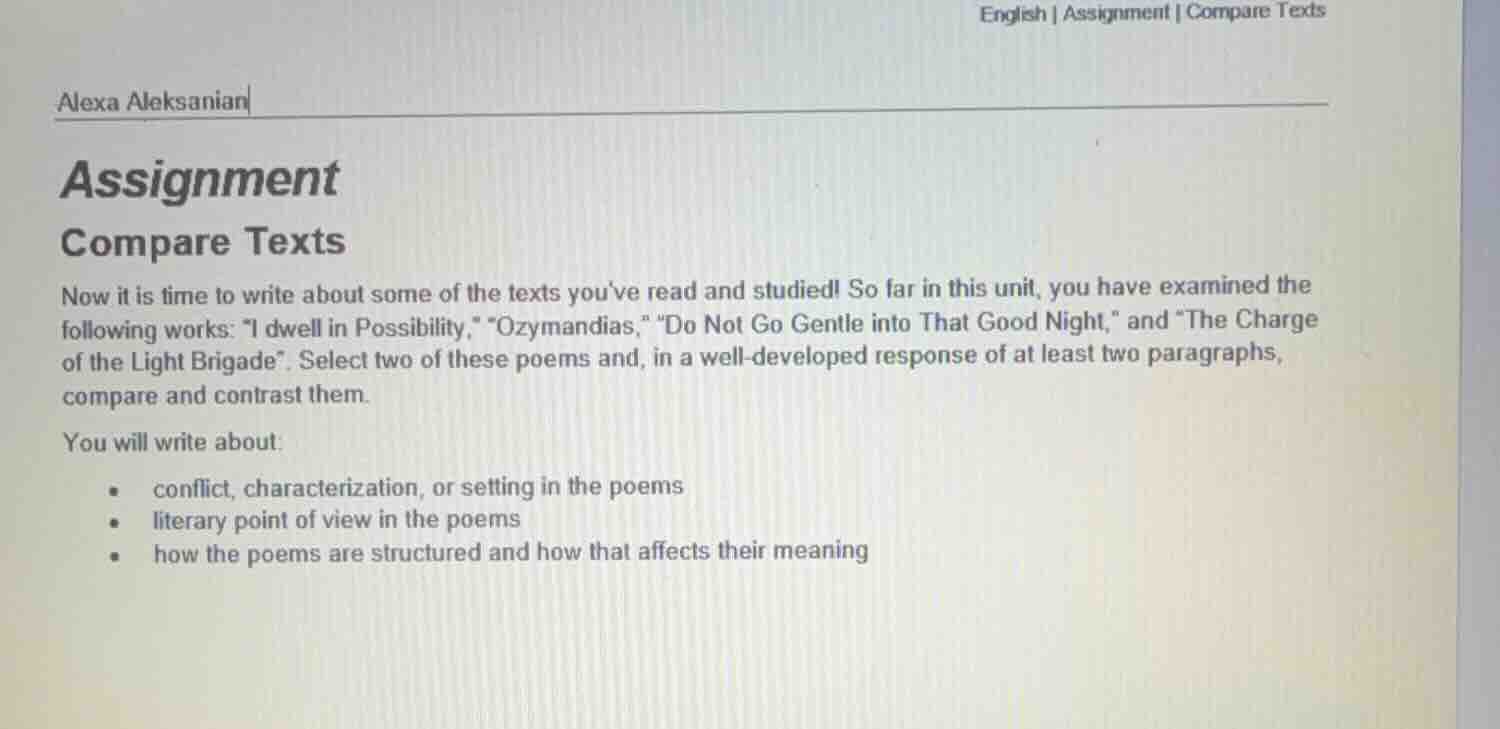
alexa aleksanian
assignment
compare texts
now it is time to write about some of the texts you’ve read and studied! so far in this unit, you have examined the following works: “i dwell in possibility,” “ozymandias,” “do not go gentle into that good night,” and “the charge of the light brigade”. select two of these poems and, in a well - developed response of at least two paragraphs, compare and contrast them.
you will write about:
- conflict, characterization, or setting in the poems
- literary point of view in the poems
- how the poems are structured and how that affects their meaning
This assignment asks to compare two selected poems from the given list, focusing on conflict/characterization/setting, literary point of view, and structural impact on meaning, in at least two paragraphs. Below is a sample response comparing "Do Not Go Gentle into That Good Night" by Dylan Thomas and "The Charge of the Light Brigade" by Alfred, Lord Tennyson:
First, in terms of conflict and point of view: "Do Not Go Gentle into That Good Night" centers on an internal and interpersonal conflict: the speaker’s plea for his dying father to resist death. It uses a first-person point of view, creating an intimate, urgent tone as the speaker addresses his father directly. "The Charge of the Light Brigade" focuses on an external, collective conflict: a military brigade’s doomed, ordered charge into enemy fire. It uses a third-person omniscient point of view, framing the event as a tragic, historical spectacle to honor the soldiers' bravery.
For structure and meaning: Thomas’s poem is a villanelle, a fixed form with repeating lines ("Do not go gentle into that good night" and "Rage, rage against the dying of the light"). This repetition amplifies the speaker’s desperate, insistent plea, emphasizing the cycle of grief and the fight against mortality. Tennyson’s poem uses a ballad structure with short, staccato lines and a consistent rhyme scheme. The rhythmic, marching-like meter mirrors the brigade’s advance, while the short lines build tension and highlight the sudden, violent tragedy of the charge, reinforcing the poem’s theme of heroic sacrifice in the face of futility.

Snap & solve any problem in the app
Get step-by-step solutions on Sovi AI
Photo-based solutions with guided steps
Explore more problems and detailed explanations
Sample comparative response (focused on "Do Not Go Gentle into That Good Night" and "The Charge of the Light Brigade"):
Paragraph 1
The core conflicts and narrative perspectives of "Do Not Go Gentle into That Good Night" and "The Charge of the Light Brigade" create vastly different emotional stakes. Dylan Thomas’s poem centers on an intimate, interpersonal conflict: a speaker begging his dying father to resist the "dying of the light" of death. Using a first-person point of view, the poem feels raw and personal, as the speaker’s direct address to his father ("You, my father, there on the sad height") channels urgent, filial grief and defiance. In contrast, Alfred, Lord Tennyson’s poem focuses on a collective, external conflict: a British cavalry brigade’s catastrophic, ordered charge into enemy cannons. Its third-person omniscient perspective frames the event as a historical tragedy, observing the brigade’s sacrifice from a distance to honor their courage rather than explore individual emotion.
Paragraph 2
The structural choices of each poem deeply shape their thematic meaning. Thomas uses a strict villanelle form, with two refrains ("Do not go gentle into that good night" and "Rage, rage against the dying of the light") that repeat throughout the five tercets and final quatrain. This repetitive, cyclical structure mirrors the unrelenting cycle of grief and the speaker’s unwavering plea, amplifying the poem’s core message of resisting mortality at all costs. Tennyson’s poem adopts a ballad structure with short, trochaic tetrameter lines and a simple A-B-C-B rhyme scheme. The staccato, marching rhythm mirrors the brigade’s steady, doomed advance, while the short lines build tension that peaks with the brutal depiction of the charge ("Into the jaws of Death, / Into the mouth of Hell"). This structure turns the tragic military blunder into a memorial, emphasizing the quiet heroism of soldiers following orders despite certain defeat.