QUESTION IMAGE
Question
analyze the data
conduct research
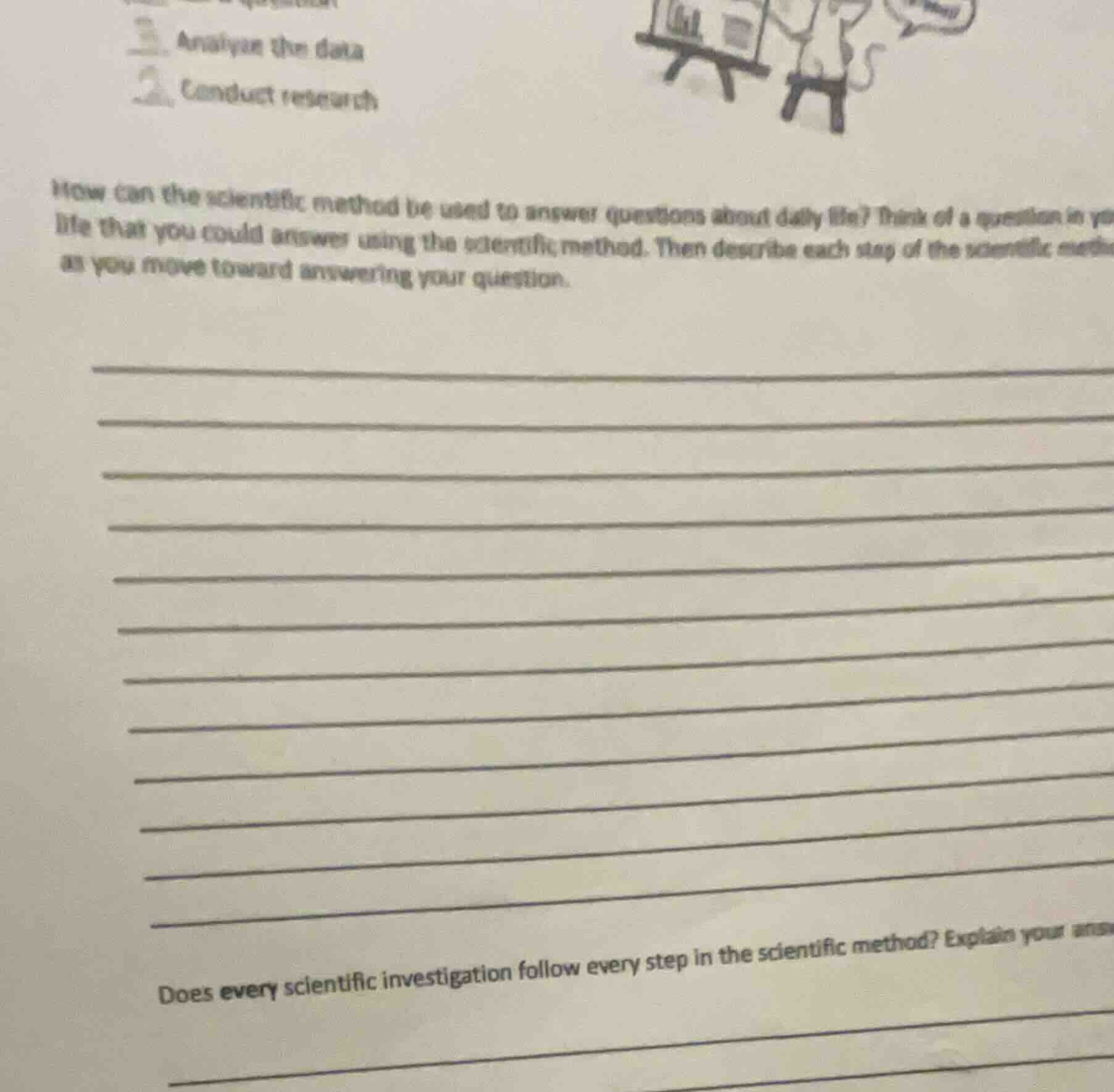
how can the scientific method be used to answer questions about daily life? think of a question in your life that you could answer using the scientific method. then describe each step of the scientific method as you move toward answering your question.
does every scientific investigation follow every step in the scientific method? explain your ans
Part 1: Using the Scientific Method in Daily Life
Let's take the question: "Does the type of soil affect the growth of a potted tomato plant?"
Step 1: Ask a Question
We start with the question about how soil type impacts tomato plant growth.
Step 2: Do Background Research
Look up information about tomato plant requirements, different soil types (e.g., sandy, loamy, clay), and their properties (drainage, nutrient retention).
Step 3: Form a Hypothesis
Hypothesis: "Loamy soil will support better growth of tomato plants than sandy or clay soil because it has balanced drainage and nutrient retention."
Step 4: Test the Hypothesis (Experiment)
- Materials: 3 identical pots, tomato seeds, loamy soil, sandy soil, clay soil, water, ruler.
- Procedure:
- Fill each pot with a different soil type.
- Plant 3 tomato seeds in each pot at the same depth.
- Place all pots in a location with equal sunlight and temperature.
- Water each pot with the same amount of water at the same time daily.
- Over 4 weeks, measure the height of the plants weekly.
Step 5: Analyze Data
Record the height of each plant weekly. At the end of 4 weeks, calculate the average height for each soil type.
Step 6: Draw Conclusions
Compare the average heights. If loamy soil plants are tallest, the hypothesis is supported. If not, revise the hypothesis (e.g., test different soil amendments) and repeat the experiment.
Part 2: Do All Investigations Follow Every Step?
No, not every scientific investigation follows every step rigidly. For example:
- In some fields (e.g., astronomy), direct experimentation (Step 4) is impossible. Researchers observe celestial bodies and analyze data instead.
- In exploratory research, a hypothesis may not be formed initially (Step 3); the goal is to gather data to generate questions or hypotheses later.
- Some investigations (e.g., quick field observations) may skip background research if the topic is well-known to the researcher.
However, the core principles of asking questions, collecting data, and analyzing results are generally followed, even if steps are adapted or reordered.
Final Answers
- Part 1 Example: The scientific method is applied by defining a question, researching, hypothesizing, experimenting, analyzing, and concluding (as shown with the tomato plant example).
- Part 2 Answer: No, not every scientific investigation follows every step. Some skip or adapt steps (e.g., no experimentation in astronomy, no initial hypothesis in exploratory research) based on the research context.

Snap & solve any problem in the app
Get step-by-step solutions on Sovi AI
Photo-based solutions with guided steps
Explore more problems and detailed explanations
Part 1: Using the Scientific Method in Daily Life
Let's take the question: "Does the type of soil affect the growth of a potted tomato plant?"
Step 1: Ask a Question
We start with the question about how soil type impacts tomato plant growth.
Step 2: Do Background Research
Look up information about tomato plant requirements, different soil types (e.g., sandy, loamy, clay), and their properties (drainage, nutrient retention).
Step 3: Form a Hypothesis
Hypothesis: "Loamy soil will support better growth of tomato plants than sandy or clay soil because it has balanced drainage and nutrient retention."
Step 4: Test the Hypothesis (Experiment)
- Materials: 3 identical pots, tomato seeds, loamy soil, sandy soil, clay soil, water, ruler.
- Procedure:
- Fill each pot with a different soil type.
- Plant 3 tomato seeds in each pot at the same depth.
- Place all pots in a location with equal sunlight and temperature.
- Water each pot with the same amount of water at the same time daily.
- Over 4 weeks, measure the height of the plants weekly.
Step 5: Analyze Data
Record the height of each plant weekly. At the end of 4 weeks, calculate the average height for each soil type.
Step 6: Draw Conclusions
Compare the average heights. If loamy soil plants are tallest, the hypothesis is supported. If not, revise the hypothesis (e.g., test different soil amendments) and repeat the experiment.
Part 2: Do All Investigations Follow Every Step?
No, not every scientific investigation follows every step rigidly. For example:
- In some fields (e.g., astronomy), direct experimentation (Step 4) is impossible. Researchers observe celestial bodies and analyze data instead.
- In exploratory research, a hypothesis may not be formed initially (Step 3); the goal is to gather data to generate questions or hypotheses later.
- Some investigations (e.g., quick field observations) may skip background research if the topic is well-known to the researcher.
However, the core principles of asking questions, collecting data, and analyzing results are generally followed, even if steps are adapted or reordered.
Final Answers
- Part 1 Example: The scientific method is applied by defining a question, researching, hypothesizing, experimenting, analyzing, and concluding (as shown with the tomato plant example).
- Part 2 Answer: No, not every scientific investigation follows every step. Some skip or adapt steps (e.g., no experimentation in astronomy, no initial hypothesis in exploratory research) based on the research context.