QUESTION IMAGE
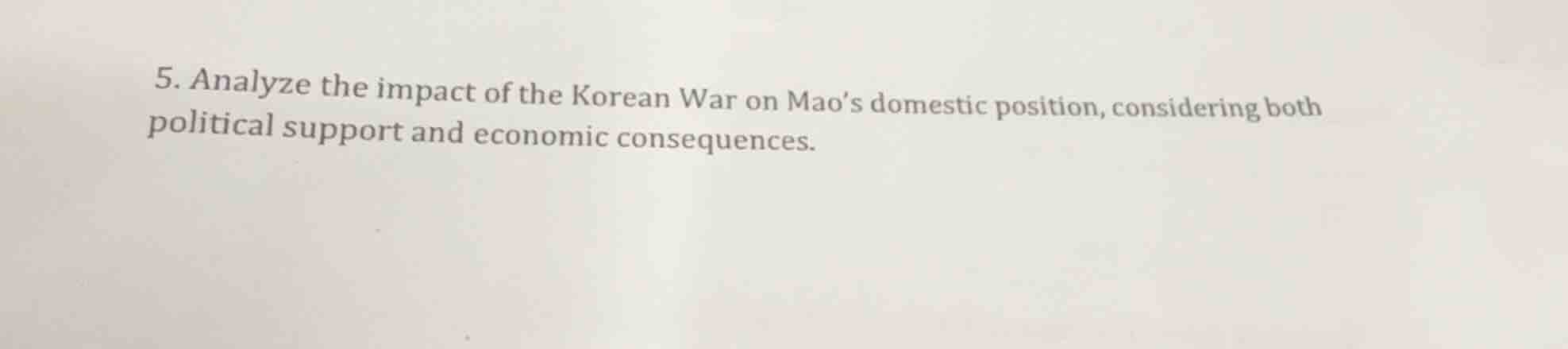
Question
- analyze the impact of the korean war on maos domestic position, considering both political support and economic consequences.
Brief Explanations
- Political Support Impacts:
- The Korean War solidified Mao's image as a strong nationalist leader who stood up to Western (U.S.) military power, boosting his legitimacy among Chinese citizens who viewed the conflict as a defense of regional sovereignty and revolutionary ideals.
- It allowed Mao to consolidate control over the Chinese Communist Party (CCP) by uniting party factions around a common external threat, suppressing internal dissent that questioned his leadership decisions.
- The war also enabled the expansion of state security and propaganda apparatuses, which further entrenched Mao's ideological authority across the country.
- Economic Consequences & Domestic Position:
- The war diverted significant state resources to military spending, delaying post-civil war economic recovery efforts and causing short-term hardships like inflation and shortages of consumer goods. This initially created some domestic discontent.
- However, the war also spurred Soviet economic and technical aid to China, which laid the groundwork for early industrialization. Mao framed this aid as a victory of his foreign policy, using it to justify his economic planning strategies and maintain support among those benefiting from industrial development.
- The conflict accelerated land reform and collectivization efforts, as Mao used the wartime emergency to push through economic restructuring that centralized state control, strengthening his ability to shape domestic economic policy.

Snap & solve any problem in the app
Get step-by-step solutions on Sovi AI
Photo-based solutions with guided steps
Explore more problems and detailed explanations
The Korean War had dual, mostly reinforcing impacts on Mao Zedong's domestic position:
- Political Support: It enhanced Mao's nationalist legitimacy by framing the conflict as a stand against U.S. imperialism, united CCP factions around a common threat, and allowed him to consolidate ideological and organizational control over the party and state.
- Economic Impacts: While short-term military spending delayed recovery and caused hardships, Soviet aid tied to the war supported early industrialization, and wartime emergency powers enabled Mao to advance collectivization and centralized economic planning, entrenching his authority over domestic economic policy. Overall, the war strengthened Mao's domestic standing by combining nationalist prestige with expanded state control.