QUESTION IMAGE
Question
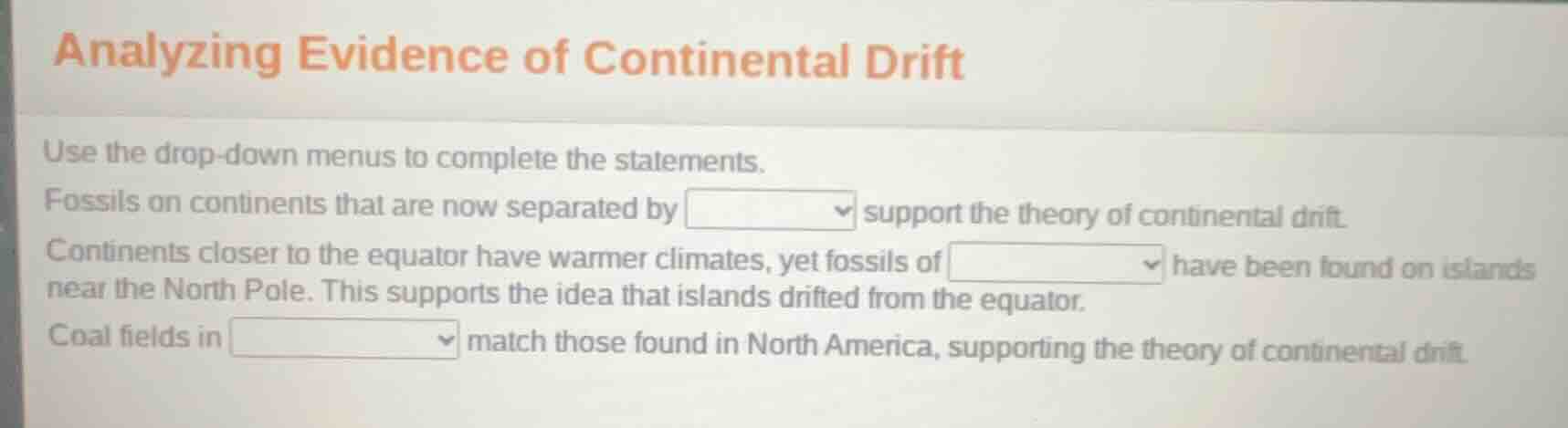
analyzing evidence of continental drift
use the drop - down menus to complete the statements.
fossils on continents that are now separated by support the theory of continental drift.
continents closer to the equator have warmer climates, yet fossils of have been found on islands near the north pole. this supports the idea that islands drifted from the equator.
coal fields in match those found in north america, supporting the theory of continental drift.
Brief Explanations
- The presence of identical fossils on continents separated by large oceans indicates these landmasses were once connected before drifting apart.
- Tropical plants only thrive in warm, equatorial climates; their fossils near the North Pole show the region was once closer to the equator and drifted north.
- Coal forms in warm, swampy environments. Matching coal fields in Europe and North America confirm these regions were once part of the same landmass with a shared climate and ecosystem.

Snap & solve any problem in the app
Get step-by-step solutions on Sovi AI
Photo-based solutions with guided steps
Explore more problems and detailed explanations
- Fossils on continents that are now separated by wide oceans support the theory of continental drift.
- Continents closer to the equator have warmer climates, yet fossils of tropical plants have been found on islands near the North Pole. This supports the idea that islands drifted from the equator.
- Coal fields in Europe match those found in North America, supporting the theory of continental drift.