QUESTION IMAGE
Question
analyzing a real - world volume problem
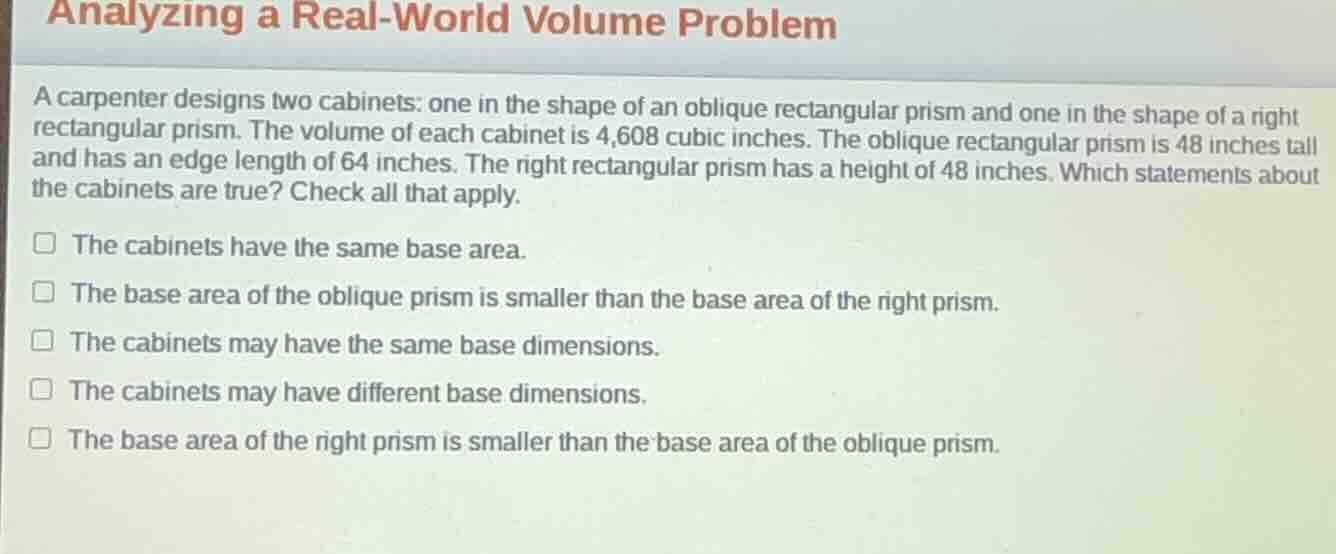
a carpenter designs two cabinets: one in the shape of an oblique rectangular prism and one in the shape of a right rectangular prism. the volume of each cabinet is 4,608 cubic inches. the oblique rectangular prism is 48 inches tall and has an edge length of 64 inches. the right rectangular prism has a height of 48 inches. which statements about the cabinets are true? check all that apply.
- the cabinets have the same base area.
- the base area of the oblique prism is smaller than the base area of the right prism.
- the cabinets may have the same base dimensions.
- the cabinets may have different base dimensions.
- the base area of the right prism is smaller than the base area of the oblique prism.
Step1: Recall prism volume formula
The volume \( V \) of any prism is \( V = B \times h \), where \( B \) is the base area, and \( h \) is the perpendicular height.
Step2: Calculate base area for right prism
Rearrange formula to solve for \( B \): \( B = \frac{V}{h} \).
For the right prism: \( V = 4608 \text{ in}^3 \), \( h = 48 \text{ in} \)
\( B_{\text{right}} = \frac{4608}{48} = 96 \text{ in}^2 \)
Step3: Calculate base area for oblique prism
For the oblique prism, the perpendicular height is 48 in (given as "tall", which refers to perpendicular height for volume).
\( B_{\text{oblique}} = \frac{4608}{48} = 96 \text{ in}^2 \)
Step4: Analyze base dimension possibilities
A base area of 96 in² can be achieved with multiple dimension pairs (e.g., \( 12 \times 8 \), \( 16 \times 6 \)), so base dimensions can be same or different.

Snap & solve any problem in the app
Get step-by-step solutions on Sovi AI
Photo-based solutions with guided steps
Explore more problems and detailed explanations
- The cabinets have the same base area.
- The cabinets may have the same base dimensions.
- The cabinets may have different base dimensions.