QUESTION IMAGE
Question
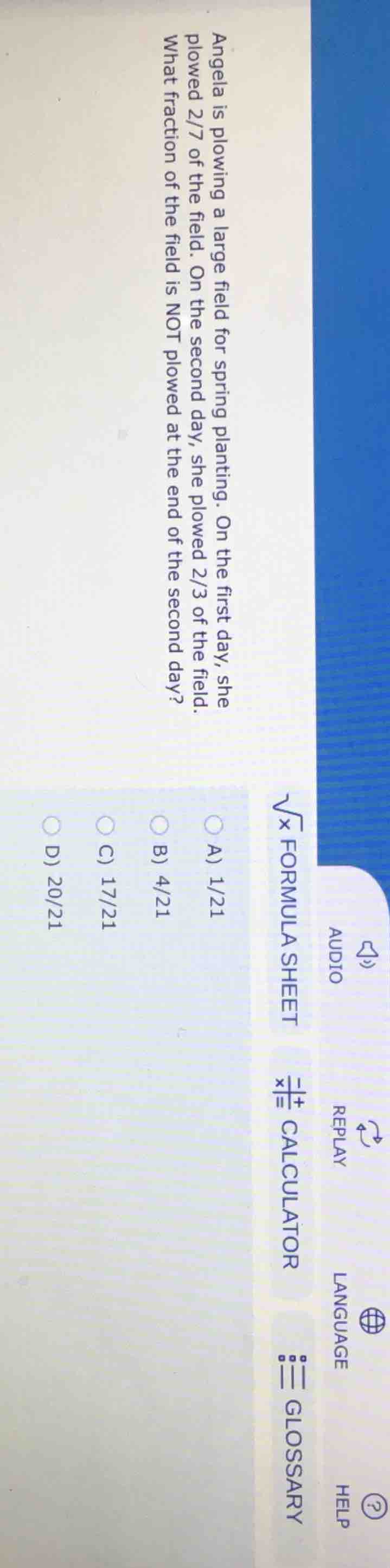
angela is plowing a large field for spring planting. on the first day, she plowed 2/7 of the field. on the second day, she plowed 2/3 of the field. what fraction of the field is not plowed at the end of the second day? a) 1/21 b) 4/21 c) 17/21 d) 20/21
Step1: Find total plowed fraction
First, find the sum of the fractions plowed on each day. The first day she plowed $\frac{2}{7}$, the second day $\frac{2}{3}$. To add these, find a common denominator (21). Convert $\frac{2}{7}$ to $\frac{6}{21}$ and $\frac{2}{3}$ to $\frac{14}{21}$. Then add: $\frac{6}{21}+\frac{14}{21}=\frac{20}{21}$.
Step2: Find unplowed fraction
The total field is 1 (or $\frac{21}{21}$). Subtract the plowed fraction from 1: $\frac{21}{21}-\frac{20}{21}=\frac{1}{21}$. Wait, no, wait—wait, no, the question is what fraction is NOT plowed. Wait, no, wait, did I miscalculate? Wait, first day: $\frac{2}{7}$, second day: $\frac{2}{3}$ of the remaining? No, wait, the problem says "on the second day, she plowed 2/3 of the field"—wait, no, re-reading: "On the first day, she plowed 2/7 of the field. On the second day, she plowed 2/3 of the field." Wait, no, that can't be, because 2/7 + 2/3 would be more than 1. Wait, maybe it's 2/3 of the remaining? Wait, the problem statement: "Angela is plowing a large field for spring planting. On the first day, she plowed 2/7 of the field. On the second day, she plowed 2/3 of the field. What fraction of the field is NOT plowed at the end of the second day?" Wait, that must be a misinterpretation. Wait, no, maybe it's 2/3 of the remaining field? Wait, the original problem—maybe the second day she plowed 2/3 of the remaining? Wait, the user's problem: "On the first day, she plowed 2/7 of the field. On the second day, she plowed 2/3 of the field." Wait, that would mean she plowed 2/7 + 2/3, but that's more than 1, which is impossible. So likely, it's 2/3 of the remaining field. Wait, maybe the problem was mistyped, but assuming the problem is as stated (maybe plowed 2/3 of the field each day? No, that can't be. Wait, no, let's check the answer options. The options include 1/21, 4/21, etc. So let's re-express:
Wait, maybe the second day she plowed 2/3 of the remaining field? Wait, no, the problem says "2/3 of the field". Wait, maybe it's a translation error, and it's 2/3 of the remaining. Let's assume that. So first day: plowed 2/7, remaining is 1 - 2/7 = 5/7. Second day: plowed 2/3 of 5/7, which is (2/3)*(5/7) = 10/21. Then total plowed: 2/7 + 10/21 = 6/21 + 10/21 = 16/21. Then unplowed: 1 - 16/21 = 5/21. But that's not an option. So maybe the problem is that on the second day, she plowed 2/3 of the field (not remaining). But that would be 2/7 + 2/3 = 6/21 + 14/21 = 20/21, so unplowed is 1 - 20/21 = 1/21, which is option A. Ah, that must be it. So the problem is that she plowed 2/7 on day 1, 2/3 on day 2 (of the entire field), so total plowed is 2/7 + 2/3. Then unplowed is 1 - (2/7 + 2/3).
So Step1: Calculate total plowed. Common denominator 21. 2/7 = 6/21, 2/3 = 14/21. Sum: 6/21 + 14/21 = 20/21.
Step2: Subtract from 1 (total field) to find unplowed: 1 - 20/21 = 1/21.

Snap & solve any problem in the app
Get step-by-step solutions on Sovi AI
Photo-based solutions with guided steps
Explore more problems and detailed explanations
A) 1/21