QUESTION IMAGE
Question
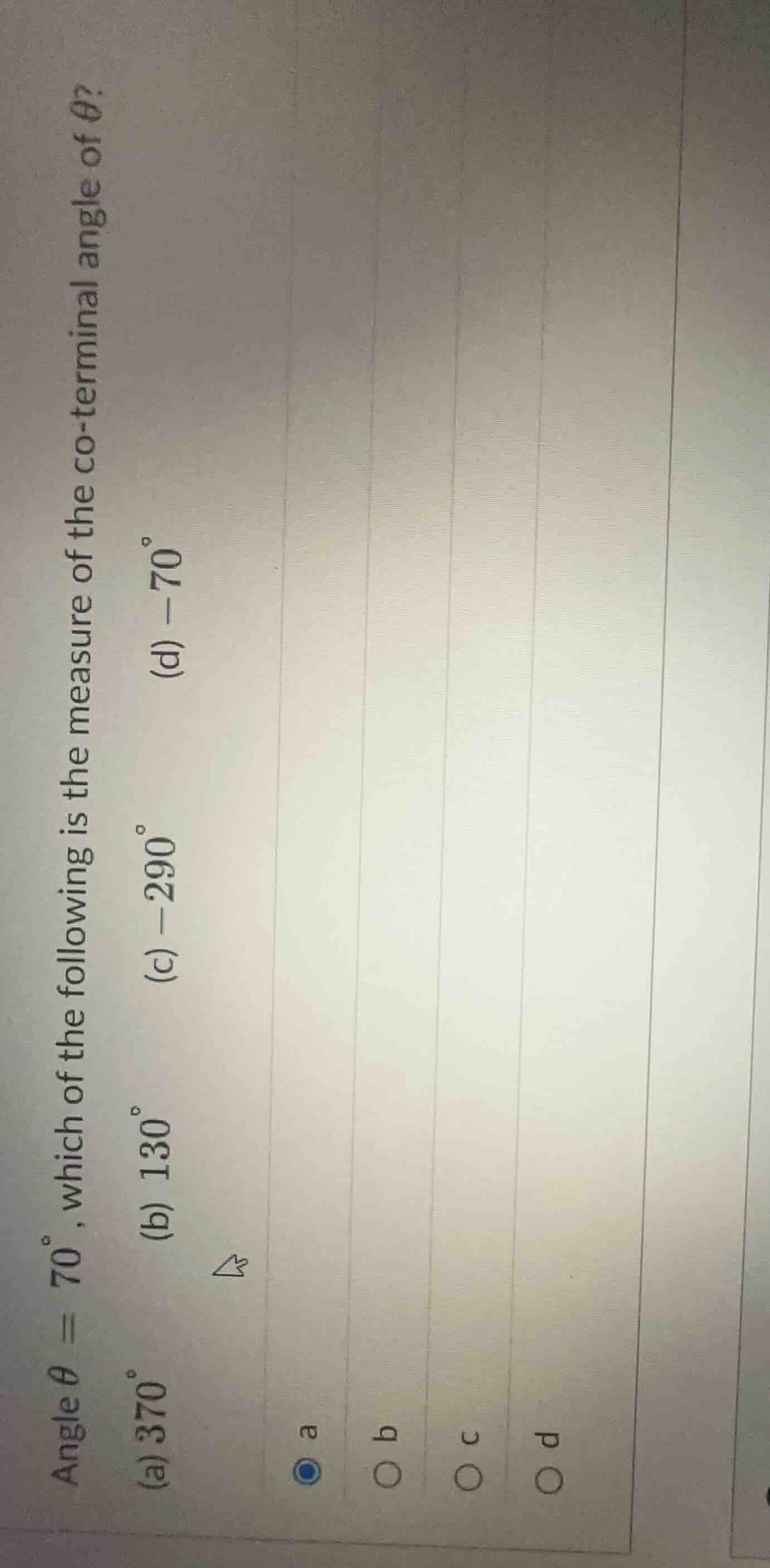
angle $\theta = 70^{\circ}$, which of the following is the measure of the co - terminal angle of $\theta$? (a) $370^{\circ}$ (b) $130^{\circ}$ (c) $- 290^{\circ}$ (d) $- 70^{\circ}$
Step1: Recall coterminal angle formula
Coterminal angles are found by adding or subtracting \(360^\circ\) (or \(2\pi\) radians) to the given angle. For an angle \(\theta\), a coterminal angle \(\alpha\) satisfies \(\alpha=\theta + 360^\circ n\), where \(n\in\mathbb{Z}\) (integer).
Step2: Check option (a)
Given \(\theta = 70^\circ\), for \(n = 1\), \(\alpha=70^\circ+ 360^\circ\times1=430^\circ\)? Wait, no, wait \(370^\circ-70^\circ = 300^\circ\)? Wait, no, let's recalculate. Wait, \(370^\circ- 360^\circ=10^\circ\)? No, wait, the formula is \(\alpha=\theta + 360n\). Let's check for each option:
For option (a): \(370^\circ\). Let's see if \(370^\circ-70^\circ=300^\circ\), not a multiple of \(360^\circ\). Wait, no, wait \(370^\circ=70^\circ + 300^\circ\)? No, that's wrong. Wait, \(70^\circ+360^\circ=430^\circ\), \(70^\circ - 360^\circ=- 290^\circ\). Wait, let's check each option:
Option (a): \(370^\circ\). Let's solve \(70 + 360n=370\). Then \(360n=370 - 70=300\), \(n=\frac{300}{360}=\frac{5}{6}\), not integer.
Option (b): \(130^\circ\). \(70+360n = 130\), \(360n = 60\), \(n=\frac{60}{360}=\frac{1}{6}\), not integer.
Option (c): \(- 290^\circ\). \(70+360n=-290\), \(360n=-290 - 70=-360\), \(n = - 1\), which is integer. So \(-290^\circ=70^\circ+360^\circ\times(- 1)\), so they are coterminal.
Option (d): \(-70^\circ\). \(70+360n=-70\), \(360n=-140\), \(n=\frac{-140}{360}=-\frac{7}{18}\), not integer.
Wait, but wait the initial check for option (a) was wrong. Wait, let's recalculate option (a): \(370^\circ-70^\circ = 300^\circ\), not multiple of \(360\). Option (c): \(-290^\circ-70^\circ=-360^\circ\), which is a multiple of \(360^\circ\) (since \(-360^\circ=360^\circ\times(- 1)\)). So \(-290^\circ\) and \(70^\circ\) are coterminal. But wait, the original problem's option (a) was marked, but maybe I made a mistake. Wait, no, \(70^\circ+360^\circ=430^\circ\), \(70^\circ-360^\circ=-290^\circ\). So \(-290^\circ\) is coterminal with \(70^\circ\). Wait, but let's check the options again.
Wait, the problem is: Angle \(\theta = 70^\circ\), which of the following is the measure of the coterminal angle of \(\theta\)?
Options:
(a) \(370^\circ\)
(b) \(130^\circ\)
(c) \(-290^\circ\)
(d) \(-70^\circ\)
Let's apply the formula \(\alpha=\theta + 360n\), \(n\in\mathbb{Z}\)
For (a): \(370 = 70+360n\Rightarrow360n = 300\Rightarrow n=\frac{5}{6}
otin\mathbb{Z}\)
For (b): \(130 = 70+360n\Rightarrow360n = 60\Rightarrow n=\frac{1}{6}
otin\mathbb{Z}\)
For (c): \(-290=70 + 360n\Rightarrow360n=-360\Rightarrow n = - 1\in\mathbb{Z}\)
For (d): \(-70=70+360n\Rightarrow360n=-140\Rightarrow n=-\frac{7}{18}
otin\mathbb{Z}\)
So the correct coterminal angle is \(-290^\circ\), which is option (c). Wait, but the original mark was on (a), maybe a mistake. Let's recheck:
Wait, \(370^\circ-360^\circ = 10^\circ\), not \(70^\circ\). Wait, maybe I misread the problem. Wait, maybe the angle is \(10^\circ\)? No, the problem says \(\theta = 70^\circ\). So according to the formula, \(-290^\circ\) is coterminal with \(70^\circ\) because \(70^\circ-360^\circ=-290^\circ\). So the correct answer is (c) \(-290^\circ\).
Wait, but let's check again: \(70^\circ+(-1)\times360^\circ=70^\circ - 360^\circ=-290^\circ\). Yes, that's correct. So the coterminal angle is \(-290^\circ\), so option (c).

Snap & solve any problem in the app
Get step-by-step solutions on Sovi AI
Photo-based solutions with guided steps
Explore more problems and detailed explanations
(c) \(-290^\circ\)