QUESTION IMAGE
Question
anisms obtain energy (continued)
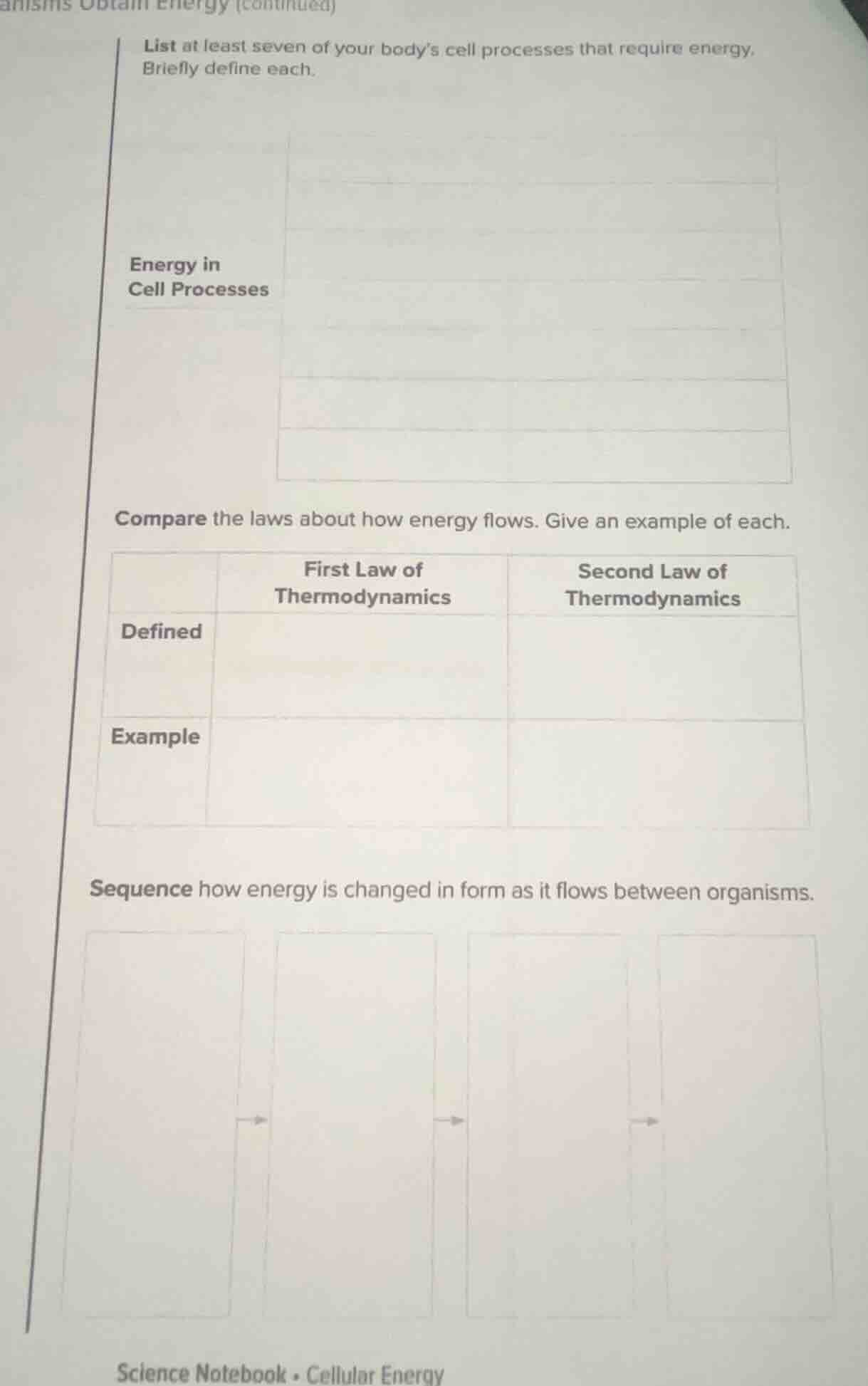
list at least seven of your body’s cell processes that require energy.
briefly define each.
energy in
cell processes
compare the laws about how energy flows. give an example of each.
\t\tfirst law of
\t\tthermodynamics\t\tsecond law of
\t\tthermodynamics
defined
example
sequence how energy is changed in form as it flows between organisms.
science notebook • cellular energy
Response
Part 1: List of Cell Processes Requiring Energy
- Active Transport: Movement of molecules (e.g., ions) across a cell membrane against their concentration gradient, requiring energy (ATP).
- Protein Synthesis: Process of creating proteins from amino acids, powered by ATP (involved in transcription and translation).
- Cell Division (Mitosis/Meiosis): Replication and division of a cell’s nucleus and cytoplasm, requiring energy for chromosome separation and membrane remodeling.
- Muscle Contraction: Shortening of muscle fibers (e.g., in skeletal or cardiac muscle) driven by ATP hydrolysis.
- Cellular Respiration (itself requires energy for early steps): Glycolysis (initial breakdown of glucose) uses ATP to prime reactions, though the overall process produces energy.
- DNA Replication: Copying of DNA during cell division, requiring ATP for enzyme activity (e.g., DNA polymerase) and unwinding the double helix.
- Signal Transduction: Transmission of chemical signals (e.g., hormones) into the cell, often involving ATP-dependent phosphorylation cascades.
Part 2: Comparing Laws of Thermodynamics
| First Law of Thermodynamics | Second Law of Thermodynamics | |
|---|---|---|
| Example | A light bulb transforms electrical energy into light and heat energy (total energy remains constant). | When wood burns, chemical energy becomes heat and ash—entropy increases as the organized wood becomes dispersed ash and heat. |
Part 3: Energy Flow Between Organisms (Sequence of Energy Transformation)
- Sunlight (Solar Energy): Captured by autotrophs (e.g., plants) during photosynthesis.
- Chemical Energy (Glucose): Plants convert solar energy into chemical energy stored in glucose (or starch).
- Chemical Energy (ATP/Organic Molecules): Herbivores (e.g., rabbits) eat plants, breaking down glucose via cellular respiration to produce ATP (usable energy) and heat.
- Chemical Energy (ATP/Organic Molecules): Carnivores (e.g., foxes) eat herbivores, using the stored chemical energy in their prey’s tissues for their own cellular processes.
- Heat Energy: At each transfer (plant → herbivore → carnivore), some energy is lost as heat (due to the Second Law of Thermodynamics), increasing entropy.
Key Takeaways
- Cell processes rely on ATP to drive work (e.g., transport, synthesis, movement).
- Thermodynamics explains energy conservation (First Law) and increasing disorder (Second Law) during transformations.
- Energy flows through ecosystems as sunlight → chemical energy in producers → chemical energy in consumers, with heat lost at each step.

Snap & solve any problem in the app
Get step-by-step solutions on Sovi AI
Photo-based solutions with guided steps
Explore more problems and detailed explanations
Part 1: List of Cell Processes Requiring Energy
- Active Transport: Movement of molecules (e.g., ions) across a cell membrane against their concentration gradient, requiring energy (ATP).
- Protein Synthesis: Process of creating proteins from amino acids, powered by ATP (involved in transcription and translation).
- Cell Division (Mitosis/Meiosis): Replication and division of a cell’s nucleus and cytoplasm, requiring energy for chromosome separation and membrane remodeling.
- Muscle Contraction: Shortening of muscle fibers (e.g., in skeletal or cardiac muscle) driven by ATP hydrolysis.
- Cellular Respiration (itself requires energy for early steps): Glycolysis (initial breakdown of glucose) uses ATP to prime reactions, though the overall process produces energy.
- DNA Replication: Copying of DNA during cell division, requiring ATP for enzyme activity (e.g., DNA polymerase) and unwinding the double helix.
- Signal Transduction: Transmission of chemical signals (e.g., hormones) into the cell, often involving ATP-dependent phosphorylation cascades.
Part 2: Comparing Laws of Thermodynamics
| First Law of Thermodynamics | Second Law of Thermodynamics | |
|---|---|---|
| Example | A light bulb transforms electrical energy into light and heat energy (total energy remains constant). | When wood burns, chemical energy becomes heat and ash—entropy increases as the organized wood becomes dispersed ash and heat. |
Part 3: Energy Flow Between Organisms (Sequence of Energy Transformation)
- Sunlight (Solar Energy): Captured by autotrophs (e.g., plants) during photosynthesis.
- Chemical Energy (Glucose): Plants convert solar energy into chemical energy stored in glucose (or starch).
- Chemical Energy (ATP/Organic Molecules): Herbivores (e.g., rabbits) eat plants, breaking down glucose via cellular respiration to produce ATP (usable energy) and heat.
- Chemical Energy (ATP/Organic Molecules): Carnivores (e.g., foxes) eat herbivores, using the stored chemical energy in their prey’s tissues for their own cellular processes.
- Heat Energy: At each transfer (plant → herbivore → carnivore), some energy is lost as heat (due to the Second Law of Thermodynamics), increasing entropy.
Key Takeaways
- Cell processes rely on ATP to drive work (e.g., transport, synthesis, movement).
- Thermodynamics explains energy conservation (First Law) and increasing disorder (Second Law) during transformations.
- Energy flows through ecosystems as sunlight → chemical energy in producers → chemical energy in consumers, with heat lost at each step.