QUESTION IMAGE
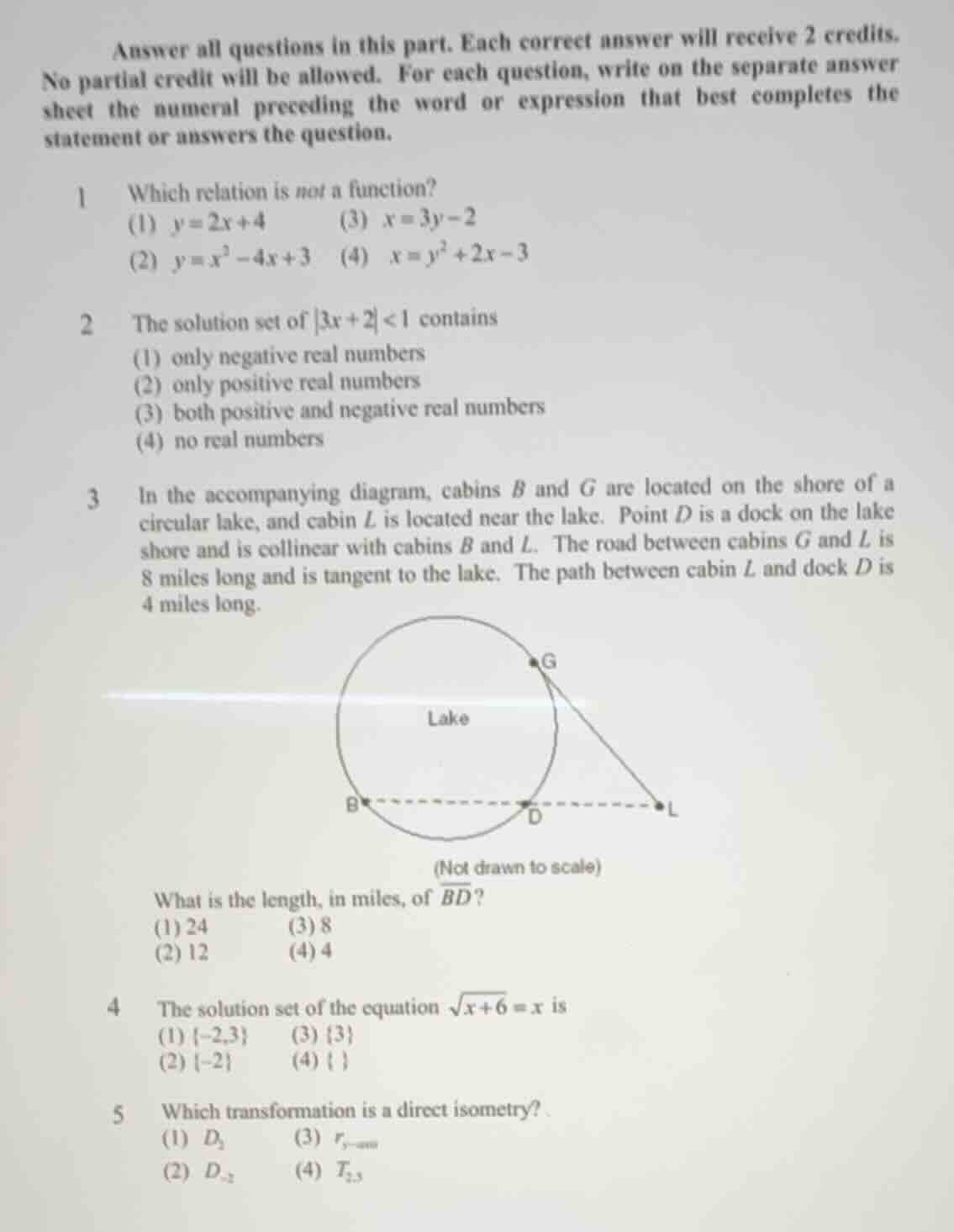
Question
answer all questions in this part. each correct answer will receive 2 credits. no partial credit will be allowed. for each question, write on the separate answer sheet the numeral preceding the word or expression that best completes the statement or answers the question.
1 which relation is not a function?
(1) $y = 2x + 4$ (3) $x = 3y - 2$
(2) $y = x^2 - 4x + 3$ (4) $x = y^2 + 2x - 3$
2 the solution set of $|3x + 2| < 1$ contains
(1) only negative real numbers
(2) only positive real numbers
(3) both positive and negative real numbers
(4) no real numbers
3 in the accompanying diagram, cabins $b$ and $g$ are located on the shore of a circular lake, and cabin $l$ is located near the lake. point $d$ is a dock on the lake shore and is collinear with cabins $b$ and $l$. the road between cabins $g$ and $l$ is 8 miles long and is tangent to the lake. the path between cabin $l$ and dock $d$ is 4 miles long.
(not drawn to scale)
what is the length, in miles, of $overline{bd}$?
(1) 24 (3) 8
(2) 12 (4) 4
4 the solution set of the equation $sqrt{x + 6} = x$ is
(1) ${-2, 3}$ (3) ${3}$
(2) ${-2}$ (4) ${}$
5 which transformation is a direct isometry?
(1) $d_2$ (3) $r_{y - axis}$
(2) $d_{-2}$ (4) $t_{2, 3}$
Question 1
Step1: Recall the definition of a function
A relation is a function if for every input \( x \), there is exactly one output \( y \). We can use the vertical line test (for equations in terms of \( x \) and \( y \)) or analyze the equations.
Step2: Analyze each option
- Option (1): \( y = 2x + 4 \) is a linear equation. For every \( x \), there is one \( y \). So it's a function.
- Option (2): \( y = x^2 - 4x + 3 \) is a quadratic equation. For every \( x \), there is one \( y \). So it's a function.
- Option (3): \( x = 3y - 2 \) can be rewritten as \( y=\frac{x + 2}{3}\), which is a linear equation. For every \( x \), there is one \( y \). So it's a function.
- Option (4): \( x=y^{2}+2x - 3\) can be rewritten as \(x-2x=y^{2}- 3\), i.e., \(-x=y^{2}-3\) or \(y^{2}=-x + 3\). For a given \( x \) (such that \(-x + 3\geq0\) or \(x\leq3\)), there are two values of \( y \) (positive and negative square roots). So it does not pass the vertical line test and is not a function.
Step1: Solve the absolute - value inequality \(|3x + 2|\lt1\)
The absolute - value inequality \(|a|\lt b\) (where \(b\gt0\)) is equivalent to \(-b\lt a\lt b\). So for \(|3x + 2|\lt1\), we have \(-1\lt3x + 2\lt1\).
Step2: Solve the compound inequality
First, solve the left - hand side: \(-1\lt3x + 2\)
Subtract 2 from both sides: \(-1-2\lt3x\), so \(-3\lt3x\), then divide by 3: \(-1\lt x\)
Then, solve the right - hand side: \(3x + 2\lt1\)
Subtract 2 from both sides: \(3x\lt1 - 2=-1\), then divide by 3: \(x\lt-\frac{1}{3}\)
So the solution is \(-1\lt x\lt-\frac{1}{3}\), which are all negative real numbers.
Step1: Recall the tangent - secant rule
If a tangent from an external point \(L\) touches a circle at \(G\) and a secant from \(L\) passes through the circle, intersecting the circle at \(D\) and \(B\) (with \(LD\) as the external segment and \(LB\) as the secant segment), then the square of the length of the tangent segment is equal to the product of the length of the external segment and the length of the entire secant segment. That is, \(LG^{2}=LD\times LB\). Let \(BD = x\). Then \(LB=LD + DB=4 + x\), \(LG = 8\) and \(LD = 4\).
Step2: Apply the tangent - secant formula
We know that \(LG^{2}=LD\times LB\). Substitute \(LG = 8\), \(LD = 4\) and \(LB=4 + x\) into the formula:
\(8^{2}=4\times(4 + x)\)
\(64 = 16+4x\)
Step3: Solve for \(x\)
Subtract 16 from both sides: \(64-16=4x\)
\(48 = 4x\)
Divide both sides by 4: \(x = 12\)

Snap & solve any problem in the app
Get step-by-step solutions on Sovi AI
Photo-based solutions with guided steps
Explore more problems and detailed explanations
4