QUESTION IMAGE
Question
answer the following questions.
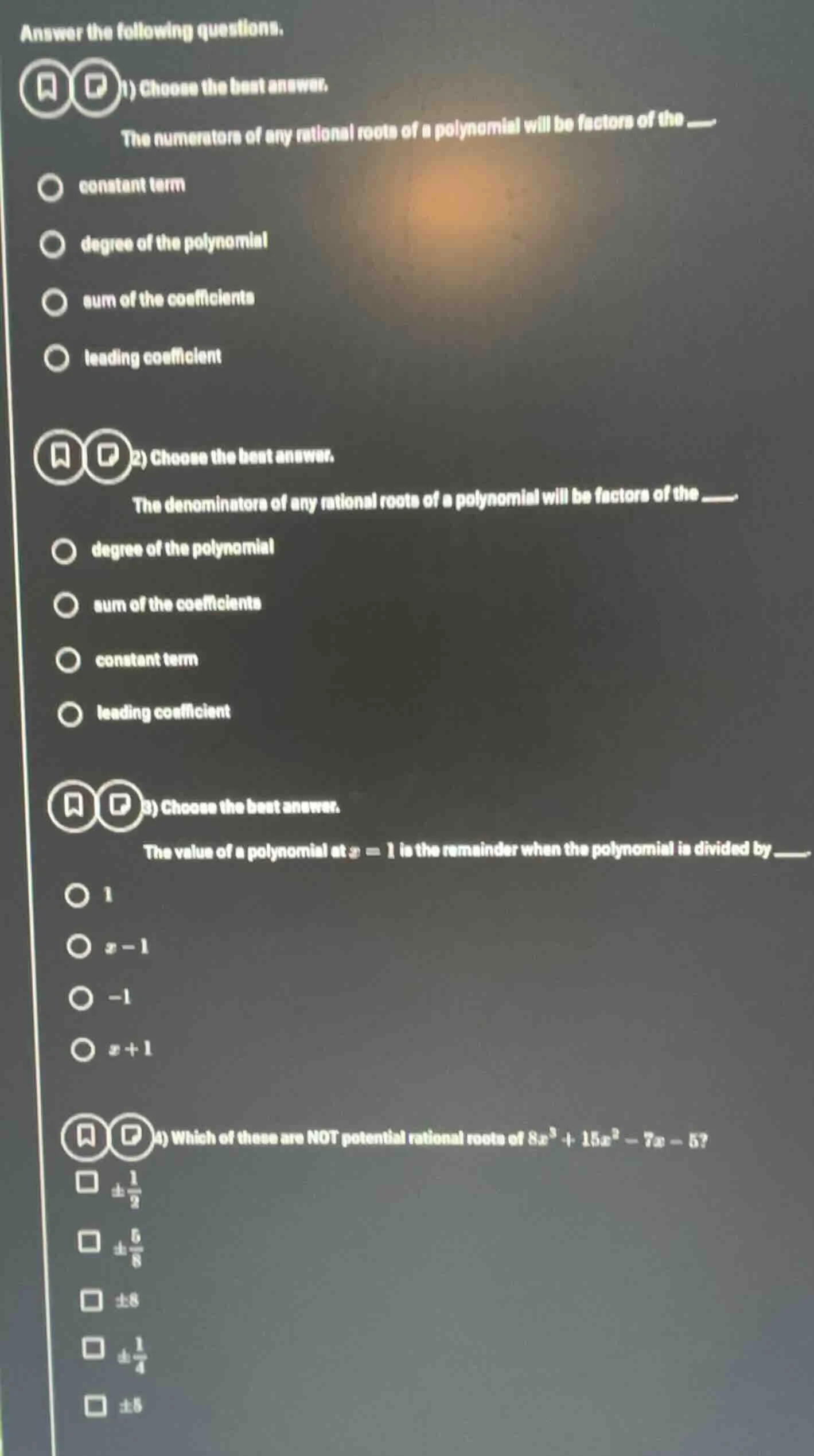
- choose the best answer.
the numerators of any rational roots of a polynomial will be factors of the ____.
constant term
degree of the polynomial
sum of the coefficients
leading coefficient
- choose the best answer.
the denominators of any rational roots of a polynomial will be factors of the ____.
degree of the polynomial
sum of the coefficients
constant term
leading coefficient
- choose the best answer.
the value of a polynomial at ( x = 1 ) is the remainder when the polynomial is divided by ____.
1
( x - 1 )
-1
( x + 1 )
- which of these are not potential rational roots of ( 8x^3 + 15x^2 - 7x - 5 )?
( pm \frac{1}{2} )
( pm \frac{5}{8} )
( pm 8 )
( pm \frac{1}{4} )
( pm 5 )
Brief Explanations
- By the Rational Root Theorem, rational roots' numerators are factors of the polynomial's constant term.
- By the Rational Root Theorem, rational roots' denominators are factors of the polynomial's leading coefficient.
- By the Remainder Theorem, the remainder of dividing a polynomial by $x-a$ is the polynomial's value at $x=a$. For $a=1$, the divisor is $x-1$.
- Using the Rational Root Theorem for $8x^3 + 15x^2 -7x -5$, potential rational roots are $\pm\frac{\text{factors of 5}}{\text{factors of 8}}$. $\pm8$ has a numerator that is not a factor of the constant term 5, so it is not a potential root.

Snap & solve any problem in the app
Get step-by-step solutions on Sovi AI
Photo-based solutions with guided steps
Explore more problems and detailed explanations
- constant term
- leading coefficient
- $x-1$
- $\pm8$