QUESTION IMAGE
Question
answer the questions below.
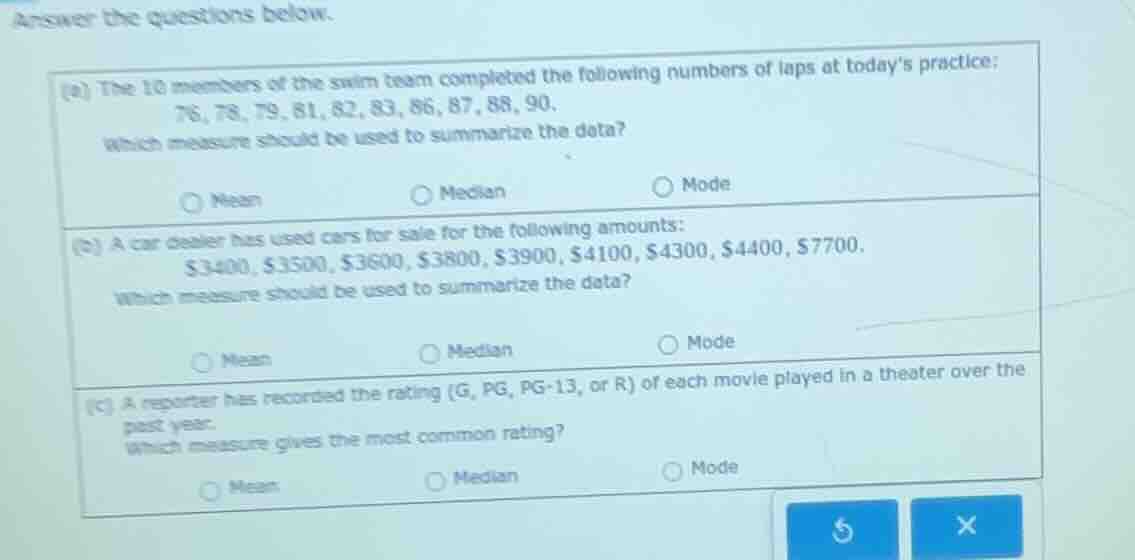
(a) the 10 members of the swim team completed the following numbers of laps at todays practice:
76, 78, 79, 81, 82, 83, 86, 87, 88, 90.
which measure should be used to summarize the data?
mean \t median \t mode
(b) a car dealer has used cars for sale for the following amounts:
$3400, $3500, $3600, $3800, $3900, $4100, $4300, $4400, $7700.
which measure should be used to summarize the data?
mean \t median \t mode
(c) a reporter has recorded the rating (g, pg, pg - 13, or r) of each movie played in a theater over the past year.
which measure gives the most common rating?
mean \t median \t mode
Part (a)
The data for the swim team's laps (76, 78, 79, 81, 82, 83, 86, 87, 88, 90) has no extreme outliers and is relatively symmetric. The mean is a good measure here as it takes all values into account and the data is balanced. Alternatively, median could also be used, but since there's no skew, mean is appropriate. However, let's check: the data is ordered, no repeated values (mode not useful). Mean or median. But in this case, since data is symmetric, mean is fine. Wait, actually, for symmetric data without outliers, mean is suitable. But let's confirm: the values are evenly spread? Let's see the differences: 78-76=2, 79-78=1, 81-79=2, 82-81=1, 83-82=1, 86-83=3, 87-86=1, 88-87=1, 90-88=2. Not perfectly symmetric, but no extreme outlier. So mean can be used. But wait, the options are mean, median, mode. Mode: no repeated values, so mode is not applicable. So between mean and median. But in this case, since there's no outlier, mean is a good summary. Alternatively, median is also good for ordered data. Wait, maybe the intended answer is mean? Wait, no, let's check the data again. Wait, the data has 10 values, so median is the average of the 5th and 6th values: (82 + 83)/2 = 82.5. Mean would be (76+78+79+81+82+83+86+87+88+90)/10. Let's calculate: 76+78=154, +79=233, +81=314, +82=396, +83=479, +86=565, +87=652, +88=740, +90=830. Mean=830/10=83. So mean is 83, median is 82.5. Since data is not extremely skewed, mean is appropriate. So the measure to use is Mean (or Median, but let's see the options. Wait, maybe the answer is Mean? Wait, no, maybe I made a mistake. Wait, the data is ordered, no outliers, so mean is suitable. But let's check the options. The options are Mean, Median, Mode. Mode has no value (all unique), so Mode is out. So between Mean and Median. In this case, since the data is relatively symmetric, Mean is a good choice.
The car prices are $3400, $3500, $3600, $3800, $3900, $4100, $4300, $4400, $7700. Here, $7700 is an extreme outlier (much higher than the others). The mean is affected by outliers, so the median is a better measure as it is resistant to outliers. The mode: no repeated prices, so Mode is out. So Median should be used.
The data is the rating of movies (G, PG, PG - 13, R), which are categorical (nominal) data. The mode is the measure that gives the most common value (frequency), which is suitable for categorical data. Mean and Median are not applicable here as they require numerical data. So Mode should be used.

Snap & solve any problem in the app
Get step-by-step solutions on Sovi AI
Photo-based solutions with guided steps
Explore more problems and detailed explanations
Mean