QUESTION IMAGE
Question
apply: circle problem #8
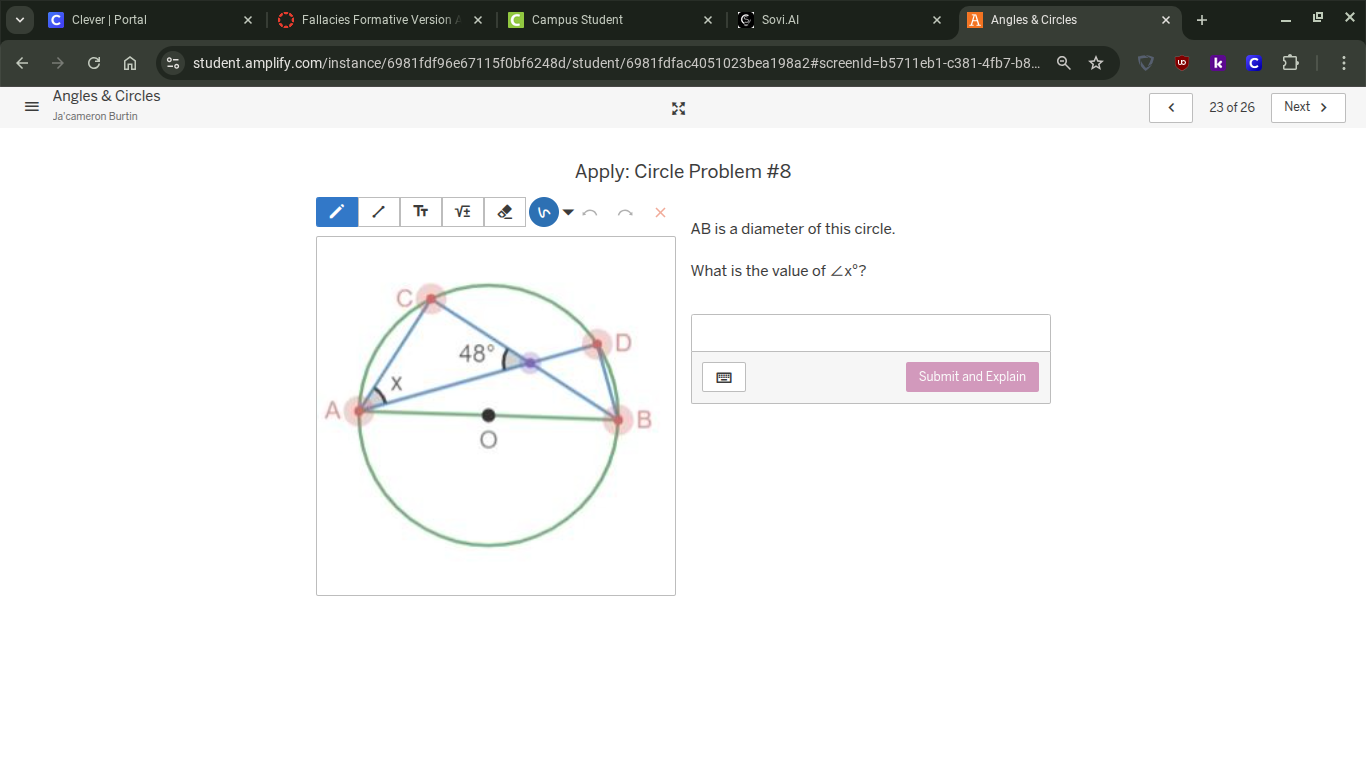
ab is a diameter of this circle.
what is the value of $\angle x^\circ$?
Step1: Recall circle theorems
We know that angles subtended by the same arc are equal, and the angle subtended by a diameter is a right angle ($90^\circ$) in a circle (Thales' theorem). Also, in a triangle, the sum of angles is $180^\circ$. The triangle formed with the diameter as one side is a right triangle, but here we also have a vertical angle or related angle. Wait, actually, the angle between the chords: the angle at the center and the angle at the circumference. Wait, the given angle is $48^\circ$ (probably a central angle or vertical angle). Wait, let's think again. The triangle $ABC$: $AB$ is diameter, so $\angle ACB = 90^\circ$ (Thales' theorem). But also, the angle between the chords: the angle $x$ and the $48^\circ$ angle. Wait, maybe the triangle has angles: in the triangle with the $48^\circ$ angle, and since $AB$ is diameter, $\angle CAB = x$, and we can find $x$ as $90^\circ - 48^\circ$? Wait, no. Wait, the angle between the radius and chord? Wait, maybe the triangle is isoceles? Wait, no. Wait, let's see: the angle given is $48^\circ$, and we need to find $x$. Since $AB$ is diameter, $\angle ACB = 90^\circ$. Then, in the triangle, if one angle is $48^\circ$, and the right angle, then $x = 90^\circ - 48^\circ = 42^\circ$? Wait, no, maybe the other way. Wait, the angle at $A$: $x$, and the angle opposite? Wait, maybe the angle between the chord $AD$ and $AC$: the vertical angle is $48^\circ$, and since $AB$ is diameter, $\angle ADB = 90^\circ$? No, maybe the triangle is a right triangle, and the angle $x$ is complementary to $48^\circ$. Wait, let's do it step by step.
Step2: Use Thales' theorem and angle sum
Thales' theorem states that an angle inscribed in a semicircle is a right angle. So $\angle ACB = 90^\circ$ (since $AB$ is diameter, so arc $AB$ is a semicircle, and $\angle ACB$ is inscribed in it). Now, in triangle $ACB$, we have a right angle at $C$. Now, the angle at the center or the angle between the chords: the angle given is $48^\circ$, which is probably equal to the angle opposite or related. Wait, maybe the triangle has angles: $\angle CAB = x$, $\angle ABC = 48^\circ$, and $\angle ACB = 90^\circ$. Then, sum of angles in a triangle is $180^\circ$, so $x + 48^\circ + 90^\circ = 180^\circ$? No, that would be $x = 180 - 90 - 48 = 42^\circ$. Wait, yes! Because in triangle $ACB$, $\angle ACB = 90^\circ$ (Thales' theorem), one angle is $48^\circ$ (let's say $\angle ABC = 48^\circ$), then $\angle CAB = x = 180^\circ - 90^\circ - 48^\circ = 42^\circ$? Wait, no, that would be if $\angle ABC = 48^\circ$. But maybe the angle given is $\angle AOC = 48^\circ$ (central angle), but no, the diagram shows a $48^\circ$ angle at the intersection of chords. Wait, maybe the angle between the chord $AC$ and $AD$ is $48^\circ$, and since $AB$ is diameter, $\angle ADB = 90^\circ$, but no. Wait, the correct approach: in a circle, the angle subtended by a diameter is a right angle (Thales' theorem), so $\angle ACB = 90^\circ$. Then, in triangle $ACB$, the sum of angles is $180^\circ$. If one of the other angles is $48^\circ$, then $x = 90^\circ - 48^\circ = 42^\circ$? Wait, no, $90 + 48 + x = 180$ => $x = 180 - 138 = 42$. Yes, that makes sense. So $x = 42^\circ$.

Snap & solve any problem in the app
Get step-by-step solutions on Sovi AI
Photo-based solutions with guided steps
Explore more problems and detailed explanations
42