QUESTION IMAGE
Question
applying what you have learned
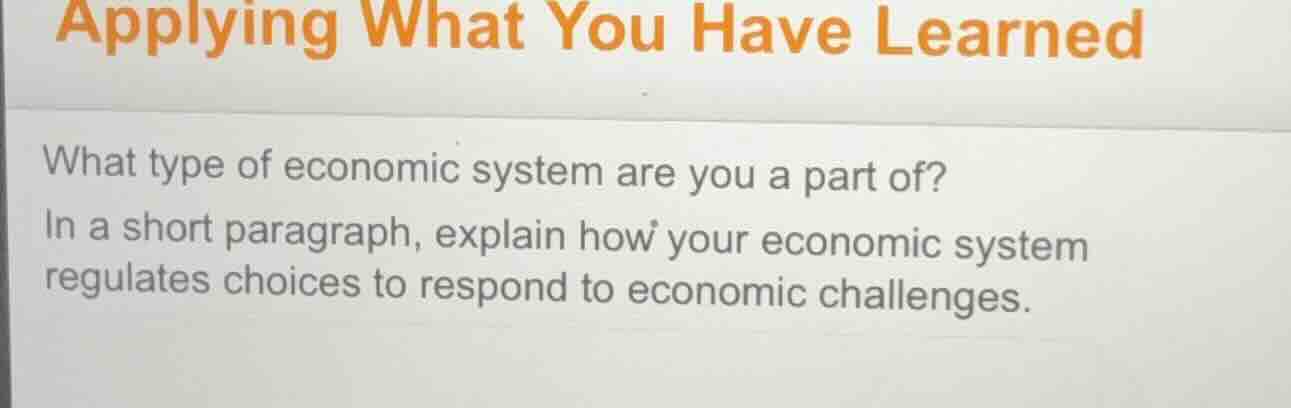
what type of economic system are you a part of?
in a short paragraph, explain how your economic system
regulates choices to respond to economic challenges.
Most individuals are part of a mixed economic system (like in many countries, e.g., the US or UK). In a mixed economy, both the government and market forces regulate choices. The market, through supply and demand, drives production and pricing for most goods/services, allowing businesses and consumers to make choices based on self - interest. The government steps in to address market failures (e.g., providing public goods like infrastructure, regulating monopolies to ensure fair competition, and implementing fiscal/monetary policies during recessions or inflation). For example, during an economic downturn, the government may increase spending (fiscal policy) or lower interest rates (monetary policy) to stimulate demand, while the market still determines the allocation of most resources in normal times. This combination helps balance efficiency and equity, responding to challenges like unemployment, inflation, and inequality.

Snap & solve any problem in the app
Get step-by-step solutions on Sovi AI
Photo-based solutions with guided steps
Explore more problems and detailed explanations
I am part of a mixed economic system. In this system, market forces (supply and demand) largely drive the production, pricing, and distribution of most goods and services, allowing businesses and consumers to make choices based on self - interest. However, the government also plays a crucial role. It regulates industries to ensure fair competition (e.g., anti - monopoly laws), provides public goods like infrastructure and education, and uses fiscal (e.g., tax and spending policies) and monetary (e.g., interest rate adjustments) policies to address economic challenges. For instance, during a recession, the government may increase spending to create jobs and stimulate demand, while in times of high inflation, it might raise interest rates to reduce borrowing and spending. This blend of market freedom and government intervention helps balance efficiency, equity, and stability, enabling the system to respond to issues like unemployment, inflation, and resource scarcity.