QUESTION IMAGE
Question
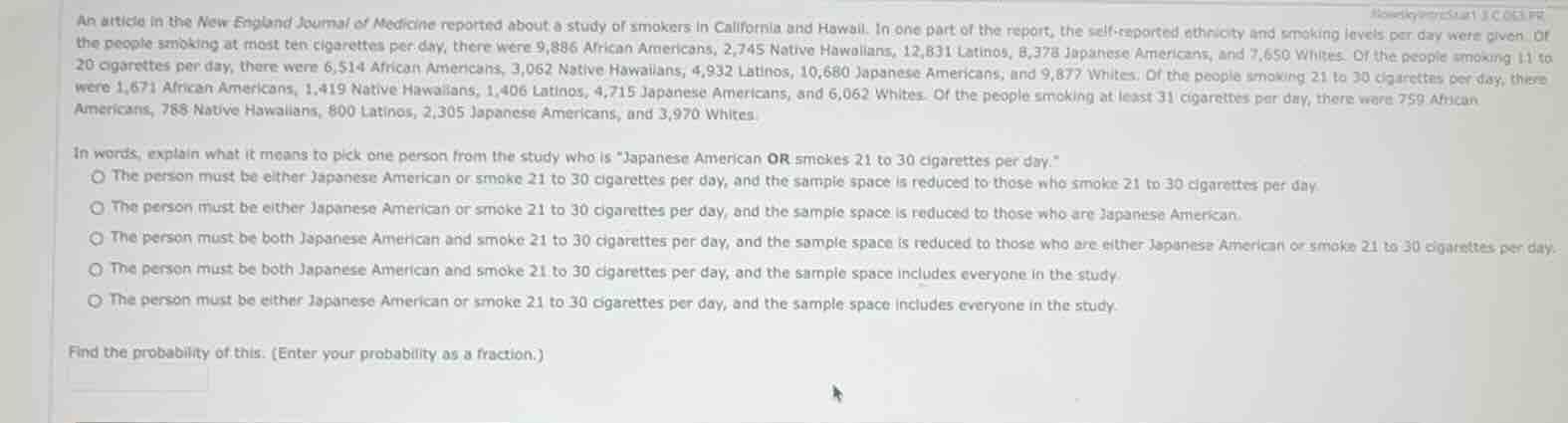
an article in the new england journal of medicine reported about a study of smokers in california and hawaii. in one part of the report, the self - reported ethnicity and smoking levels per day were given. of the people smoking at most ten cigarettes per day, there were 9,886 african americans, 2,745 native hawaiians, 12,831 latinos, 8,378 japanese americans, and 7,650 whites. of the people smoking 11 to 20 cigarettes per day, there were 6,514 african americans, 3,062 native hawaiians, 4,932 latinos, 10,680 japanese americans, and 9,877 whites. of the people smoking 21 to 30 cigarettes per day, there were 1,671 african americans, 1,419 native hawaiians, 1,406 latinos, 4,715 japanese americans, and 6,062 whites. of the people smoking at least 31 cigarettes per day, there were 759 african americans, 788 native hawaiians, 800 latinos, 2,305 japanese americans, and 3,970 whites.
in words, explain what it means to pick one person from the study who is \japanese american or smokes 21 to 30 cigarettes per day.\
○ the person must be either japanese american or smoke 21 to 30 cigarettes per day, and the sample space is reduced to those who smoke 21 to 30 cigarettes per day.
○ the person must be either japanese american or smoke 21 to 30 cigarettes per day, and the sample space is reduced to those who are japanese american.
○ the person must be both japanese american and smoke 21 to 30 cigarettes per day, and the sample space is reduced to those who are either japanese american or smoke 21 to 30 cigarettes per day.
○ the person must be both japanese american and smoke 21 to 30 cigarettes per day, and the sample space includes everyone in the study.
○ the person must be either japanese american or smoke 21 to 30 cigarettes per day, and the sample space includes everyone in the study.
find the probability of this. (enter your probability as a fraction.)
Part 1: Interpreting "Japanese American OR smokes 21 to 30 cigarettes per day"
- The logical "OR" in set theory (and probability) means the event includes elements (people here) that satisfy either of the two conditions (being Japanese American, smoking 21 - 30 cigarettes per day, or both).
- The sample space for a probability involving any person in the study (since we are picking one person from the entire study) includes all participants.
- Let's analyze each option:
- Option 1: Incorrect. The sample space isn't reduced to just 21 - 30 smokers; it's all in the study.
- Option 2: Incorrect. The sample space isn't reduced to just Japanese Americans; it's all in the study.
- Option 3: Incorrect. "OR" is not "AND"; "OR" includes either or both, and the sample space is the entire study, not a subset of "either Japanese American or 21 - 30 smokers".
- Option 4: Incorrect. "OR" is not "AND"; this misdefines "OR" as "AND".
- Option 5: Correct. "OR" means the person is Japanese American, or smokes 21 - 30 cigarettes per day, or both. The sample space is everyone in the study (since we pick from the entire study).

Snap & solve any problem in the app
Get step-by-step solutions on Sovi AI
Photo-based solutions with guided steps
Explore more problems and detailed explanations
The person must be either Japanese American or smoke 21 to 30 cigarettes per day, and the sample space includes everyone in the study. (The last option in the list: "The person must be either Japanese American or smoke 21 to 30 cigarettes per day, and the sample space includes everyone in the study.")
Part 2: Calculating the Probability
First, we need to find the number of people who are Japanese American OR smoke 21 to 30 cigarettes per day. We use the principle of inclusion - exclusion: \( n(A \cup B)=n(A)+n(B)-n(A \cap B) \), where:
- \( A \): event of being Japanese American
- \( B \): event of smoking 21 - 30 cigarettes per day
Step 1: Calculate \( n(A) \) (number of Japanese Americans)
We sum Japanese Americans across all smoking levels:
- At most 10: \( 8,378 \)
- 11 - 20: \( 10,680 \)
- 21 - 30: \( 4,715 \)
- At least 31: \( 2,305 \)
\( n(A)=8378 + 10680+4715 + 2305=8378+10680 = 19058; 19058+4715 = 23773; 23773+2305 = 26078 \)
Step 2: Calculate \( n(B) \) (number of people smoking 21 - 30 cigarettes per day)
We sum all ethnicities in the 21 - 30 category:
\( 1,671+1,419 + 1,406+4,715+6,062 \)
\( 1671+1419 = 3090; 3090+1406 = 4496; 4496+4715 = 9211; 9211+6062 = 15273 \)
Step 3: Calculate \( n(A \cap B) \) (number of Japanese Americans smoking 21 - 30 cigarettes per day)
From the data, this is \( 4,715 \)
Step 4: Calculate \( n(A \cup B) \)
Using inclusion - exclusion:
\( n(A \cup B)=n(A)+n(B)-n(A \cap B)=26078+15273 - 4715 \)
\( 26078+15273 = 41351; 41351-4715 = 36636 \)
Step 5: Calculate the total number of people in the study (\( N \))
We sum all ethnicities across all smoking levels:
- At most 10 cigarettes per day: \( 9,886+2,745 + 12,831+8,378+7,650 \)
\( 9886+2745 = 12631; 12631+12831 = 25462; 25462+8378 = 33840; 33840+7650 = 41490 \)
- 11 - 20 cigarettes per day: \( 6,514+3,062 + 4,932+10,680+9,877 \)
\( 6514+3062 = 9576; 9576+4932 = 14508; 14508+10680 = 25188; 25188+9877 = 35065 \)
- 21 - 30 cigarettes per day: \( 15273 \) (calculated earlier)
- At least 31 cigarettes per day: \( 759+788 + 800+2,305+3,970 \)
\( 759+788 = 1547; 1547+800 = 2347; 2347+2305 = 4652; 4652+3970 = 8622 \)
Total \( N = 41490+35065+15273+8622 \)
\( 41490+35065 = 76555; 76555+15273 = 91828; 91828+8622 = 100450 \)
Step 6: Calculate the probability \( P(A \cup B)=\frac{n(A \cup B)}{N}=\frac{36636}{100450} \)
Simplify the fraction: divide numerator and denominator by 2: \( \frac{18318}{50225} \) (check if further simplification is possible; GCD of 18318 and 50225: GCD(18318,50225). Let's check: 50225 ÷ 18318 = 2 with remainder 13589; 18318 ÷ 13589 = 1 with remainder 4729; 13589 ÷ 4729 = 2 with remainder 4131; 4729 ÷ 4131 = 1 with remainder 598; 4131 ÷ 598 = 6 with remainder 543; 598 ÷ 543 = 1 with remainder 55; 543 ÷ 55 = 9 with remainder 48; 55 ÷ 48 = 1 with remainder 7; 48 ÷ 7 = 6 with remainder 6; 7 ÷ 6 = 1 with remainder 1; 6 ÷ 1 = 6 with remainder 0. So GCD is 1. So the simplified fraction is \( \frac{18318}{50225} \) or as a decimal approximately 0.3645, but as a fraction, \( \frac{36636}{100450}=\frac{18318}{50225} \)