QUESTION IMAGE
Question
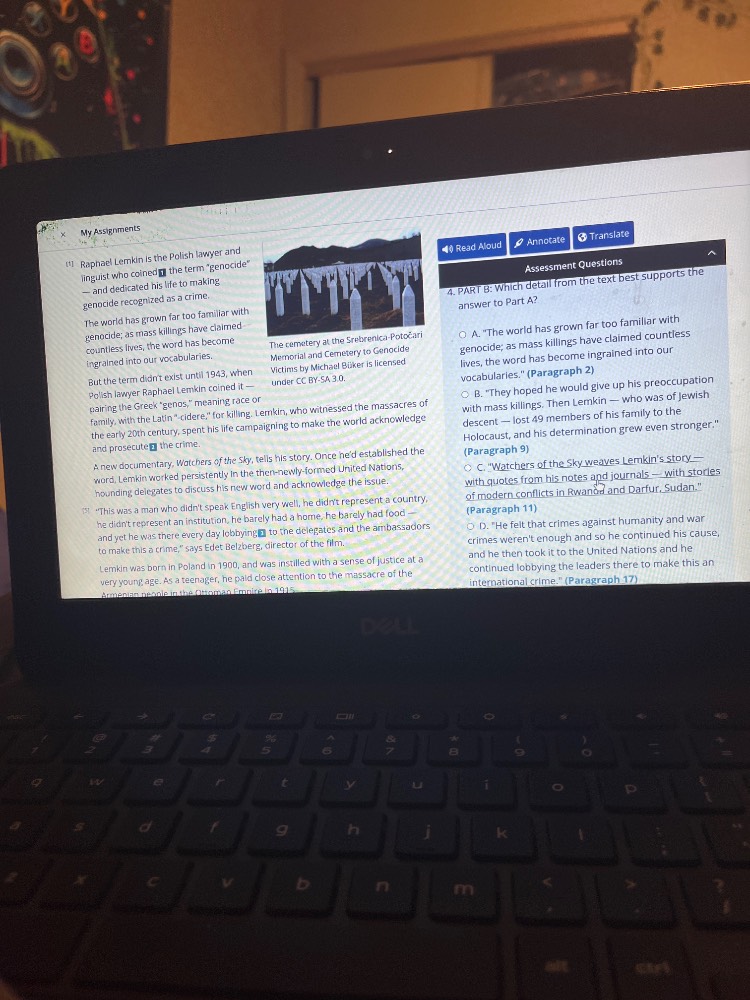
my assignments(1) raphael lemkin is the polish lawyer and linguist who coined the term \genocide\ and dedicated his life to making genocide recognized as a crime.the world has grown far too familiar with genocide, as mass killings have claimed countless lives, the word has become ingrained into our vocabularies.but the term didnt exist until 1943, when polish lawyer raphael lemkin coined it - pairing the greek \genos,\ meaning race or family, with the latin \cidere\ for killing. lemkin, who witnessed the massacres of the early 20th century, spent his life campaigning to make the world acknowledge and prosecute the crime.a new documentary, watchers of the sky, tells his story. once hed established the word, lemkin worked persistently in the then-recently formed united nations, hounding delegates to discuss his new word and acknowledge the issue.(2) \this was a man who didnt speak english very well, he didnt represent a country, he didnt represent an institution, he barely had a home, he barely had food and yet he was there every day lobbying to the delegates and the ambassadors to make this a crime,\ says edet belzberg, director of the film.lemkin was born in poland in 1900, and was instilled with a sense of justice at a very young age. as a teenager, he paid close attention to the massacre of the armenian people in the ottoman empire in 1915.the cemetery at the srebrenica-potočari memorial and cemetery to genocide victims by michael biker is licensed under cc by-sa 3.0.assessment questions4. part b: which detail from the text best supports the answer to part a?○ a. \the world has grown far too familiar with genocide, as mass killings have claimed countless lives, the word has become ingrained into our vocabularies.\ (paragraph 2)○ b. \they hoped he would give up his preoccupation with mass killings. then lemkin — who was of jewish descent — lost 49 members of his family to the holocaust, and his determination grew even stronger.\ (paragraph 9)○ c. \watchers of the sky weaves lemkins story— with quotes from his notes and journals — with stories of modern conflicts in rwanda and darfur, sudan.\ (paragraph 11)○ d. \he felt that crimes against humanity and war crimes werent enough and so he continued his cause, and he then took it to the united nations and he continued lobbying the leaders there to make this an international crime.\ (paragraph 17)
To determine which detail supports the answer to Part A (implied to be about Raphael Lemkin's dedication to establishing genocide as an international crime), we analyze each option:
- Option A describes general familiarity with genocide, not Lemkin's efforts.
- Option B focuses on his personal motivation but not his active work to create the crime classification.
- Option C explains how a documentary tells his story, not his direct actions to achieve his goal.
- Option D explicitly states that Lemkin continued his cause after existing crimes were insufficient, and lobbied UN leaders to make genocide an international crime, directly supporting the core of his life's work.

Snap & solve any problem in the app
Get step-by-step solutions on Sovi AI
Photo-based solutions with guided steps
Explore more problems and detailed explanations
D. "He felt that crimes against humanity and war crimes weren't enough and so he continued his cause, and he then took it to the United Nations and he continued lobbying the leaders there to make this an international crime." (Paragraph 17)