QUESTION IMAGE
Question
ate the converse used
7.
converse: _______________
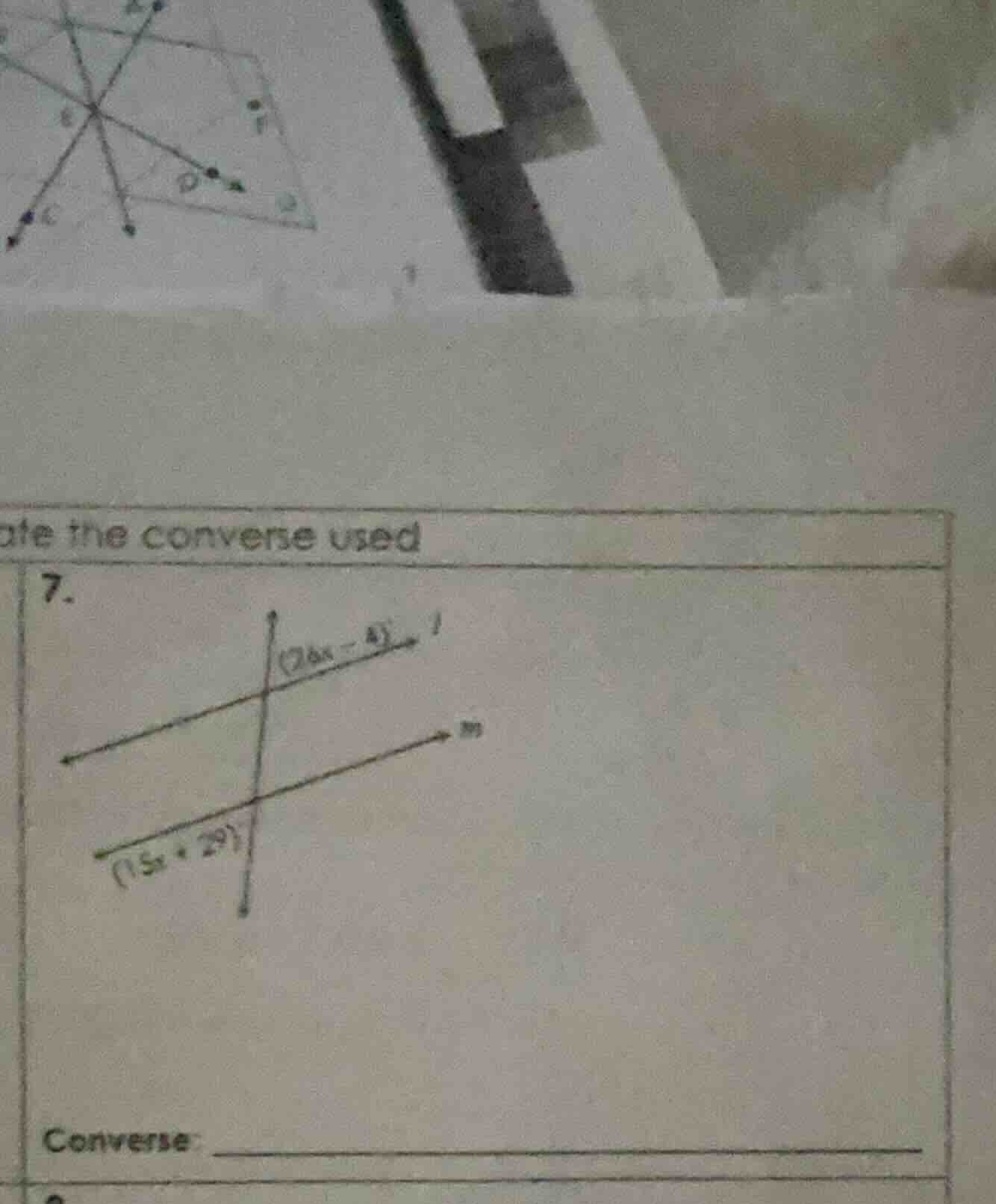
Step1: Identify the relationship
The angles \((26x - 4)^\circ\) and \((15x + 29)^\circ\) are corresponding angles (since lines \(l\) and \(m\) are parallel, and the transversal creates corresponding angles). For parallel lines, corresponding angles are equal. So we set the two expressions equal:
\(26x - 4 = 15x + 29\)
Step2: Solve for \(x\)
Subtract \(15x\) from both sides:
\(26x - 15x - 4 = 15x - 15x + 29\)
\(11x - 4 = 29\)
Add 4 to both sides:
\(11x - 4 + 4 = 29 + 4\)
\(11x = 33\)
Divide both sides by 11:
\(x = \frac{33}{11}\)
\(x = 3\)
Step3: Find the converse
The converse of the Corresponding Angles Theorem states that if two lines are cut by a transversal and the corresponding angles are congruent, then the lines are parallel. Here, we used the fact that if \(l \parallel m\), corresponding angles are equal (theorem), and the converse would be used to prove \(l \parallel m\) if corresponding angles are equal.

Snap & solve any problem in the app
Get step-by-step solutions on Sovi AI
Photo-based solutions with guided steps
Explore more problems and detailed explanations
The converse used is: If two lines are cut by a transversal and the corresponding angles are congruent, then the two lines are parallel. (And \(x = 3\) if solving for \(x\) was part of the problem, but based on the "converse" question, the converse is about corresponding angles implying parallel lines.)