QUESTION IMAGE
Question
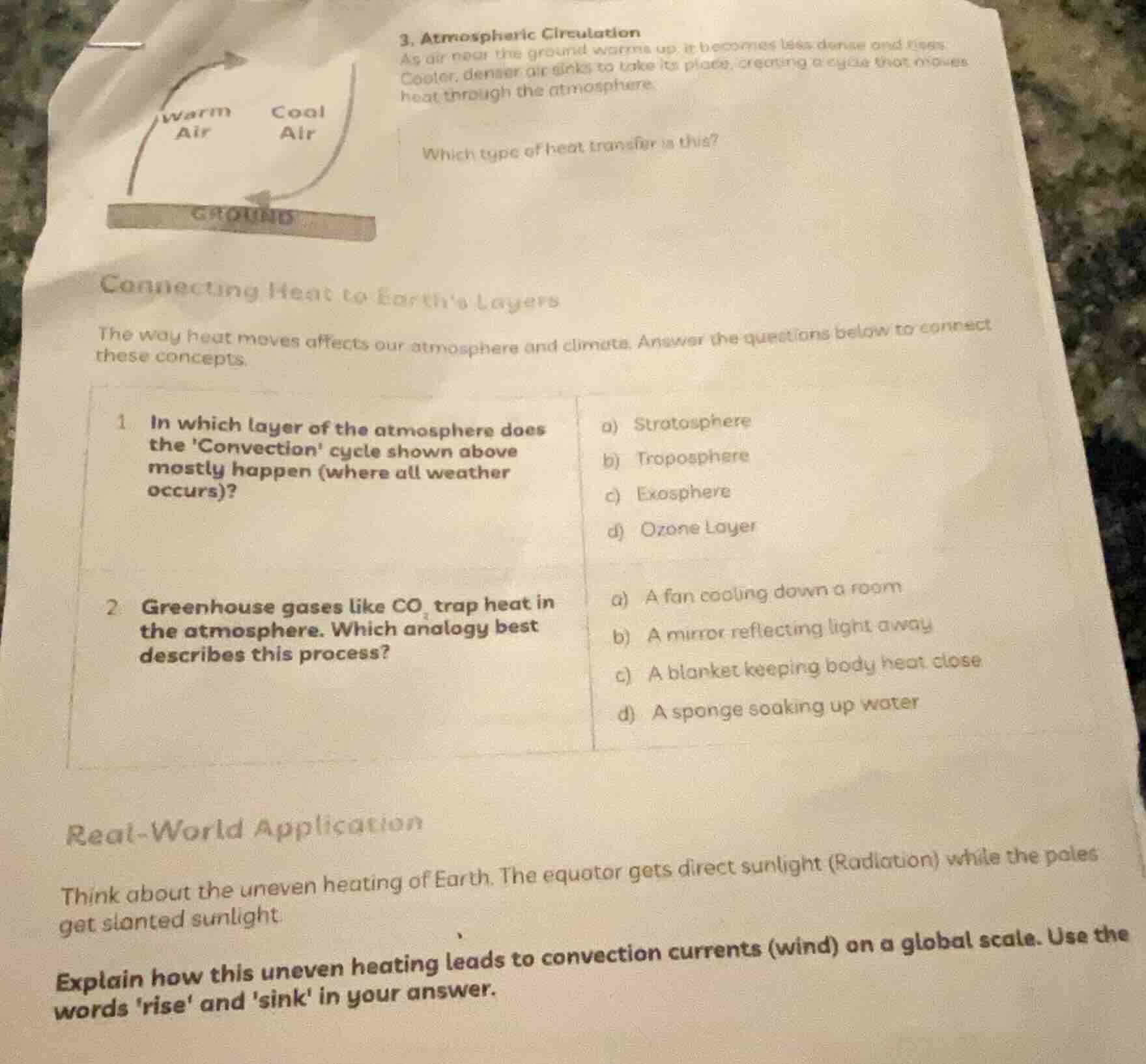
- atmospheric circulationas air near the ground warms up, it becomes less dense and rises. cooler, denser air sinks to take its place, creating a cycle that moves heat through the atmosphere.which type of heat transfer is this?connecting heat to earths layersthe way heat moves affects our atmosphere and climate. answer the questions below to connect these concepts.1 in which layer of the atmosphere does the convection cycle shown above mostly happen (where all weather occurs)?a) stratosphereb) tropospherec) exosphered) ozone layer2 greenhouse gases like $\text{co}_2$ trap heat in the atmosphere. which analogy best describes this process?a) a fan cooling down a roomb) a mirror reflecting light awayc) a blanket keeping body heat closed) a sponge soaking up waterreal-world applicationthink about the uneven heating of earth. the equator gets direct sunlight (radiation) while the poles get slanted sunlight.explain how this uneven heating leads to convection currents (wind) on a global scale. use the words rise and sink in your answer.
For question 1:
The troposphere is the lowest atmospheric layer, where all weather phenomena occur, and it is the primary layer where convection cycles of warm and cool air take place.
For question 2:
Greenhouse gases trap heat near Earth's surface, similar to how a blanket traps body heat close to a person, preventing it from escaping.
For the final explanation question:
Uneven heating means air at the equator is warmed more intensely. This warm, less dense air will rise. As it rises and moves away from the equator, it cools, becomes denser, and sinks back toward the surface. This cycle of rising warm air and sinking cool air creates large-scale global convection currents that form wind patterns.

Snap & solve any problem in the app
Get step-by-step solutions on Sovi AI
Photo-based solutions with guided steps
Explore more problems and detailed explanations
- b) Troposphere
- c) A blanket keeping body heat close
- Uneven heating warms equatorial air more: this warm air becomes less dense and rises. As it moves toward the poles, it cools, grows denser, and sinks back toward the surface. This cycle of rising warm air and sinking cool air drives global-scale convection currents, which create wind.