QUESTION IMAGE
Question
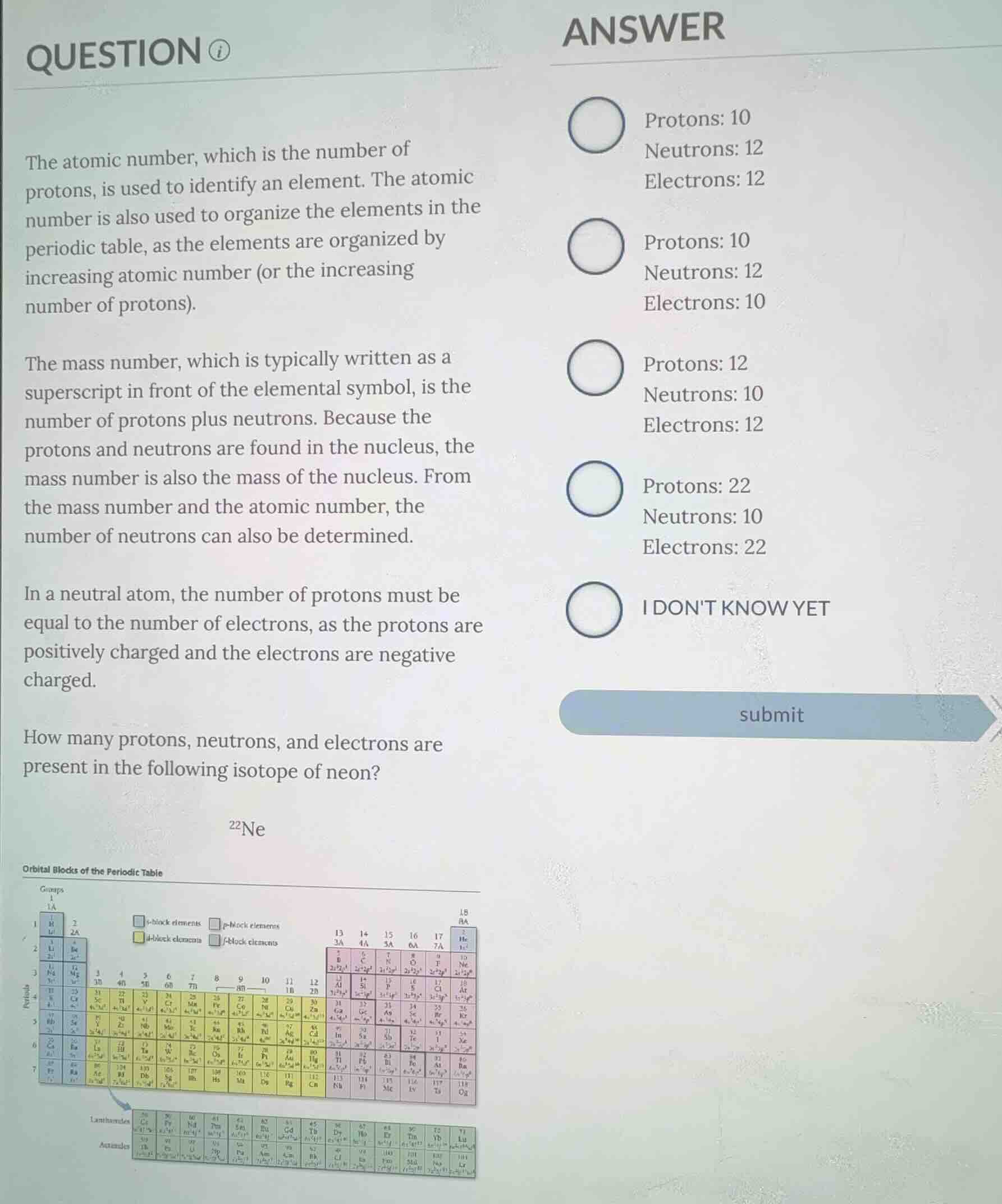
the atomic number, which is the number of protons, is used to identify an element. the atomic number is also used to organize the elements in the periodic table, as the elements are organized by increasing atomic number (or the increasing number of protons). the mass number, which is typically written as a superscript in front of the elemental symbol, is the number of protons plus neutrons. because the protons and neutrons are found in the nucleus, the mass number is also the mass of the nucleus. from the mass number and the atomic number, the number of neutrons can also be determined. in a neutral atom, the number of protons must be equal to the number of electrons, as the protons are positively charged and the electrons are negative charged. how many protons, neutrons, and electrons are present in the following isotope of neon? $^{22}\text{ne}$
Step1: Determine protons
Neon (Ne) has an atomic number of 10, so protons = 10.
Step2: Determine neutrons
Mass number of \(^{22}\text{Ne}\) is 22. Neutrons = mass number - protons = \(22 - 10 = 12\).
Step3: Determine electrons
In a neutral atom, electrons = protons = 10.

Snap & solve any problem in the app
Get step-by-step solutions on Sovi AI
Photo-based solutions with guided steps
Explore more problems and detailed explanations
Protons: 10
Neutrons: 12
Electrons: 10 (the second option)