QUESTION IMAGE
Question
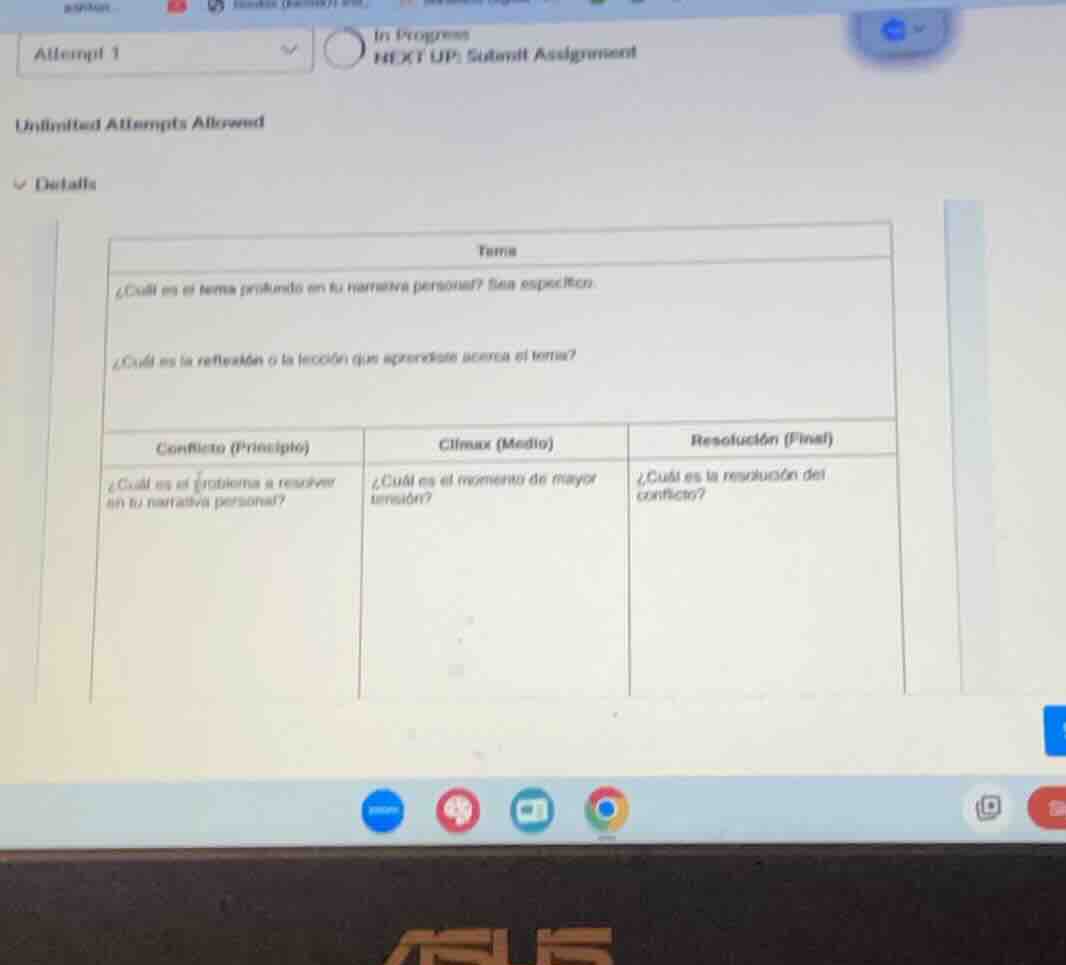
attempt 1 in progress next up: submit assignment unlimited attempts allowed details tema ¿cuál es el tema principal en tu narrativa personal? dale especificos. ¿cuál es la reflexión o la lección que aprendes acerca del tema? conflicto (principio) ¿cuál es el problema a resolver en tu narrativa personal? clímax (medio) ¿cuál es el momento de mayor tensión? resolución (final) ¿cuál es la resolución del conflicto?
This appears to be a personal narrative assignment in Spanish, asking you to reflect on a deep theme in your personal story, along with the conflict, climax, and resolution of that narrative. Since it's a personal reflection and narrative - building task, the subfield of Arts (specifically Literature or Writing) is most appropriate. Here's how you can approach each part:
1. ¿Cuál es el tema profundo en tu narrativa personal? (What is the deep theme in your personal narrative?)
- Explanation: Think about a significant experience or idea that has had a lasting impact on you. For example, if you've gone through a period of learning to be independent after moving away from home, the theme could be "the journey of self - discovery through independence".
- Answer: Let's say your theme is "Overcoming fear through taking risks". You would write something like "El tema profundo en mi narrativa personal es la superación del miedo a través de la toma de riesgos. Esta narrativa se centra en cómo he ido enfrentando situaciones que me han hecho sentir inseguro, como hablar en público o intentar una actividad nueva, y cómo cada vez que he asumido el riesgo, he ido comprendiendo mejor mi capacidad de superar mis miedos."
2. ¿Cuál es la reflexión o la lección que aprendes acerca del tema? (What is the reflection or lesson you learn about the theme?)
- Explanation: Based on the theme, think about what you've come to understand. If the theme is about overcoming fear, the lesson might be about how fear is often a self - imposed limit.
- Answer: "La lección que he aprendido es que el miedo muchas veces es una barrera que yo misma me he construido. Al enfrentarme a situaciones que me asustan, he visto que la mayoría de las veces el resultado no es tan terrible como imaginaba y que cada vez que supero un miedo, me siento más empoderado. Además, he aprendido que el crecimiento personal muchas veces pasa por salir de la zona de confort, incluso cuando hay miedo involucrado."
3. Conflicto (Principio): ¿Cuál es el problema a resolver en tu narrativa personal? (Conflict (Beginning): What is the problem to solve in your personal narrative?)
- Explanation: Identify the main problem related to your theme. If the theme is overcoming fear, the conflict could be your initial fear of a particular situation.
- Answer: "El problema a resolver en mi narrativa personal es mi profundo miedo a hablar en público. Este miedo me ha impedido participar en oportunidades como presentar proyectos en la escuela o unirme a grupos de debate, y sentía que estaba perdiendo oportunidades de crecimiento y de expresarme."
4. Clímax (Medio): ¿Cuál es el momento de mayor tensión? (Climax (Middle): What is the moment of greatest tension?)
- Explanation: The climax is the most intense part of the story where the conflict reaches a peak. For the fear of public speaking, it could be a moment when you have to speak in front of a large audience.
- Answer: "El momento de mayor tensión ocurrió cuando tuve que presentar un trabajo final en frente de toda mi clase y de varios profesores invitados. Sentía que mi corazón iba a saltar de mi pecho, mis manos estaban sudorosas y me costaba respirar. Sabía que si no lograba superar este miedo en ese momento, iba a seguir evitando situaciones similares en el futuro."
5. Resolución (Final): ¿Cuál es la resolución del conflicto? (Resolution (End): What is the resolution of the conflict?)
- Explanation: Describe how the problem was solved. In the case of the fear of public speaking, it could be how y…

Snap & solve any problem in the app
Get step-by-step solutions on Sovi AI
Photo-based solutions with guided steps
Explore more problems and detailed explanations
This appears to be a personal narrative assignment in Spanish, asking you to reflect on a deep theme in your personal story, along with the conflict, climax, and resolution of that narrative. Since it's a personal reflection and narrative - building task, the subfield of Arts (specifically Literature or Writing) is most appropriate. Here's how you can approach each part:
1. ¿Cuál es el tema profundo en tu narrativa personal? (What is the deep theme in your personal narrative?)
- Explanation: Think about a significant experience or idea that has had a lasting impact on you. For example, if you've gone through a period of learning to be independent after moving away from home, the theme could be "the journey of self - discovery through independence".
- Answer: Let's say your theme is "Overcoming fear through taking risks". You would write something like "El tema profundo en mi narrativa personal es la superación del miedo a través de la toma de riesgos. Esta narrativa se centra en cómo he ido enfrentando situaciones que me han hecho sentir inseguro, como hablar en público o intentar una actividad nueva, y cómo cada vez que he asumido el riesgo, he ido comprendiendo mejor mi capacidad de superar mis miedos."
2. ¿Cuál es la reflexión o la lección que aprendes acerca del tema? (What is the reflection or lesson you learn about the theme?)
- Explanation: Based on the theme, think about what you've come to understand. If the theme is about overcoming fear, the lesson might be about how fear is often a self - imposed limit.
- Answer: "La lección que he aprendido es que el miedo muchas veces es una barrera que yo misma me he construido. Al enfrentarme a situaciones que me asustan, he visto que la mayoría de las veces el resultado no es tan terrible como imaginaba y que cada vez que supero un miedo, me siento más empoderado. Además, he aprendido que el crecimiento personal muchas veces pasa por salir de la zona de confort, incluso cuando hay miedo involucrado."
3. Conflicto (Principio): ¿Cuál es el problema a resolver en tu narrativa personal? (Conflict (Beginning): What is the problem to solve in your personal narrative?)
- Explanation: Identify the main problem related to your theme. If the theme is overcoming fear, the conflict could be your initial fear of a particular situation.
- Answer: "El problema a resolver en mi narrativa personal es mi profundo miedo a hablar en público. Este miedo me ha impedido participar en oportunidades como presentar proyectos en la escuela o unirme a grupos de debate, y sentía que estaba perdiendo oportunidades de crecimiento y de expresarme."
4. Clímax (Medio): ¿Cuál es el momento de mayor tensión? (Climax (Middle): What is the moment of greatest tension?)
- Explanation: The climax is the most intense part of the story where the conflict reaches a peak. For the fear of public speaking, it could be a moment when you have to speak in front of a large audience.
- Answer: "El momento de mayor tensión ocurrió cuando tuve que presentar un trabajo final en frente de toda mi clase y de varios profesores invitados. Sentía que mi corazón iba a saltar de mi pecho, mis manos estaban sudorosas y me costaba respirar. Sabía que si no lograba superar este miedo en ese momento, iba a seguir evitando situaciones similares en el futuro."
5. Resolución (Final): ¿Cuál es la resolución del conflicto? (Resolution (End): What is the resolution of the conflict?)
- Explanation: Describe how the problem was solved. In the case of the fear of public speaking, it could be how you managed to give the presentation and how that changed your relationship with your fear.
- Answer: "La resolución del conflicto fue que pude dar la presentación. Aunque al principio me sentía muy nervioso, me concentré en lo que quería transmitir y en la preparación que había hecho. Al finalizar, recibí aplausos y comentarios positivos de mis compañeros y profesores. Este hecho me hizo darme cuenta de que podía superar mi miedo a hablar en público. Ahora, aunque todavía siento un poco de nerviosismo, ya no evito estas situaciones y incluso busco oportunidades para hablar en público, ya que sé que puedo hacerlo."