QUESTION IMAGE
Question
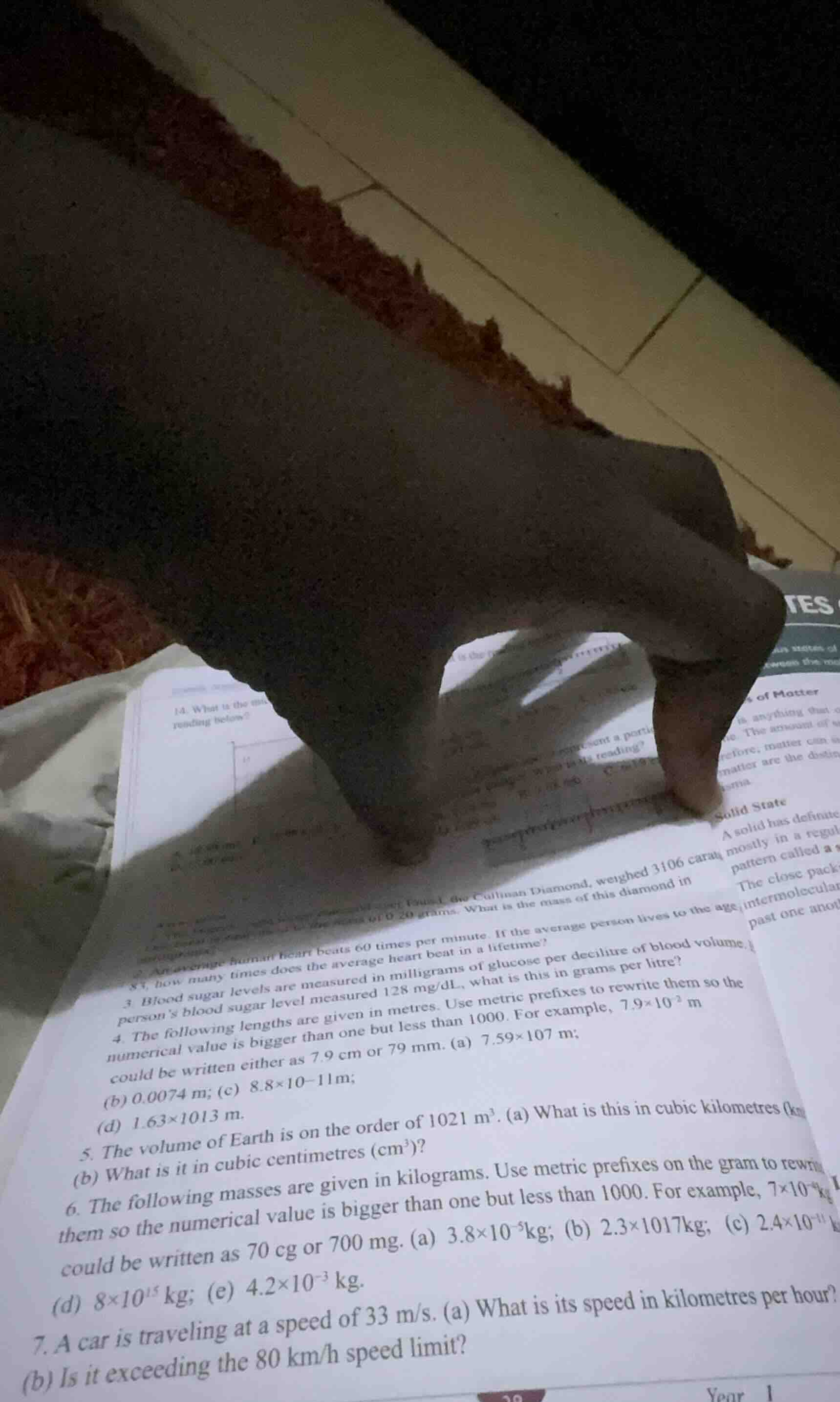
- an average human heart beats 60 times per minute. if the average person lives to the age 85, how many times does the average heart beat in a lifetime?
- blood sugar levels are measured in milligrams of glucose per decilitre of blood volume. if a person’s blood sugar level measured 128 mg/dl, what is this in grams per litre?
- the following lengths are given in metres. use metric prefixes to rewrite them so the numerical value is bigger than one but less than 1000. for example, $7.9 \times 10^{-2}$ m could be written either as 7.9 cm or 79 mm. (a) $7.59 \times 10^{7}$ m;
(b) 0.0074 m; (c) $8.8 \times 10^{-11}$m;
(d) $1.63 \times 10^{13}$ m.
- the volume of earth is on the order of $10^{21}$ m³. (a) what is this in cubic kilometres (km³)?
(b) what is it in cubic centimetres (cm³)?
- the following masses are given in kilograms. use metric prefixes on the gram to rewrite them so the numerical value is bigger than one but less than 1000. for example, $7 \times 10^{-5}$ kg could be written as 70 cg or 700 mg. (a) $3.8 \times 10^{-5}$kg; (b) $2.3 \times 10^{17}$kg; (c) $2.4 \times 10^{-11}$ kg
(d) $8 \times 10^{15}$ kg; (e) $4.2 \times 10^{-3}$ kg.
- a car is traveling at a speed of 33 m/s. (a) what is its speed in kilometres per hour?
(b) is it exceeding the 80 km/h speed limit?
Step1: Solve Q1 (Diamond mass)
Given 1 carat = 0.20 grams, total carats = 3106.
$\text{Mass} = 3106 \times 0.20 = 621.2$ grams
Step2: Solve Q2 (Lifetime heartbeats)
Convert 83 years to minutes: $83 \times 365 \times 24 \times 60 = 43624800$ minutes.
$\text{Total beats} = 43624800 \times 60 = 2.617488 \times 10^9$
Step3: Solve Q3 (Blood sugar conversion)
1 mg = $10^{-3}$ g, 1 dL = $10^{-1}$ L.
$\text{Conversion: } 128 \times \frac{10^{-3}\text{ g}}{10^{-1}\text{ L}} = 1.28$ g/L
Step4: Solve Q4 (Metric prefix rewrite)
(a) $7.59 \times 10^7$ m = $75.9 \times 10^6$ m = 75.9 Mm
(b) $0.0074$ m = $7.4 \times 10^{-3}$ m = 7.4 mm
(c) $8.8 \times 10^{-11}$ m = $88 \times 10^{-12}$ m = 88 pm
(d) $1.63 \times 10^{13}$ m = $16.3 \times 10^{12}$ m = 16.3 Tm
Step5: Solve Q5 (Earth volume conversion)
(a) $1$ km = $10^3$ m, so $1$ km³ = $(10^3)^3$ m³ = $10^9$ m³.
$\text{Volume} = \frac{10^{21}}{10^9} = 10^{12}$ km³
(b) $1$ m = $10^2$ cm, so $1$ m³ = $(10^2)^3$ cm³ = $10^6$ cm³.
$\text{Volume} = 10^{21} \times 10^6 = 10^{27}$ cm³
Step6: Solve Q6 (Mass metric prefix rewrite)
(a) $3.8 \times 10^{-5}$ kg = $3.8 \times 10^{-2}$ g = 3.8 cg
(b) $2.3 \times 10^{17}$ kg = $2.3 \times 10^{20}$ g = 230 Eg
(c) $2.4 \times 10^{-11}$ kg = $2.4 \times 10^{-8}$ g = 24 ng
(d) $8 \times 10^{15}$ kg = $8 \times 10^{18}$ g = 8 Eg
(e) $4.2 \times 10^{-3}$ kg = 4.2 g
Step7: Solve Q7 (Car speed conversion)
(a) 1 m/s = 3.6 km/h.
$\text{Speed} = 33 \times 3.6 = 118.8$ km/h
(b) Compare to 80 km/h: $118.8 > 80$

Snap & solve any problem in the app
Get step-by-step solutions on Sovi AI
Photo-based solutions with guided steps
Explore more problems and detailed explanations
- 621.2 grams
- $2.62 \times 10^9$ beats (rounded)
- 1.28 g/L
- (a) 75.9 Mm; (b) 7.4 mm; (c) 88 pm; (d) 16.3 Tm
- (a) $10^{12}$ km³; (b) $10^{27}$ cm³
- (a) 3.8 cg; (b) 230 Eg; (c) 24 ng; (d) 8 Eg; (e) 4.2 g
- (a) 118.8 km/h; (b) Yes, it is exceeding the speed limit