QUESTION IMAGE
Question
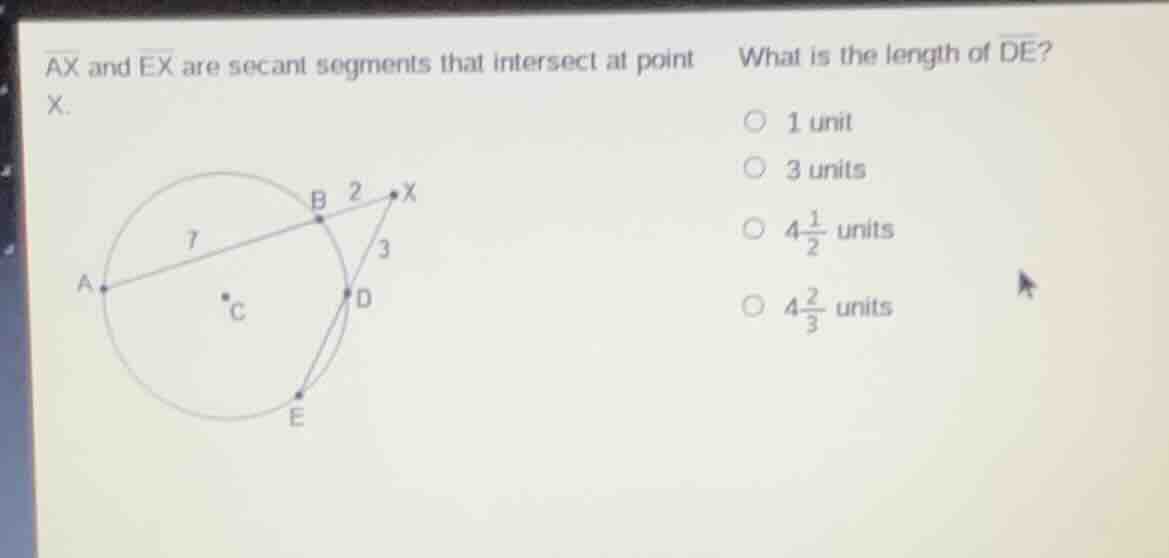
ax and ex are secant segments that intersect at point x. what is the length of \\(\overline{de}\\)? \\(\bigcirc\\) 1 unit \\(\bigcirc\\) 3 units \\(\bigcirc\\) \\(4\frac{1}{2}\\) units \\(\bigcirc\\) \\(4\frac{2}{3}\\) units
Step1: Recall the Secant-Secant Theorem
The Secant - Secant Theorem states that if two secant segments are drawn from a point outside a circle, then the product of the length of one secant segment and its external part is equal to the product of the length of the other secant segment and its external part. Mathematically, if we have a point \( X \) outside the circle, with one secant \( XA \) (where \( XB \) is the external part and \( BA \) is the internal part) and another secant \( XE \) (where \( XD \) is the external part and \( DE \) is the internal part), then \( XB\times XA=XD\times XE \).
First, find the length of \( XA \). We know that \( AB = 7 \) and \( XB=2 \), so \( XA=XB + AB=2 + 7=9 \). Let the length of \( DE=x \). The length of \( XE=XD + DE=3 + x \), and \( XD = 3 \), \( XB = 2 \), \( XA=9 \).
Step2: Apply the Secant - Secant Formula
According to the Secant - Secant Theorem:
\( XB\times XA=XD\times XE \)
Substitute the known values:
\( 2\times9=3\times(3 + x) \)
Simplify the left - hand side: \( 18 = 3\times(3 + x) \)
Step3: Solve for \( x \)
Divide both sides of the equation \( 18=3\times(3 + x) \) by 3:
\( \frac{18}{3}=3 + x \)
\( 6=3 + x \)
Subtract 3 from both sides:
\( x=6 - 3=3 \)? Wait, no, wait. Wait, I made a mistake. Wait, the formula is \( \text{External part}_1\times(\text{External part}_1+\text{Internal part}_1)=\text{External part}_2\times(\text{External part}_2+\text{Internal part}_2) \)
Wait, \( XA \) is \( XB+BA \), where \( XB \) is external, \( BA \) is internal. \( XE \) is \( XD + DE \), where \( XD \) is external, \( DE \) is internal.
So correct formula: \( XB\times(XB + AB)=XD\times(XD + DE) \)
We have \( XB = 2 \), \( AB = 7 \), so \( XB+AB=2 + 7 = 9 \), \( XD = 3 \), let \( DE=x \), so \( XD + DE=3 + x \)
So \( 2\times9=3\times(3 + x) \)
\( 18=9 + 3x \)
Subtract 9 from both sides: \( 18-9 = 3x \)
\( 9 = 3x \)
Divide both sides by 3: \( x = 3 \)? Wait, but that's one of the options, but let me check again.
Wait, maybe I misread the diagram. Let's re - examine:
Wait, \( AB \) is 7, \( XB \) is 2, so \( XA=XB + AB=2 + 7 = 9 \)
\( XD \) is 3, let \( DE=x \), so \( XE=XD + DE=3 + x \)
By Secant - Secant rule: \( XB\times XA=XD\times XE \)
So \( 2\times9=3\times(3 + x) \)
\( 18 = 9+3x \)
\( 3x=18 - 9=9 \)
\( x = 3 \)

Snap & solve any problem in the app
Get step-by-step solutions on Sovi AI
Photo-based solutions with guided steps
Explore more problems and detailed explanations
3 units