QUESTION IMAGE
Question
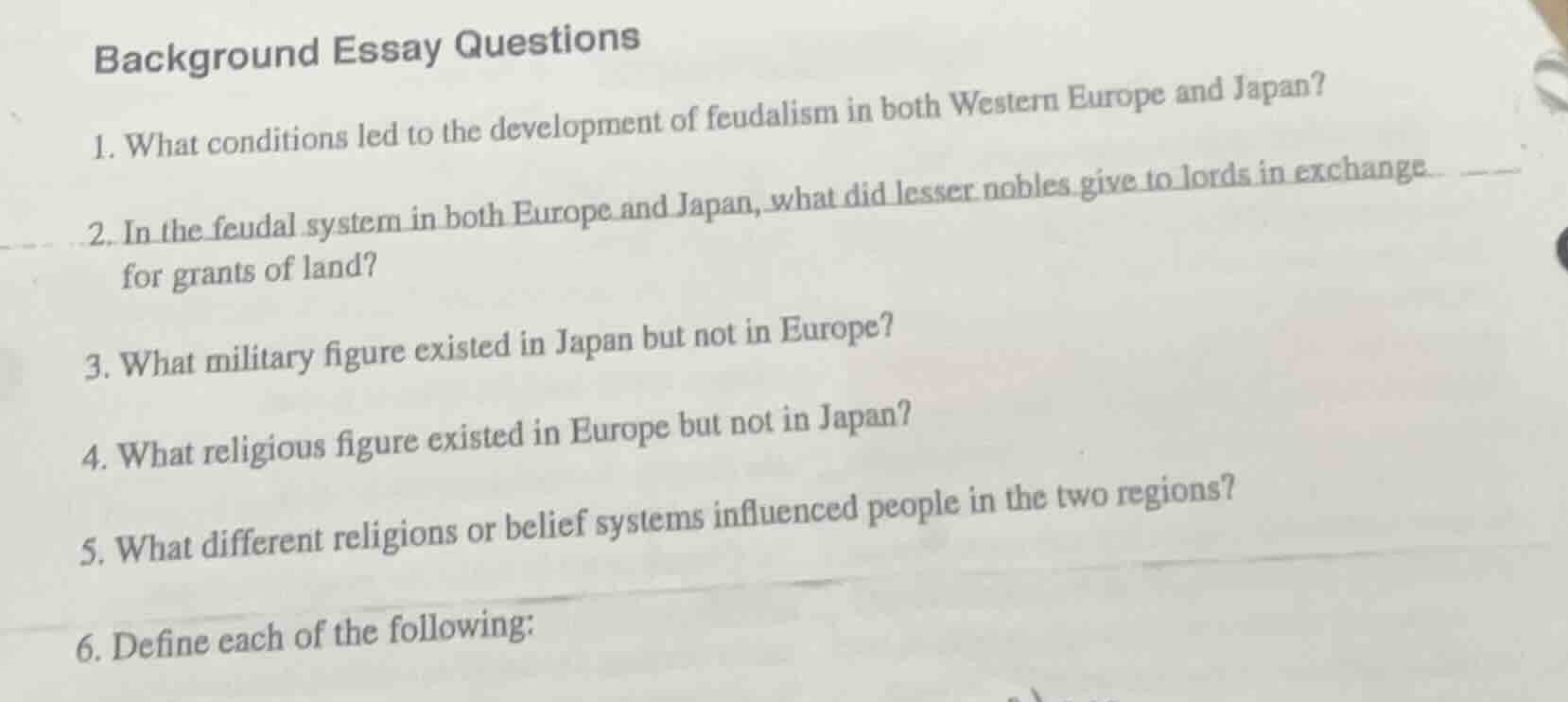
background essay questions
- what conditions led to the development of feudalism in both western europe and japan?
- in the feudal system in both europe and japan, what did lesser nobles give to lords in exchange for grants of land?
- what military figure existed in japan but not in europe?
- what religious figure existed in europe but not in japan?
- what different religions or belief systems influenced people in the two regions?
- define each of the following:
Question 1
To determine the conditions leading to feudalism in Western Europe and Japan, we analyze political, economic, and social factors. In Western Europe, the collapse of the Roman Empire led to a power vacuum, weak central authority, and the need for local protection. Economic instability, like the decline of trade and urban centers, pushed people toward self - sufficient manors. Socially, a hierarchical structure emerged with lords, vassals, and serfs. In Japan, after the Heian period, the central government weakened, local clans (daimyo) gained power, and the need for military protection (due to internal conflicts and potential external threats) led to the rise of samurai and a feudal system. Both regions had a need for local governance and protection when central power waned, along with agrarian - based economies that supported a hierarchical land - based system.
In the feudal systems of both Europe and Japan, the relationship between lesser nobles and lords (vassal - lord relationship) was based on mutual obligations. Lesser nobles (vassals in Europe, samurai - related nobles or vassals to daimyo in Japan) offered military service and loyalty to the lords. In exchange for land grants (fiefs in Europe, land from daimyo in Japan), they would provide military support (e.g., serving in the lord's army, protecting the lord's lands) and show loyalty (following the lord's commands, participating in the feudal hierarchy).
In Japan's feudal system, the shogun was a unique military figure not present in European feudalism. The shogun was the military dictator who held real power, while the emperor was more of a symbolic figure. In Europe, there was no equivalent position with the same level of military and political power as the shogun. European feudal systems had kings, lords, and knights, but no single military ruler with the shogun's role (a military leader who effectively ruled while the nominal head of state - emperor in Japan, king in Europe - had limited power).

Snap & solve any problem in the app
Get step-by-step solutions on Sovi AI
Photo-based solutions with guided steps
Explore more problems and detailed explanations
In Western Europe, the collapse of the Roman Empire created a power vacuum, weak central rule, economic decline (trade, urban centers), and the need for local protection. In Japan, the weakening of the central government (post - Heian period), rise of local clans (daimyo), internal conflicts, and the need for military protection led to feudalism. Common factors included weak central authority, the need for local security, and an agrarian - based hierarchical land system.