QUESTION IMAGE
Question
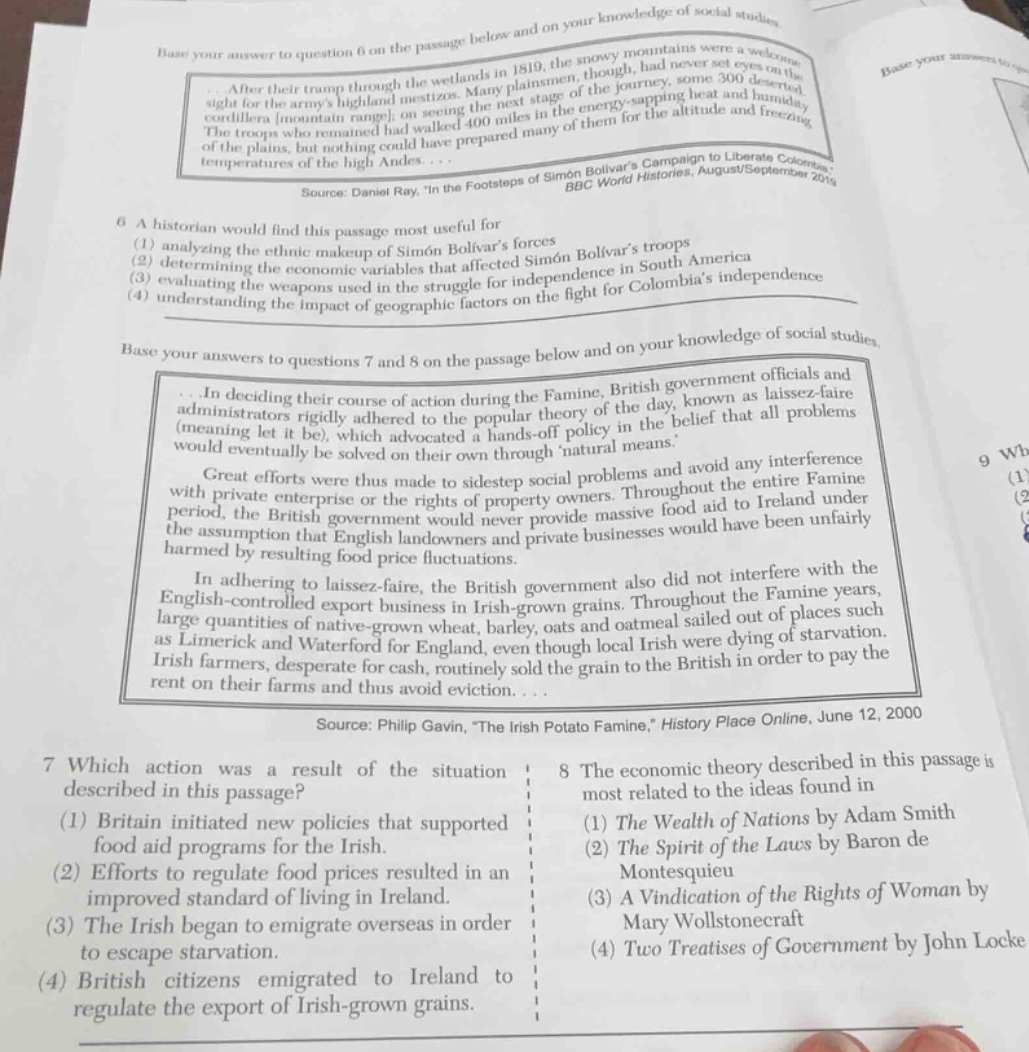
base your answer to question 6 on the passage below and on your knowledge of social studies.
... after their tramp through the wetlands in 1819, the snowy mountains were a welcome sight for the armys highland moustizes. many plainsmen, though, had never set eyes on the cordillera mountain range; on seeing the next stage of the journey, some 300 deserted. the troops who remained had walked 400 miles in the energy - sapping heat and humidity of the plains, but nothing could have prepared many of them for the altitude and freezing temperatures of the high andes....
source: daniel ray, \in the footsteps of simón bolívars campaign to liberate colombia\ bbc world histories, august/september 2019
6 a historian would find this passage most useful for
(1) analyzing the ethnic makeup of simón bolívars forces
(2) determining the economic variables that affected simón bolívars troops
(3) evaluating the weapons used in the struggle for independence in south america
(4) understanding the impact of geographic factors on the fight for colombias independence
base your answers to questions 7 and 8 on the passage below and on your knowledge of social studies.
... in deciding their course of action during the famine, british government officials and administrators rigidly adhered to the popular theory of the day, known as laissez - faire (meaning let it be), which advocated a hands - off policy in the belief that all problems would eventually be solved on their own through natural means.
great efforts were thus made to sidestep social problems and to avoid any interference with private enterprise or the rights of property owners. throughout the entire famine period, the british government would never provide massive food aid to ireland under the assumption that english landowners and private businesses would have been unfairly harmed by resulting food price fluctuations.
in adhering to laissez - faire, the british government also did not interfere with the english - controlled export business in irish - grown grains. throughout the famine years, large quantities of native - grown wheat, barley, oats and oatmeal sailed out of places such as limerick and waterford for england, even though local irish were dying of starvation. irish farmers, desperate for cash, routinely sold the grain to the british in order to pay the rent on their farms and thus avoid eviction....
source: philip gavin, \the irish potato famine,\ history place online, june 12, 2000
7 which action was a result of the situation described in this passage?
(1) britain initiated new policies that supported food aid programs for the irish.
(2) efforts to regulate food prices resulted in an improved standard of living in ireland.
(3) the irish began to emigrate overseas in order to escape starvation.
(4) british citizens emigrated to ireland to regulate the export of irish - grown grains.
8 the economic theory described in this passage is most related to the ideas found in
(1) the wealth of nations by adam smith
(2) the spirit of the laws by baron de montesquieu
(3) a vindication of the rights of woman by mary wollstonecraft
(4) two treatises of government by john locke
Question 6
The passage talks about the army's journey through wetlands, snowy mountains, and the high Andes, focusing on how geographic features (mountains, plains, altitude, freezing temps) affected the troops. Option (1) is about ethnic makeup, not in the passage. Option (2) is about economic variables, not mentioned. Option (3) is about weapons, not discussed. Option (4) matches as it's about geographic factors (mountains, altitude, climate) impacting the fight for Colombia’s independence (part of Bolivar’s campaign).
The passage describes the Irish Potato Famine, British laissez - faire policy, export of Irish grains while Irish starved, and Irish farmers selling grain to pay rent. Option (1): Britain didn't support food aid (they had a hands - off policy). Option (2): No regulation of food prices, and standard of living didn't improve. Option (3): Irish starving would emigrate overseas to escape, which is a logical result. Option (4): British didn't emigrate to Ireland for that purpose.
The economic theory is laissez - faire (hands - off, let market solve problems). Adam Smith’s The Wealth of Nations promotes free - market capitalism and limited government intervention, matching laissez - faire. Montesquieu’s work is about separation of powers, Wollstonecraft’s about women’s rights, Locke’s about government and natural rights. So option (1) is correct.

Snap & solve any problem in the app
Get step-by-step solutions on Sovi AI
Photo-based solutions with guided steps
Explore more problems and detailed explanations
(4) understanding the impact of geographic factors on the fight for Colombia’s independence