QUESTION IMAGE
Question
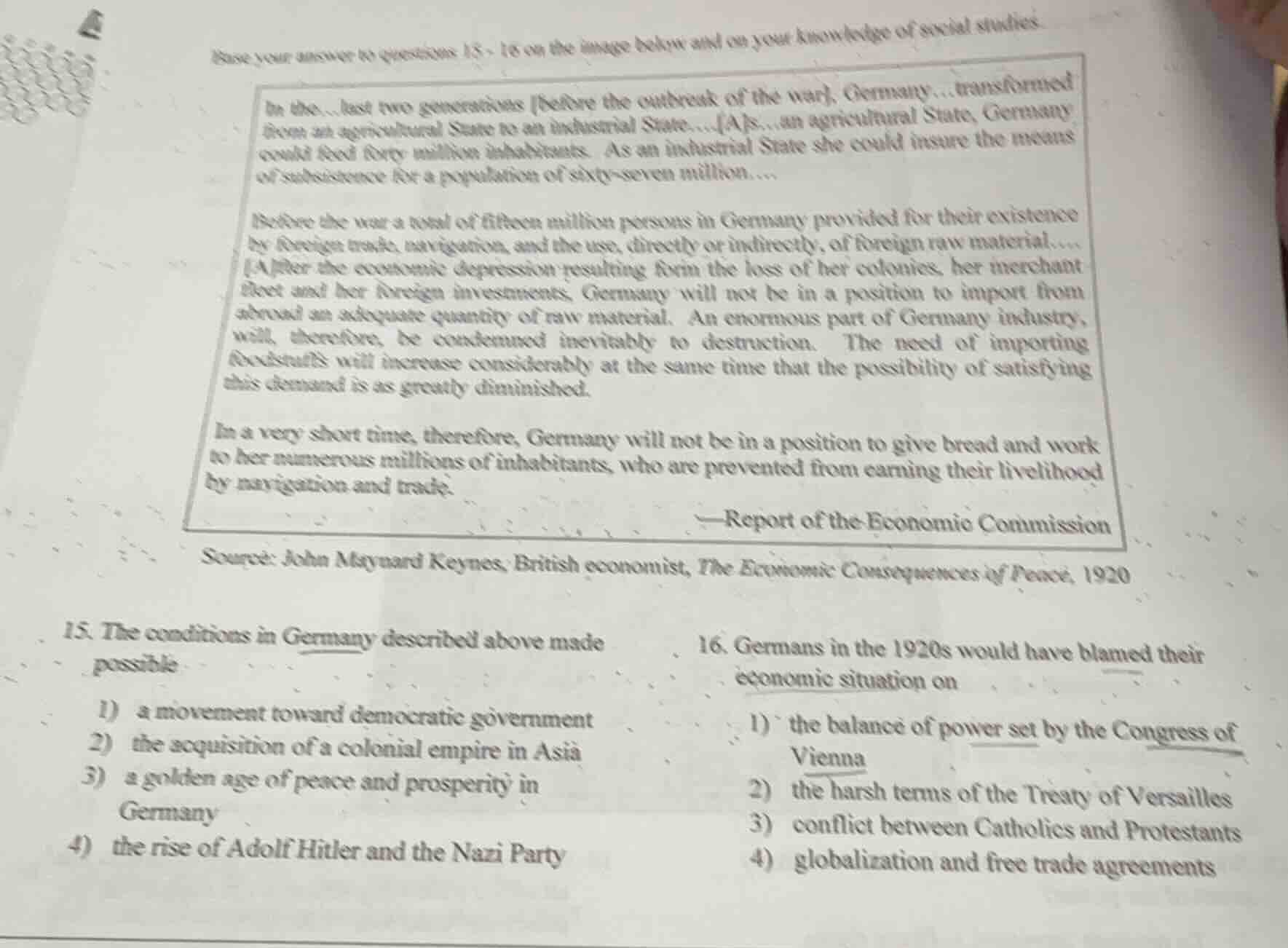
base your answer to questions 15 - 16 on the image below and on your knowledge of social studies.
in the...last two generations before the outbreak of the war, germany...transformed from an agricultural state to an industrial state....as...an agricultural state, germany could feed forty million inhabitants. as an industrial state she could insure the means of subsistence for a population of sixty - seven million....
before the war a total of fifteen million persons in germany provided for their existence by foreign trade, navigation, and the use, directly or indirectly, of foreign raw material....after the economic depression resulting from the loss of her colonies, her merchant fleet and her foreign investments, germany will not be in a position to import from abroad an adequate quantity of raw material. an enormous part of germany industry, will, therefore, be condemned inevitably to destruction. the need of importing foodstuffs will increase considerably at the same time that the possibility of satisfying this demand is as greatly diminished.
in a very short time, therefore, germany will not be in a position to give bread and work to her numerous millions of inhabitants, who are prevented from earning their livelihood by navigation and trade.
—report of the economic commission
source: john maynard keynes, british economist, the economic consequences of peace, 1920
- the conditions in germany described above made
- a movement toward democratic government
- the acquisition of a colonial empire in asia
- a golden age of peace and prosperity in germany
- the rise of adolf hitler and the nazi party
- germans in the 1920s would have blamed their economic situation on
- the balance of power set by the congress of vienna
- the harsh terms of the treaty of versailles
- conflict between catholics and protestants
- globalization and free trade agreements
Question 15
The text describes Germany's post - war economic struggles, including industrial destruction, food shortage, and unemployment. The rise of Hitler and the Nazi Party was fueled by such economic hardships as people sought solutions. Option 1: Democratic government movement was not driven by this economic woe. Option 2: Germany lost colonies, not acquired in Asia. Option 3: There was no golden age of peace and prosperity.
The Treaty of Versailles imposed harsh terms on Germany, including loss of colonies, merchant fleet, and foreign investments, leading to economic depression. Option 1: Congress of Vienna was in 1815, not related. Option 3: Religious conflict wasn't the economic cause. Option 4: Globalization and free trade didn't cause the 1920s German economic issues.

Snap & solve any problem in the app
Get step-by-step solutions on Sovi AI
Photo-based solutions with guided steps
Explore more problems and detailed explanations
- the rise of Adolf Hitler and the Nazi Party