QUESTION IMAGE
Question
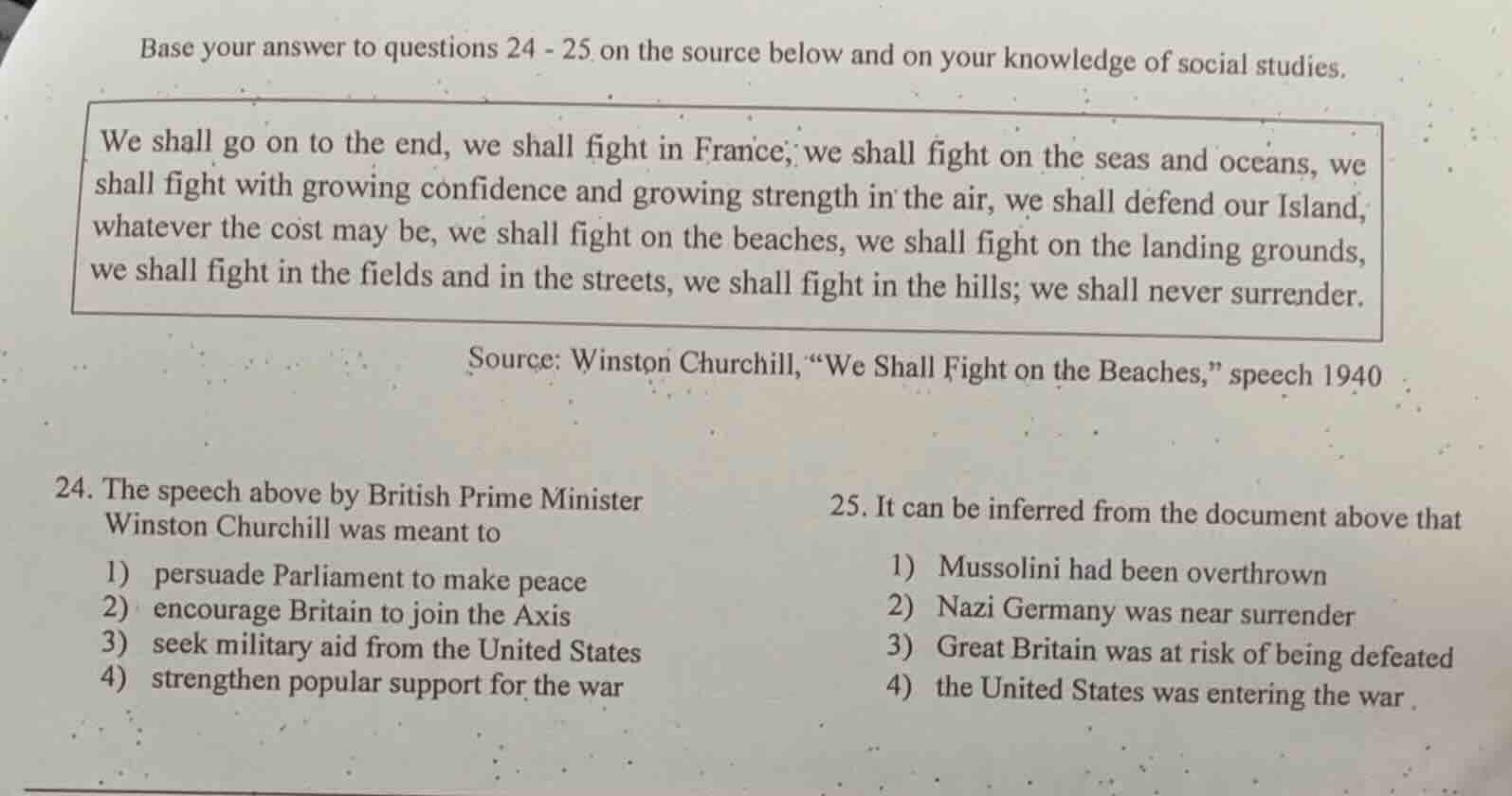
base your answer to questions 24 - 25 on the source below and on your knowledge of social studies.
we shall go on to the end, we shall fight in france, we shall fight on the seas and oceans, we shall fight with growing confidence and growing strength in the air, we shall defend our island, whatever the cost may be, we shall fight on the beaches, we shall fight on the landing grounds, we shall fight in the fields and in the streets, we shall fight in the hills; we shall never surrender.
source: winston churchill, \we shall fight on the beaches,\ speech 1940
- the speech above by british prime minister winston churchill was meant to
- persuade parliament to make peace
- encourage britain to join the axis
- seek military aid from the united states
- strengthen popular support for the war
- it can be inferred from the document above that
- mussolini had been overthrown
- nazi germany was near surrender
- great britain was at risk of being defeated
- the united states was entering the war
Response
Question 24
Brief Explanations
- Option 1: The speech is about fighting, not making peace, so eliminate.
- Option 2: Britain was against the Axis (Germany, Italy, Japan), so this is incorrect.
- Option 3: The speech focuses on Britain's own fight, not seeking US aid (though US aid came later, the speech's main goal isn't this).
- Option 4: Churchill's repeated "we shall fight" aims to boost public morale and support for continuing the war against Nazi Germany.
Brief Explanations
- Option 1: Mussolini was overthrown in 1943, but the speech is from 1940, so this is wrong.
- Option 2: In 1940, Nazi Germany was advancing, not near surrender, so eliminate.
- Option 3: The extensive fighting locations (beaches, fields, hills, etc.) and the need to defend the island imply Britain was under threat of defeat from Nazi Germany's advances.
- Option 4: The US entered the war in 1941, and the speech is from 1940, so this is incorrect.

Snap & solve any problem in the app
Get step-by-step solutions on Sovi AI
Photo-based solutions with guided steps
Explore more problems and detailed explanations
- strengthen popular support for the war