QUESTION IMAGE
Question
1.1 beginning rhythm
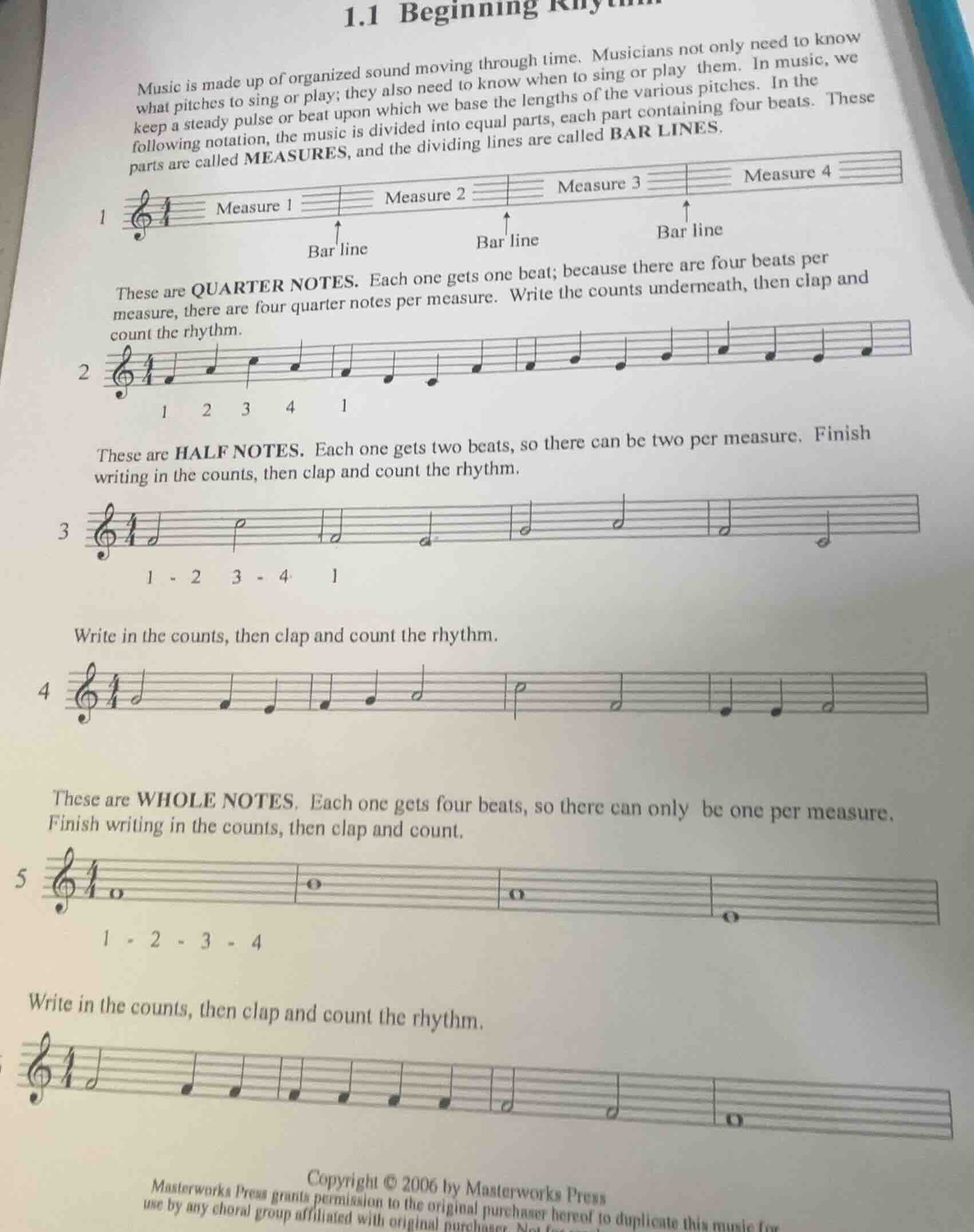
music is made up of organized sound moving through time. musicians not only need to know what pitches to sing or play; they also need to know when to sing or play them. in music, we keep a steady pulse or beat upon which we base the lengths of the various pitches. in the following notation, the music is divided into equal parts, each part containing four beats. these parts are called measures, and the dividing lines are called bar lines.
1 musical staff with treble clef, 4/4 time, labeled measure 1, measure 2, measure 3, measure 4, and bar lines
these are quarter notes. each one gets one beat; because there are four beats per measure, there are four quarter notes per measure. write the counts underneath, then clap and count the rhythm.
2 musical staff with treble clef, 4/4 time, quarter notes, with some counts written: 1, 2, 3, 4, 1
these are half notes. each one gets two beats, so there can be two per measure. finish writing in the counts, then clap and count the rhythm.
3 musical staff with treble clef, 4/4 time, half notes, with some counts written: 1 - 2, 3 - 4, 1
write in the counts, then clap and count the rhythm.
4 musical staff with treble clef, 4/4 time, notes including half and quarter notes
these are whole notes. each one gets four beats, so there can only be one per measure. finish writing in the counts, then clap and count.
5 musical staff with treble clef, 4/4 time, whole notes, with some counts written: 1 - 2 - 3 - 4
write in the counts, then clap and count the rhythm.
another musical staff with treble clef, 4/4 time, notes including half, quarter, and whole notes
copyright © 2006 by masterworks press
masterworks press grants permission to the original purchaser hereof to duplicate this music for use by any choral group affiliated with original purchaser. not for resale.
All exercises use 4/4 time (4 beats per measure). Quarter notes = 1 beat, half notes = 2 beats, whole notes = 4 beats. Counts are written to map each beat of the note.

Snap & solve any problem in the app
Get step-by-step solutions on Sovi AI
Photo-based solutions with guided steps
Explore more problems and detailed explanations
Exercise 2 (Quarter Notes):
Measure 2: 2 3 4
Measure 3: 1 2 3 4
Measure 4: 1 2 3 4
Exercise 3 (Half Notes):
Measure 2: 2 - 3 - 4
Measure 3: 1 - 2 3 - 4
Measure 4: 1 - 2 3 - 4
Exercise 4 (Mixed Notes):
Measure 1: 1 - 2 3 4
Measure 2: 1 2 3 - 4
Measure 3: 1 - 2 3 - 4
Measure 4: 1 2 3 - 4
Exercise 5 (Whole Notes):
Measure 2: 1 - 2 - 3 - 4
Measure 3: 1 - 2 - 3 - 4
Measure 4: 1 - 2 - 3 - 4
Final Exercise (Mixed Notes):
Measure 1: 1 - 2 3 4
Measure 2: 1 2 3 4
Measure 3: 1 - 2 3 - 4
Measure 4: 1 - 2 - 3 - 4