QUESTION IMAGE
Question
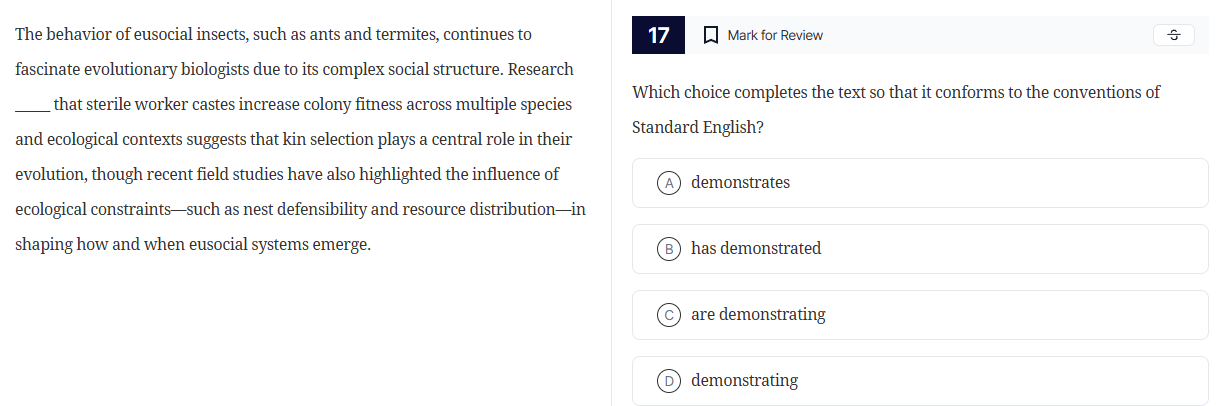
the behavior of eusocial insects, such as ants and termites, continues to fascinate evolutionary biologists due to its complex social structure. research ____ that sterile worker castes increase colony fitness across multiple species and ecological contexts suggests that kin selection plays a central role in their evolution, though recent field studies have also highlighted the influence of ecological constraints—such as nest defensibility and resource distribution—in shaping how and when eusocial systems emerge. 17 mark for review which choice completes the text so that it conforms to the conventions of standard english? a demonstrates b has demonstrated c are demonstrating d demonstrating
To solve this, we analyze subject - verb agreement and sentence structure. The subject is “Research”, which is a singular noun.
- Option A: “demonstrates” is a singular present - tense verb. But the context of the research (showing that sterile worker castes increase colony fitness) is something that has been done and has relevance to the present (suggests kin selection's role), so simple present may not be the best fit.
- Option B: “has demonstrated” is in the present perfect tense. This tense is appropriate as it shows an action (the research demonstrating something) that started in the past and has a connection to the present (the result of the research is used to suggest kin selection's role). Also, “has demonstrated” agrees with the singular subject “Research”.
- Option C: “are demonstrating” is a plural verb form (since “are” is used for plural subjects), and “Research” is singular, so this is incorrect.
- Option D: “demonstrating” is a gerund or present - participle. If we use “demonstrating”, the sentence would lack a main verb, as “Research demonstrating...” would be a noun phrase and the sentence would not be grammatically complete.

Snap & solve any problem in the app
Get step-by-step solutions on Sovi AI
Photo-based solutions with guided steps
Explore more problems and detailed explanations
B. has demonstrated