QUESTION IMAGE
Question
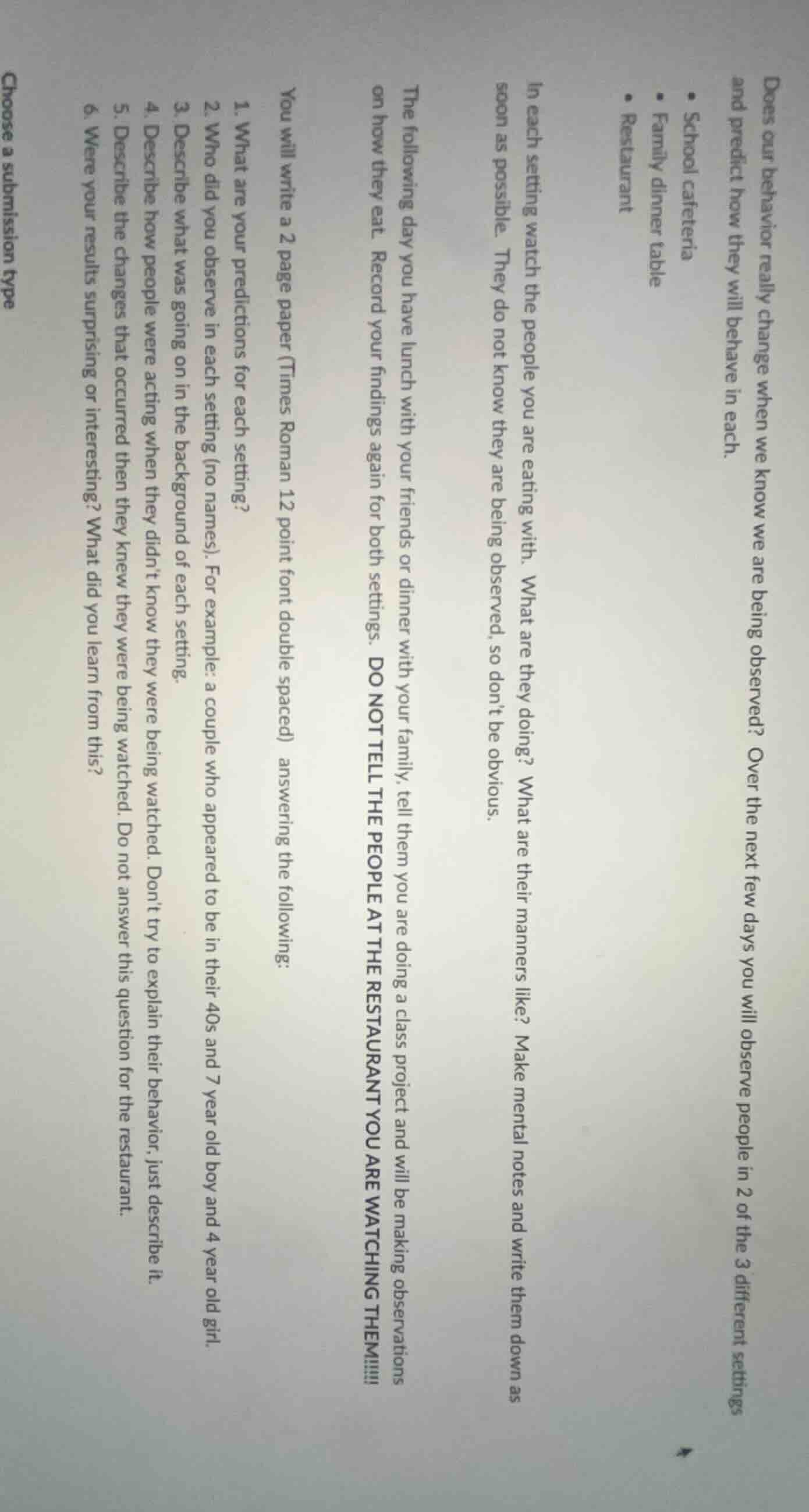
does our behavior really change when we know we are being observed? over the next few days you will observe people in 2 of the 3 different settings and predict how they will behave in each.- school cafeteria- family dinner table- restaurantin each setting watch the people you are eating with. what are they doing? what are their manners like? make mental notes and write them down as soon as possible. they do not know they are being observed, so dont be obvious.the following day you have lunch with your friends or dinner with your family, tell them you are doing a class project and will be making observations on how they eat. record your findings again for both settings. do not tell the people at the restaurant you are watching them!!!!!you will write a 2 page paper (times roman 12 point font double spaced) answering the following:1. what are your predictions for each setting?2. who did you observe in each setting (no names). for example: a couple who appeared to be in their 40s and 7 year old boy and 4 year old girl.3. describe what was going on in the background of each setting.4. describe how people were acting when they didnt know they were being watched. dont try to explain their behavior, just describe it.5. describe the changes that occurred then they knew they were being watched. do not answer this question for the restaurant.6. were your results surprising or interesting? what did you learn from this?choose a submission type
This is a behavioral observation project focused on the Hawthorne effect, where people modify behavior when aware of being observed. Below is a structured response addressing all required prompts, using the school cafeteria and family dinner table as the two settings.
- Predictions: Based on social norms, people in the cafeteria (public, peer-focused) will follow basic etiquette, while family dinner (private, casual) will have more relaxed behavior. When told they are being observed, both groups will adjust to conform to stricter social standards.
- Observations: Record of unobserved and observed behavior in each setting, including background context.
- Behavior Changes: Clear description of shifts when awareness of observation is introduced, limited to non-restaurant settings.
- Reflection: Analysis of surprises and key takeaways about social behavior and observation effects.

Snap & solve any problem in the app
Get step-by-step solutions on Sovi AI
Photo-based solutions with guided steps
Explore more problems and detailed explanations
1. Predictions for Each Setting
- School Cafeteria (Unobserved): Students will eat quickly, use casual table manners (e.g., elbows on table, talking with food in mouth), leave crumbs/trash on tables, and prioritize chatting over formal etiquette.
- School Cafeteria (Observed): Students will sit up straight, avoid elbows on tables, chew with mouths closed, clean up their tables fully, and use quieter, more polite language.
- Family Dinner Table (Unobserved): Family members will slouch in chairs, use phones while eating, talk over each other, and leave dishes on the table after eating.
- Family Dinner Table (Observed): Family members will sit upright, put phones away, take turns speaking, and clear their plates immediately after finishing.
2. Observations in Each Setting
- School Cafeteria (Unobserved): A group of 4 high school juniors (16-17 years old) sat at a corner table. They laughed loudly, talked with food in their mouths, rested elbows on the table, and left half-eaten fries and a crumpled napkin on the table when they left. The background was noisy, with other groups chatting and cafeteria staff wiping down nearby tables.
- Family Dinner Table (Unobserved): A family of 4 (parents in 40s, 10-year-old son, 8-year-old daughter) ate meatloaf and potatoes. The son slouched in his chair, played a game on his phone while eating, and talked over his mom when she asked about his day. The dad left his plate on the table and went to the couch right after eating. The background included a TV playing a news program in the living room.
3. Background of Each Setting
- School Cafeteria: A large, brightly lit space with 20+ rectangular tables, serving pre-packaged and hot lunch options. It was 12:15 PM, the peak lunch period, with ~100 students and 5 staff present.
- Family Dinner Table: A small, dimly lit dining room attached to a kitchen. It was 6:30 PM, a typical weekday dinner time, with only the immediate family present.
4. Behavior When Unobserved
- School Cafeteria: Students were casual and task-focused on eating quickly to return to free time. They prioritized socializing with peers over formal manners, and showed little concern for cleaning up after themselves, likely assuming staff would handle it.
- Family Dinner Table: Everyone was relaxed and unselfconscious. The son felt comfortable using his phone during the meal, and family members did not follow strict turn-taking in conversation, as the setting felt low-pressure and unjudgmental.
5. Behavior Changes When Observed
- School Cafeteria: The group of juniors sat up straight, moved their elbows off the table, and stopped talking with food in their mouths. One student wiped crumbs off the table before they left, and they spoke in quieter, more measured tones.
- Family Dinner Table: The son put his phone in his pocket immediately, sat up in his chair, and waited for his mom to finish speaking before responding. The dad cleared his plate and helped wipe the table after the meal, and everyone avoided interrupting each other.
6. Surprises and Key Learnings
The results were not surprising, but they highlighted how strongly social context and awareness of observation shape behavior. The most notable takeaway is that even in casual, familiar settings (like a family dinner), people quickly adjust their actions to match perceived social expectations when they know they are being watched. This shows that the desire to be seen as "polite" or "proper" is a powerful motivator across both public and private social spaces.