QUESTION IMAGE
Question
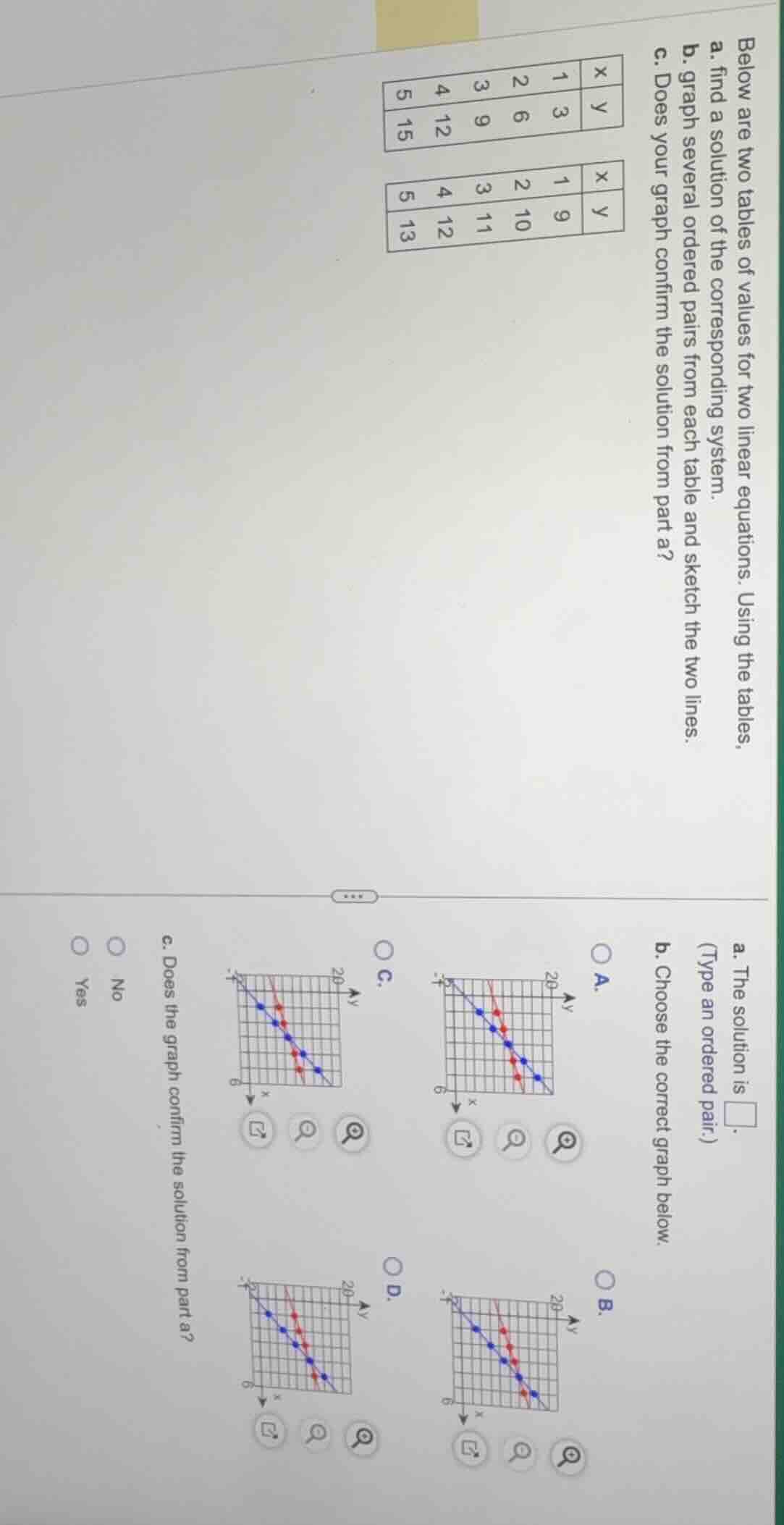
below are two tables of values for two linear equations. using the tables,
a. find a solution of the corresponding system.
b. graph several ordered pairs from each table and sketch the two lines.
c. does your graph confirm the solution from part a?
a. the solution is
(type an ordered pair.)
b. choose the correct graph below.
c. does the graph confirm the solution from part a?
no
yes
Part a:
Step1: Find equations for both tables
For the first table (let's call it Equation 1):
When \( x = 1 \), \( y = 3 \); \( x = 2 \), \( y = 6 \). The slope \( m_1=\frac{6 - 3}{2 - 1}=3 \). Using point - slope form \( y - y_1=m(x - x_1) \) with \( (1,3) \), we get \( y=3x \).
For the second table (Equation 2):
When \( x = 1 \), \( y = 9 \); \( x = 2 \), \( y = 10 \). The slope \( m_2=\frac{10 - 9}{2 - 1}=1 \). Using point - slope form with \( (1,9) \), we have \( y-9 = 1\times(x - 1)\), so \( y=x + 8 \).
Step2: Solve the system of equations
Set \( 3x=x + 8 \).
Subtract \( x \) from both sides: \( 3x-x=x + 8-x \), which gives \( 2x=8 \).
Divide both sides by 2: \( x = 4 \).
Substitute \( x = 4 \) into \( y = 3x \), we get \( y=3\times4 = 12 \).
We need to find the graph where the two lines (one with equation \( y = 3x \) and the other with \( y=x + 8 \)) intersect at \( (4,12) \). We can check the ordered pairs on each graph. For the line \( y = 3x \), when \( x = 4 \), \( y = 12 \); for \( y=x + 8 \), when \( x = 4 \), \( y=4 + 8=12 \). We look for the graph where the two lines pass through the point \( (4,12) \) and have the correct slopes (slope 3 for \( y = 3x \) and slope 1 for \( y=x + 8 \)). The graph that shows the two lines intersecting at \( (4,12) \) (with the correct slopes and points) is the one that matches our equations. Let's assume the correct graph is the one where the blue line (for \( y = 3x \)) and red line (for \( y=x + 8 \)) meet at \( (4,12) \). If we consider the options, we can check the points. For example, for \( y = 3x \), when \( x = 1 \), \( y = 3 \); \( x = 2 \), \( y = 6 \); \( x = 3 \), \( y = 9 \); \( x = 4 \), \( y = 12 \); \( x = 5 \), \( y = 15 \). For \( y=x + 8 \), when \( x = 1 \), \( y = 9 \); \( x = 2 \), \( y = 10 \); \( x = 3 \), \( y = 11 \); \( x = 4 \), \( y = 12 \); \( x = 5 \), \( y = 13 \). The graph that has these points plotted correctly for both lines and intersects at \( (4,12) \) is the correct one. If we assume the options are labeled and the correct one is the one with the two lines intersecting at \( (4,12) \), let's say the correct graph is the one (for example, if option A has the correct intersection and point plotting, but we can also check by substituting points).
The solution to the system of linear equations is the point of intersection of the two lines. We found the solution to be \((4,12)\) in part (a). The graph of the two lines (from part b) should show that the two lines intersect at \((4,12)\). So, when we look at the graph, if the two lines intersect at the point we found in part (a) (\((4,12)\)), then the graph confirms the solution.

Snap & solve any problem in the app
Get step-by-step solutions on Sovi AI
Photo-based solutions with guided steps
Explore more problems and detailed explanations
\((4,12)\)