QUESTION IMAGE
Question
biology - electron transport chain
section:
schools
homework u3cl08
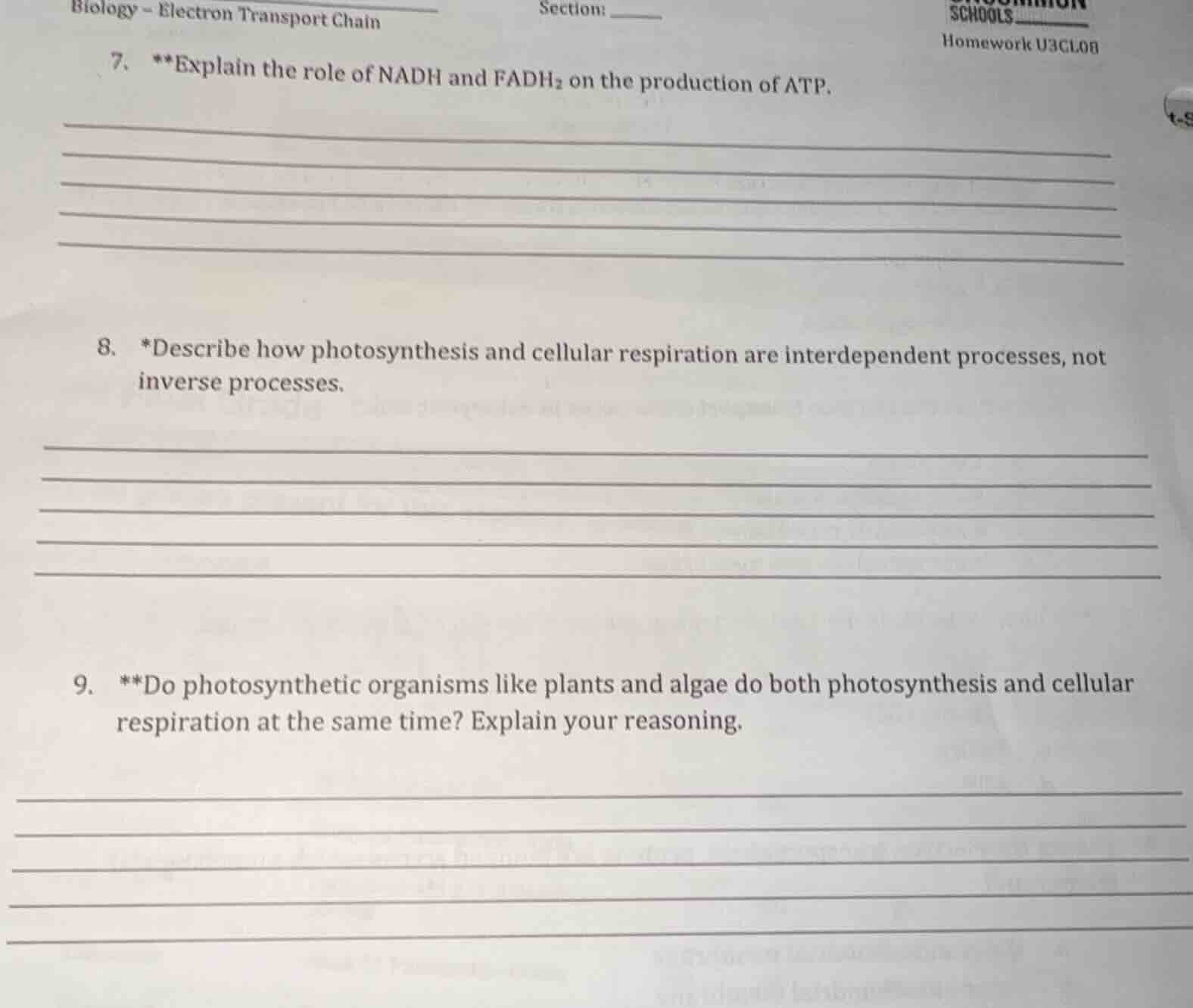
- **explain the role of nadh and fadh₂ on the production of atp.
- *describe how photosynthesis and cellular respiration are interdependent processes, not inverse processes.
- **do photosynthetic organisms like plants and algae do both photosynthesis and cellular respiration at the same time? explain your reasoning.
For Question 7:
NADH and FADH₂ are electron carriers generated in earlier cellular respiration stages (glycolysis, pyruvate oxidation, Krebs cycle). They donate high-energy electrons to the electron transport chain (ETC) in the inner mitochondrial membrane. As electrons move through the ETC, protons are pumped into the intermembrane space, creating a proton gradient. This gradient drives ATP synthesis via chemiosmosis. NADH donates electrons earlier in the ETC, producing ~2.5 ATP per molecule, while FADH₂ donates later, producing ~1.5 ATP per molecule.
For Question 8:
Photosynthesis (in producers) uses CO₂, water, and light energy to make glucose and O₂, while cellular respiration (in all eukaryotes) uses glucose and O₂ to make CO₂, water, and ATP. They are interdependent because the products of one are the reactants of the other: photosynthesis supplies glucose/O₂ for respiration, and respiration supplies CO₂/water for photosynthesis. They are not inverses because they occur in different organelles (chloroplasts vs mitochondria), use different energy sources (light vs chemical energy), and have distinct intermediate reactions and enzyme systems.
For Question 9:
Yes, photosynthetic organisms perform both processes simultaneously. Photosynthesis only occurs in light in chloroplasts, producing glucose and O₂. However, all cells (including photosynthetic ones) need ATP for constant cellular functions (e.g., active transport, biosynthesis) even during the day. Cellular respiration occurs continuously in mitochondria, breaking down some of the glucose produced by photosynthesis to generate ATP, using the O₂ either from photosynthesis or the environment.

Snap & solve any problem in the app
Get step-by-step solutions on Sovi AI
Photo-based solutions with guided steps
Explore more problems and detailed explanations
- NADH and FADH₂ act as electron carriers that donate high-energy electrons to the electron transport chain. This drives proton gradient formation, which powers ATP synthesis via chemiosmosis; NADH yields ~2.5 ATP per molecule, FADH₂ yields ~1.5 ATP per molecule.
- Photosynthesis and cellular respiration are interdependent because the products of one (glucose/O₂ from photosynthesis, CO₂/water from respiration) are the reactants of the other. They are not inverses: they occur in different organelles, use different energy sources, and have unique intermediate pathways.
- Yes, photosynthetic organisms perform both processes at the same time. Photosynthesis produces glucose and oxygen in light, but all cells require constant ATP for basic functions, which is generated by continuous cellular respiration using the glucose and oxygen produced (or from the environment).