QUESTION IMAGE
Question
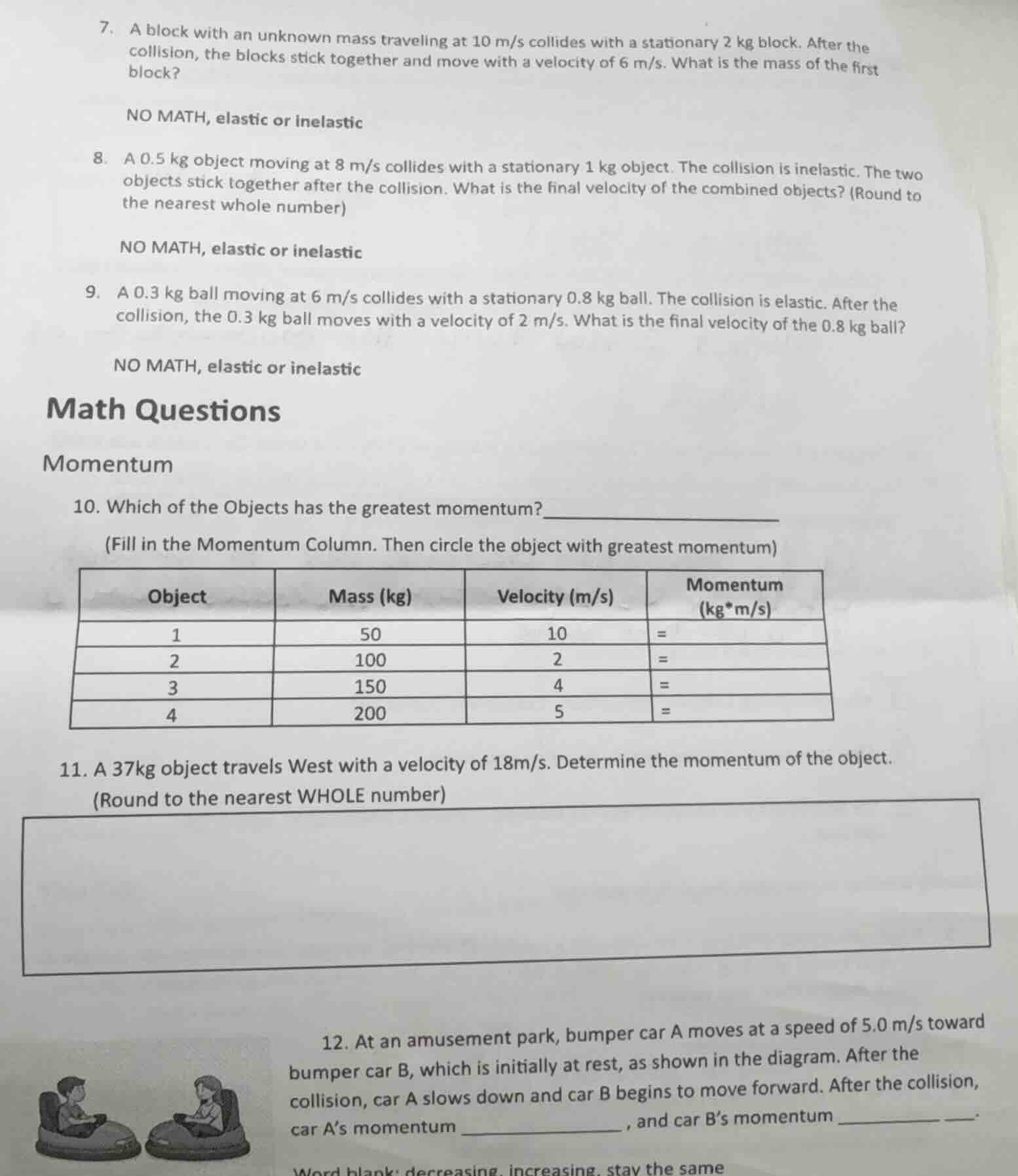
- a block with an unknown mass traveling at 10 m/s collides with a stationary 2 kg block. after the collision, the blocks stick together and move with a velocity of 6 m/s. what is the mass of the first block?
no math, elastic or inelastic
- a 0.5 kg object moving at 8 m/s collides with a stationary 1 kg object. the collision is inelastic. the two objects stick together after the collision. what is the final velocity of the combined objects? (round to the nearest whole number)
no math, elastic or inelastic
- a 0.3 kg ball moving at 6 m/s collides with a stationary 0.8 kg ball. the collision is elastic. after the collision, the 0.3 kg ball moves with a velocity of 2 m/s. what is the final velocity of the 0.8 kg ball?
no math, elastic or inelastic
math questions
momentum
- which of the objects has the greatest momentum?
(fill in the momentum column. then circle the object with greatest momentum)
| object | mass (kg) | velocity (m/s) | momentum (kg*m/s) |
|---|---|---|---|
| 2 | 100 | 2 | = |
| 3 | 150 | 4 | = |
| 4 | 200 | 5 | = |
- a 37kg object travels west with a velocity of 18m/s. determine the momentum of the object.
(round to the nearest whole number)
- at an amusement park, bumper car a moves at a speed of 5.0 m/s toward bumper car b, which is initially at rest, as shown in the diagram. after the collision, car a slows down and car b begins to move forward. after the collision, car as momentum _____________, and car bs momentum _____________.
word blank: decreasing, increasing, stay the same
Step1: Identify collision type (Q7)
This is an inelastic collision (blocks stick).
Apply conservation of momentum: $m_1v_1 + m_2v_2 = (m_1+m_2)v_f$
Substitute values: $m_1(10) + 2(0) = (m_1+2)(6)$
Step2: Solve for $m_1$ (Q7)
Expand and isolate $m_1$:
$10m_1 = 6m_1 + 12$
$4m_1 = 12$
$m_1 = \frac{12}{4} = 3$
Step3: Identify collision type (Q8)
This is an inelastic collision (objects stick).
Apply conservation of momentum: $m_1v_1 + m_2v_2 = (m_1+m_2)v_f$
Substitute values: $0.5(8) + 1(0) = (0.5+1)v_f$
Step4: Solve for $v_f$ (Q8)
Calculate and round:
$4 = 1.5v_f$
$v_f = \frac{4}{1.5} \approx 3$
Step5: Identify collision type (Q9)
This is an elastic collision (given).
Apply conservation of momentum: $m_1v_1 + m_2v_2 = m_1v_{1f} + m_2v_{2f}$
Substitute values: $0.3(6) + 0.8(0) = 0.3(2) + 0.8v_{2f}$
Step6: Solve for $v_{2f}$ (Q9)
Calculate final velocity:
$1.8 = 0.6 + 0.8v_{2f}$
$1.2 = 0.8v_{2f}$
$v_{2f} = \frac{1.2}{0.8} = 1.5$
Step7: Calculate momentum (Q10)
Use $p = mv$ for each object:
Object1: $p_1 = 50 \times 10 = 500$
Object2: $p_2 = 100 \times 2 = 200$
Object3: $p_3 = 150 \times 4 = 600$
Object4: $p_4 = 200 \times 5 = 1000$
Step8: Calculate momentum (Q11)
Use $p = mv$, include direction:
$p = 37 \times 18 = 666$ (West)
Step9: Analyze momentum change (Q12)
Car A slows: velocity decreases, so momentum decreases.
Car B moves from rest: velocity increases, so momentum increases.

Snap & solve any problem in the app
Get step-by-step solutions on Sovi AI
Photo-based solutions with guided steps
Explore more problems and detailed explanations
- Mass of first block: $\boldsymbol{3\ \text{kg}}$; Collision type: Inelastic
- Final velocity: $\boldsymbol{3\ \text{m/s}}$; Collision type: Inelastic
- Final velocity of 0.8 kg ball: $\boldsymbol{1.5\ \text{m/s}}$; Collision type: Elastic
10.
| Object | Mass (kg) | Velocity (m/s) | Momentum (kg*m/s) |
|---|---|---|---|
| 2 | 100 | 2 | 200 |
| 3 | 150 | 4 | 600 |
| 4 | 200 | 5 | 1000 |
Object 4 has the greatest momentum.
- $\boldsymbol{666\ \text{kg*m/s West}}$
- car A's momentum: $\boldsymbol{decreasing}$; car B's momentum: $\boldsymbol{increasing}$