QUESTION IMAGE
Question
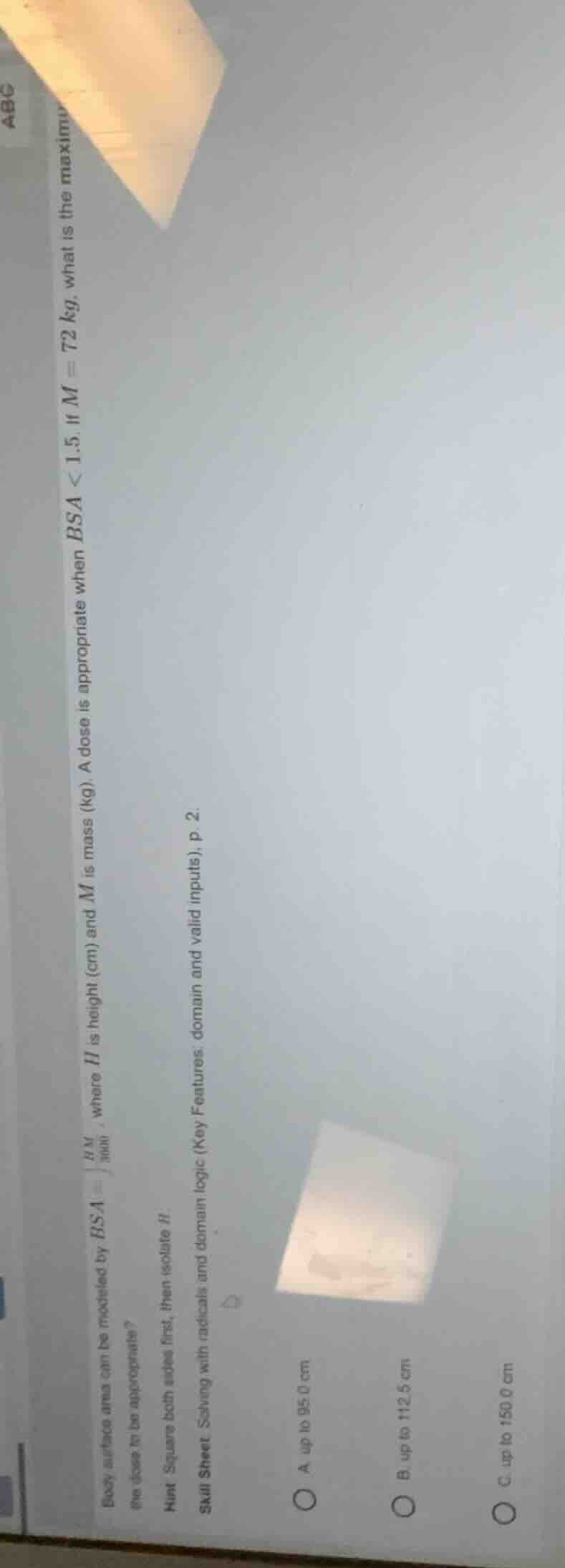
body surface area can be modeled by ( bsa = sqrt{\frac{hm}{3600}} ), where ( h ) is height (cm) and ( m ) is mass (kg). a dose is appropriate when ( bsa < 1.5 ). if ( m = 72 ) kg, what is the maximum the dose to be appropriate? hint: square both sides first, then isolate ( h ). skill sheet: solving with radicals and domain logic (key features, domain and valid inputs), p 2. a up to 95.0 cm b up to 112.5 cm c up to 150.0 cm
Step1: Start with the BSA formula
We know that \( BSA=\sqrt{\frac{HM}{3600}} \) (assuming the correct formula is \( BSA = \sqrt{\frac{Height\times Mass}{3600}} \), since the given text has some formatting issues, we infer the formula as \( BSA=\sqrt{\frac{HM}{3600}} \)) and \( BSA < 1.5 \), \( M = 72\space kg \). Substitute \( M = 72 \) into the formula: \( 1.5>\sqrt{\frac{H\times72}{3600}} \)
Step2: Square both sides
To eliminate the square root, square both sides of the inequality. Remember that if \( a > b \) and \( b\geq0 \), then \( a^{2}>b^{2} \). Here, \( \sqrt{\frac{72H}{3600}}\geq0 \) (since it's a square root of a non - negative number) and \( 1.5>0 \), so we can square both sides:
\( 1.5^{2}>\frac{72H}{3600} \)
Calculate \( 1.5^{2}=2.25 \), so the inequality becomes \( 2.25>\frac{72H}{3600} \)
Step3: Solve for H
First, multiply both sides of the inequality by 3600 to get rid of the denominator:
\( 2.25\times3600>72H \)
Calculate \( 2.25\times3600 = 8100 \), so \( 8100>72H \)
Then, divide both sides by 72 to solve for H:
\( H<\frac{8100}{72} \)
Calculate \( \frac{8100}{72}=112.5 \)
So \( H < 112.5\space cm \), which means the height is up to 112.5 cm.

Snap & solve any problem in the app
Get step-by-step solutions on Sovi AI
Photo-based solutions with guided steps
Explore more problems and detailed explanations
B. up to 112.5 cm