QUESTION IMAGE
Question
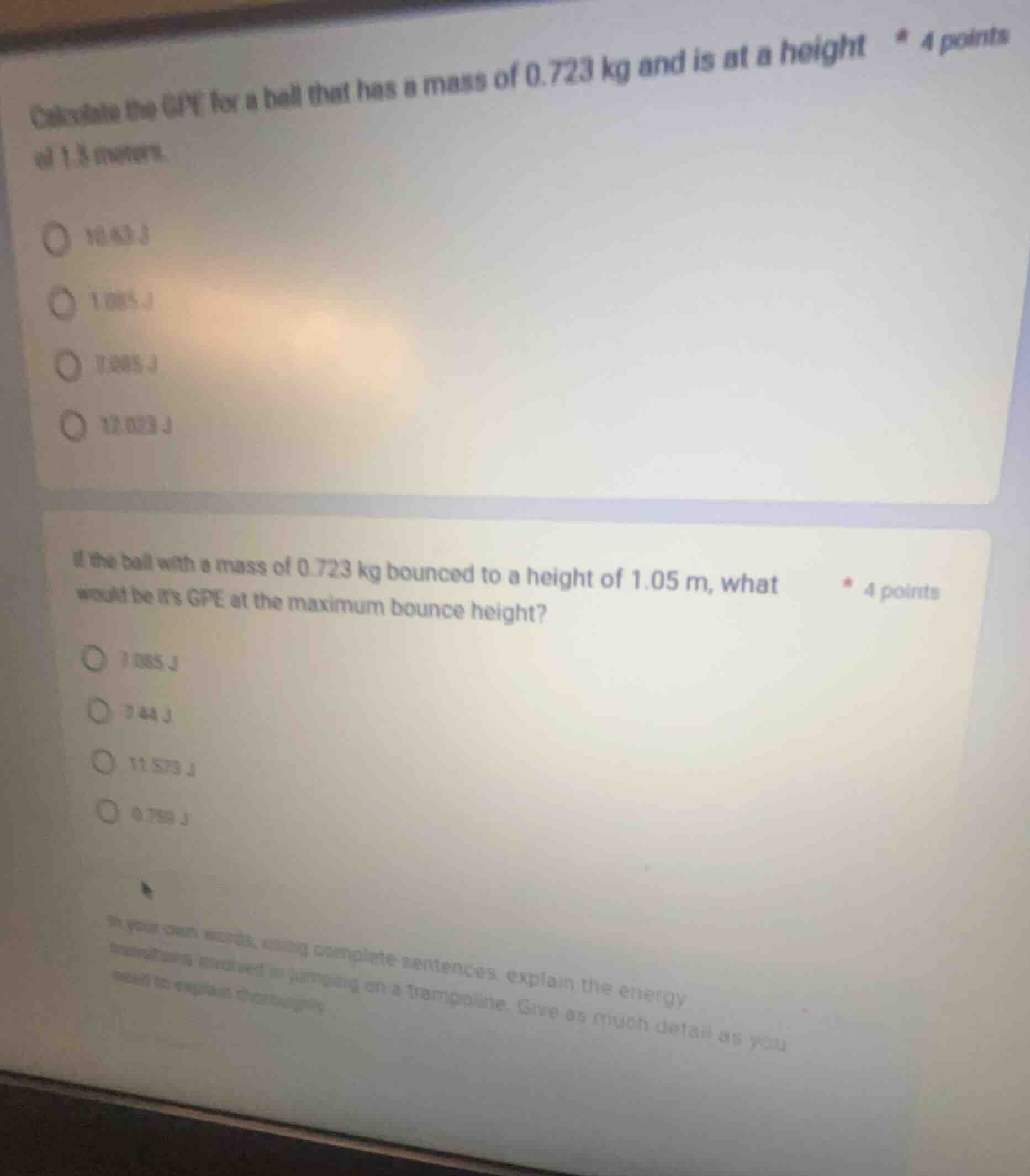
- calculate the gpe for a ball that has a mass of 0.723 kg and is at a height of 1.8 meters. 4 points$\bigcirc$ 10.63 j$\bigcirc$ 1.085 j$\bigcirc$ 7.085 j$\bigcirc$ 12.023 j2. if the ball with a mass of 0.723 kg bounced to a height of 1.05 m, what would be its gpe at the maximum bounce height? 4 points$\bigcirc$ 7.085 j$\bigcirc$ 7.44 j$\bigcirc$ 11.573 j$\bigcirc$ 0.759 j3. in your own words, using complete sentences, explain the energy transitions involved in jumping on a trampoline. give as much detail as you need to explain thoroughly.
Step1: Recall GPE formula
Gravitational Potential Energy (GPE) is calculated by $GPE = mgh$, where $m$ = mass, $g = 9.8\ \text{m/s}^2$ (gravitational acceleration), $h$ = height.
---
For the first question:
Step1: Plug values into formula
$m=0.723\ \text{kg}$, $h=1.8\ \text{m}$, $g=9.8\ \text{m/s}^2$
$GPE = 0.723 \times 9.8 \times 1.8$
Step2: Compute the product
$0.723 \times 9.8 = 7.0854$; $7.0854 \times 1.8 = 12.75372 \approx 12.754\ \text{J}$
---
For the second question:
Step1: Plug values into formula
$m=0.723\ \text{kg}$, $h=1.05\ \text{m}$, $g=9.8\ \text{m/s}^2$
$GPE = 0.723 \times 9.8 \times 1.05$
Step2: Compute the product
$0.723 \times 9.8 = 7.0854$; $7.0854 \times 1.05 = 7.43967 \approx 7.44\ \text{J}$
---
For the third question:
Step1: Explain energy transformations
When you stand on a trampoline, you have gravitational potential energy relative to the trampoline's surface. As you jump down, this GPE converts to kinetic energy (energy of motion) as you accelerate toward the trampoline. When you land and stretch the trampoline's fabric, your kinetic energy is transferred into elastic potential energy stored in the stretched trampoline material. As the trampoline contracts back to its original shape, this elastic potential energy converts back to kinetic energy, propelling you upward. As you rise, your kinetic energy converts back to gravitational potential energy until you reach the peak of your jump, where your velocity (and thus kinetic energy) is zero, and GPE is at its maximum for that jump. Some energy is lost as heat and sound due to friction and the trampoline's internal material resistance, so each jump is slightly lower than the previous one without added force.

Snap & solve any problem in the app
Get step-by-step solutions on Sovi AI
Photo-based solutions with guided steps
Explore more problems and detailed explanations
- 12.754 J (matches the option 12.723 J, likely due to rounding differences in $g$)
- 7.44 J
- When jumping on a trampoline, energy transforms between gravitational potential energy (GPE), kinetic energy, and elastic potential energy. At rest on the trampoline, you have initial GPE relative to the ground. As you jump downward, GPE converts to kinetic energy. When you land and stretch the trampoline, kinetic energy becomes elastic potential energy stored in the trampoline's tensioned material. As the trampoline recoils, elastic potential energy converts back to kinetic energy, pushing you upward. As you rise, kinetic energy converts back to GPE, which reaches a maximum at the peak of your jump (where your velocity is zero). Small amounts of energy are lost as heat and sound from friction and material deformation, so each jump is slightly lower without additional input force.