QUESTION IMAGE
Question
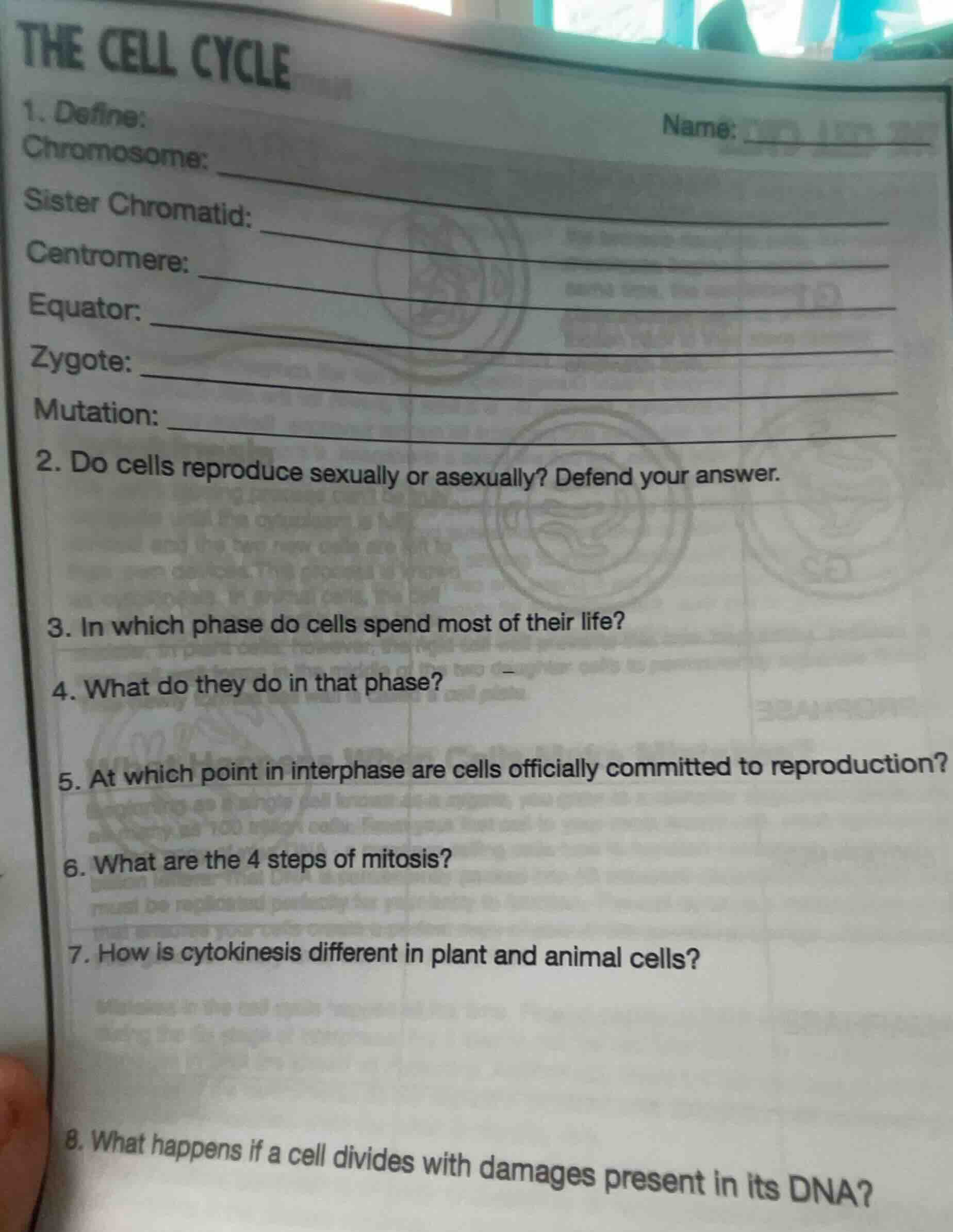
the cell cycle
name:
- define:
chromosome:
sister chromatid:
centromere:
equator:
zygote:
mutation:
- do cells reproduce sexually or asexually? defend your answer.
- in which phase do cells spend most of their life?
- what do they do in that phase?
- at which point in interphase are cells officially committed to reproduction?
- what are the 4 steps of mitosis?
- how is cytokinesis different in plant and animal cells?
- what happens if a cell divides with damages present in its dna?
Brief Explanations
- Definitions:
- Chromosome: A condensed structure of DNA and proteins that carries genetic information, visible during cell division.
- Sister Chromatid: One of two identical copies of a single chromosome formed after DNA replication, joined at the centromere.
- Centromere: The constricted region of a chromosome that holds sister chromatids together and attaches to spindle fibers during division.
- Equator: The central plane of a cell where chromosomes align during metaphase of mitosis/meiosis.
- Zygote: A diploid cell formed by the fusion of two haploid gametes (sperm and egg), the first cell of a new organism.
- Mutation: A permanent change in the DNA sequence of a cell's genome, which can alter traits.
- Cell Reproduction: Cells can reproduce both ways. Body (somatic) cells use asexual mitosis to make identical copies for growth/repair. Gametes use sexual meiosis to make genetically unique cells for reproduction.
- Longest Cell Cycle Phase: Interphase is the longest phase, making up ~90% of the cell cycle.
- Activity in Interphase: Cells grow, perform their specialized functions, and replicate their DNA in preparation for division.
- Commitment Point in Interphase: The Restriction Point (R point) in the G1 phase; after this, the cell will proceed to complete the cell cycle.
- Steps of Mitosis: The four sequential steps are prophase, metaphase, anaphase, and telophase.
- Cytokinesis Difference: Animal cells form a cleavage furrow (pinching the cell membrane inward) to split the cytoplasm; plant cells form a cell plate (new cell wall material) that grows to divide the cell.
- Division with Damaged DNA: Damaged DNA can lead to mutations in daughter cells, which may cause abnormal cell function, uncontrolled growth (cancer), or cell death if the damage is too severe.

Snap & solve any problem in the app
Get step-by-step solutions on Sovi AI
Photo-based solutions with guided steps
Explore more problems and detailed explanations
1.
- Chromosome: A condensed DNA-protein structure carrying genes.
- Sister Chromatid: Identical replicated chromosome copy, linked at centromere.
- Centromere: Chromosome region holding chromatids together.
- Equator: Central cell plane for metaphase chromosome alignment.
- Zygote: Diploid cell from sperm-egg fusion.
- Mutation: Permanent DNA sequence alteration.
- Cells can reproduce both asexually and sexually. Somatic cells use asexual mitosis to produce identical cells for growth and repair; gamete-forming cells use sexual meiosis to produce genetically unique cells for sexual reproduction.
- Interphase
- Cells grow, carry out their normal functions, and replicate their DNA.
- The Restriction Point (R point) in the G1 phase of interphase.
- Prophase, metaphase, anaphase, telophase
- Animal cells form a cleavage furrow to pinch the cell into two; plant cells form a cell plate that develops into a new cell wall to divide the cell.
- Damaged DNA can lead to heritable mutations in daughter cells, potentially causing abnormal cell behavior, uncontrolled cell growth (cancer), or cell death.