QUESTION IMAGE
Question
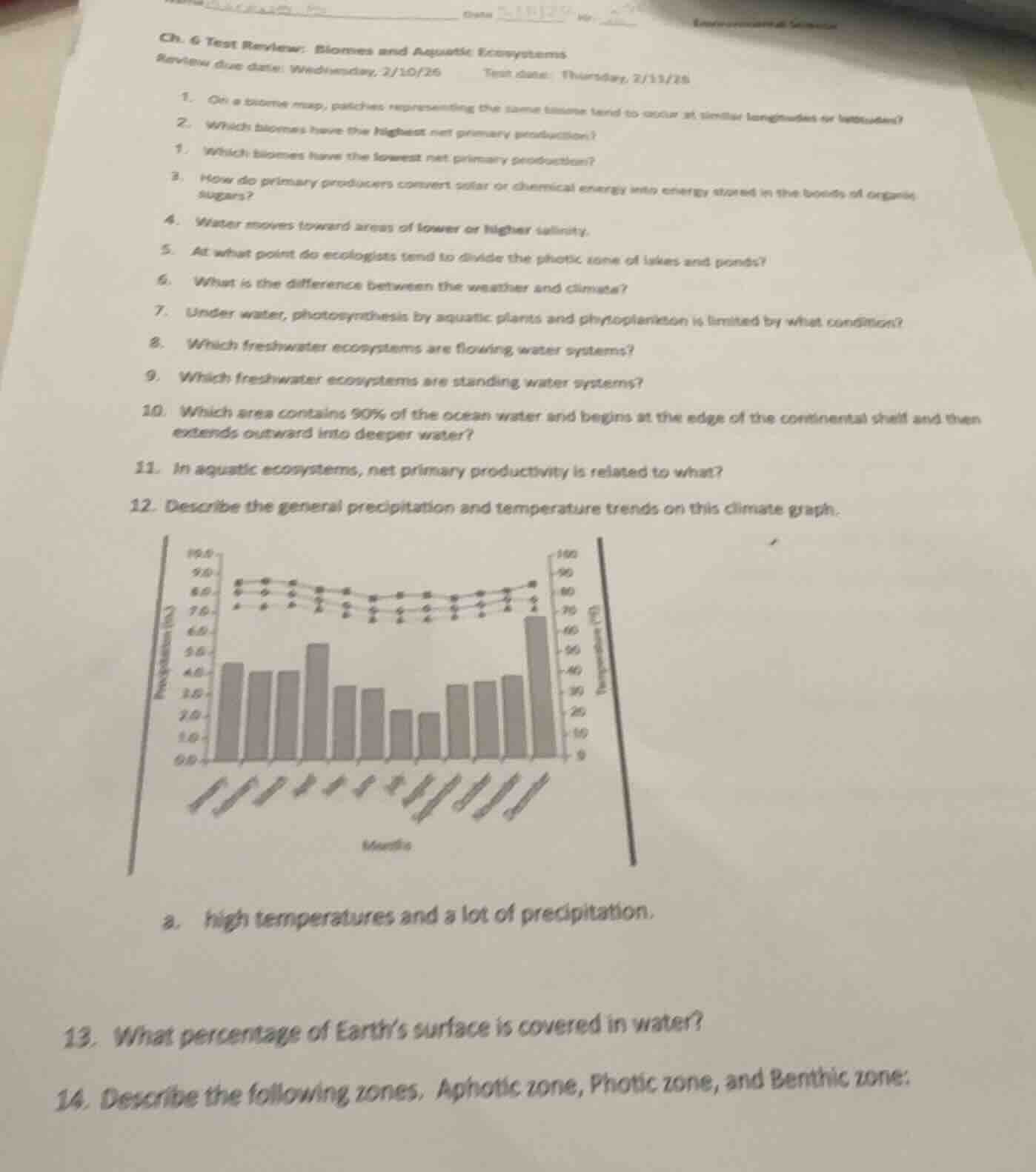
ch. 6 test review: biomes and aquatic ecosystemsreview due date: wednesday, 2/10/26 test date: thursday, 2/11/261. on a biome map, patches representing the same biome tend to occur at similar longitudes or latitudes?2. which biomes have the highest net primary production?1. which biomes have the lowest net primary production?3. how do primary producers convert solar or chemical energy into energy stored in the bonds of organic sugars?4. water moves toward areas of lower or higher salinity.5. at what point do ecologists tend to divide the photic zone of lakes and ponds?6. what is the difference between the weather and climate?7. under water, photosynthesis by aquatic plants and phytoplankton is limited by what condition?8. which freshwater ecosystems are flowing water systems?9. which freshwater ecosystems are standing water systems?10. which area contains 90% of the ocean water and begins at the edge of the continental shelf and then extends outward into deeper water?11. in aquatic ecosystems, net primary productivity is related to what?12. describe the general precipitation and temperature trends on this climate graph.a. high temperatures and a lot of precipitation.13. what percentage of earths surface is covered in water?14. describe the following zones. aphotic zone, photic zone, and benthic zone:
- Biomes are defined by climate, which is tied to latitude/longitude.
- Wet, warm biomes have the most plant growth.
- Dry, cold biomes have limited plant growth.
- Primary producers use photosynthesis/chemosynthesis to make sugars.
- Water moves to balance salt concentration via osmosis.
- The photic zone is where sunlight penetrates; the division is where light is too low for most photosynthesis.
- Weather is short-term, climate is long-term regional patterns.
- Underwater, light decreases with depth, limiting photosynthesis.
- Flowing freshwater systems have moving water.
- Standing freshwater systems have still water.
- The ocean's continental slope leads to the largest water volume region.
- Aquatic primary productivity depends on light and nutrient availability.
- The graph shows consistently warm temps and moderate-high rainfall.
- Earth's surface is mostly covered by ocean water.
- Each aquatic zone is defined by light and position relative to the bottom.

Snap & solve any problem in the app
Get step-by-step solutions on Sovi AI
Photo-based solutions with guided steps
Explore more problems and detailed explanations
- Similar latitudes
- Tropical rainforests and wetlands (like marshes/swamps)
- Deserts, tundra (arctic and alpine), and open ocean (oligotrophic)
- Most use photosynthesis: $6\text{CO}_2 + 6\text{H}_2\text{O} \xrightarrow{\text{light energy}} \text{C}_6\text{H}_{12}\text{O}_6 + 6\text{O}_2$; chemosynthetic producers use chemical energy from inorganic compounds to make organic sugars.
- Higher salinity (water moves to areas of higher solute concentration via osmosis)
- At the depth where only 1% of sunlight remains (typically ~200 meters in clear water), which is the limit for most photosynthetic organisms.
- Weather refers to short-term (hours to days) atmospheric conditions (temperature, rain, wind) in a small area; climate is the long-term (decades+) average of these conditions for a large region.
- Availability of sunlight (light penetration decreases rapidly with water depth)
- Rivers, streams, and creeks
- Lakes, ponds, and wetlands (like marshes)
- The oceanic zone
- Net primary productivity in aquatic ecosystems is related to the availability of sunlight, dissolved nutrients (like nitrogen and phosphorus), and water temperature.
- a. high temperatures and a lot of precipitation
- Approximately 71% of Earth's surface is covered in water
- - Photic zone: The upper layer of water where sunlight penetrates enough to support photosynthesis; it is home to most aquatic producers and the organisms that feed on them.
- Aphotic zone: The layer of water below the photic zone where there is not enough sunlight for photosynthesis; organisms here rely on detritus or chemosynthesis for energy, and many are adapted to low-light or no-light conditions.
- Benthic zone: The bottom substrate of any aquatic ecosystem (from shallow shorelines to deep ocean trenches); it includes organisms that live on or in the sediment (benthos), such as worms, clams, and some algae.